Economic Pulse Net | Sources: World Bank World Development Indicators, Government Sources | 2026
Key Takeaways
– Belarus operates under one of Europe’s most authoritarian regimes, with President Alexander Lukashenko maintaining an iron grip since 1994 — a political reality that fundamentally shapes every aspect of the economy.
– The country’s industrial backbone rests on state-owned giants like Belaruskali (potash), BelAZ (mining equipment), and Belarusian Railway, making it heavily reliant on heavy industry and resource extraction.
– Telecommunications firm A1 and the Belarus High Technologies Park represent rare bright spots in an economy largely dominated by state-controlled enterprises.
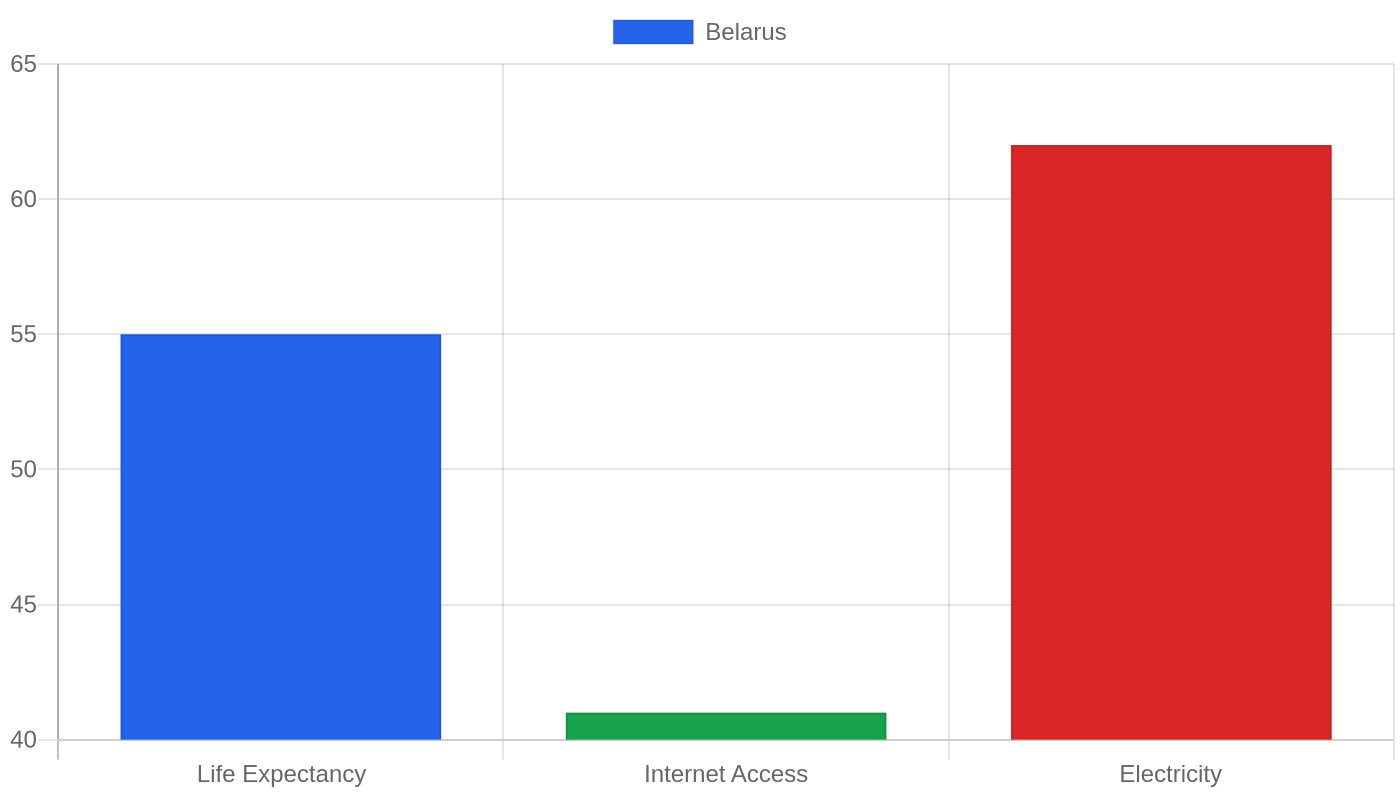
– With critical economic indicators from the World Bank marked as unavailable, Belarus presents a transparency challenge for investors and analysts alike.
– The country’s designation as “Europe’s last dictatorship” by numerous media outlets creates a unique risk profile that separates it from all other European economies.
The Machinery of State Control — An Economy Built on Heavy Industry
Belarus presents a peculiar economic puzzle. The World Bank, typically the gold standard for cross-country economic comparison, offers no data on GDP growth, inflation, unemployment, or GDP per capita for this nation of approximately nine million people. This absence is itself a data point — it speaks to a deliberate opacity that characterises the Belarusian economic model.
What we do know is that Belarus’s industrial landscape is dominated by state-owned behemoths. Belaruskali, one of the world’s largest potash producers, sits at the centre of the country’s export economy. Potash — a potassium-rich salt used in fertiliser — has been both a blessing and a geopolitical weapon for Minsk. Alongside Belaruskali, BelAZ manufactures enormous mining dump trucks that are sold globally, while Belkommunmash produces trams and electric buses.
The Belarusian Railway, another state-owned industrial giant, moves goods across the country and into neighbouring Russia, which remains Belarus’s primary economic and political patron.
The financial sector mirrors this state dominance. Belarusbank, the country’s largest financial institution, operates under government control, channelling credit to state enterprises and managing household savings in an environment where independent banking has been severely curtailed. This is not a market economy in the Western sense — it is a system where political loyalty and state ownership determine capital allocation.
The concentration of economic activity in heavy industry and state-controlled enterprises leaves Belarus acutely vulnerable to external shocks. When European Union sanctions tighten — as they have repeatedly since the disputed 2020 election — the industrial export model faces direct pressure. The economy’s ability to adapt is constrained by the very political structure that defines it.
Living Costs in a Closed Economy — The Price of Isolation
Cost of living data for Belarus is notably absent from the available statistics, but the broader economic picture allows for informed observation. In an economy where the state controls major industries and sets prices for utilities and basic goods, the cost of living is less a market phenomenon and more a political instrument. The Lukashenko government has historically used subsidised housing, cheap energy imports from Russia, and price controls on food staples to maintain social stability.
Rent versus buy calculations in Minsk, the capital, operate differently than in market economies. Much of the housing stock remains in state hands or was privatised at nominal prices during the post-Soviet period. For those outside the state-controlled system, however — including independent professionals, foreign workers, and political dissidents — housing costs can be significantly higher, as private rental markets cater to a smaller, more affluent segment.
Daily expenses for food, transport, and utilities are kept artificially low through subsidies, but this comes at a cost. The quality and variety of consumer goods are limited compared to Western European neighbours like Poland or Lithuania. The Belarusian consumer faces a trade-off: lower headline costs for basic necessities, but far fewer choices and a currency that cannot be freely converted on international markets.
Where Capital Meets Control — The Investment Landscape
For the investor, Belarus is a study in contradictions. The roster of top companies reveals both the state’s heavy hand and the occasional private-sector success. A1, a telecommunications provider, operates in a sector that requires significant capital investment and technological sophistication — yet it functions within a system where the state can change the rules at any moment.
Aliasworlds Entertainment, a technology firm, represents the potential for digital innovation, but operates under the shadow of one of Europe’s most sophisticated internet surveillance regimes.
The Belarus High Technologies Park, a special economic zone designed to attract IT companies, has been the country’s most visible attempt to build a modern knowledge economy. It has attracted outsourcing contracts from European and Israeli tech firms, drawn by a relatively educated workforce and lower wages than in Moscow or Warsaw.
Yet the Park’s success is inseparable from the political context — after 2020, many of its member companies faced pressure to relocate or restructure as Western clients reconsidered exposure to Belarus.
The business environment is defined by political risk. Contract enforcement is unreliable when the state is a counterparty. Currency controls can freeze capital. Sanctions can sever access to international payment systems. For the risk-tolerant investor willing to navigate these complexities, opportunities exist in resource extraction, heavy machinery, and IT outsourcing — but the reward must justify the exceptional uncertainty.
Europe’s Last Dictatorship — Safety, Politics, and Daily Life
The political landscape of Belarus is the single most important factor in understanding the country. By constitutional design, Belarus is a semi-presidential republic with separation of powers. In practice, as numerous media outlets and authors have documented, it operates as what many call “Europe’s last dictatorship.” President Alexander Lukashenko, in power since 1994, has been described by some politicians and journalists as “Europe’s last dictator.”
This characterisation is not mere rhetoric. The 2020 presidential election, which the Lukashenko government claimed resulted in a landslide victory, was widely condemned internationally as neither free nor fair. The subsequent protests — the largest in Belarusian history — were met with a brutal crackdown involving mass arrests, torture allegations, and a forced exile of opposition figures.
The political system has since become even more closed, with independent media shuttered and civil society organisations labelled as extremist.
Crime and safety indices are unavailable from the data provided, but the nature of safety in Belarus is paradoxical. Street crime in Minsk is relatively low compared to Western European capitals — a function of pervasive state surveillance and a police state apparatus. Yet political “crime” — dissent, protest, independent journalism — carries severe penalties. For the average citizen who avoids politics, daily life may feel orderly and safe.
For anyone who challenges the system, the state’s security apparatus is swift and unforgiving.
Quality of life, like so much in Belarus, depends entirely on one’s relationship with the state. Those within the system — state employees, pensioners, workers at state enterprises — benefit from subsidised living costs and stability. Those outside it — activists, independent businesspeople, critical journalists — face a life of constant surveillance and risk.
The Minsk Paradox — Current Affairs in a Frozen State
The most striking feature of Belarus’s current affairs is the apparent stability of a system that should, by most measures, be highly unstable. The post-2020 crackdown succeeded in crushing overt opposition, but it did so at the cost of international isolation. European Union sanctions have targeted key industries, including potash exports and the financial sector.
Russia, Belarus’s traditional ally, has become both a lifeline and a threat — providing subsidised energy and political support, but also demanding ever-greater integration that threatens what remains of Belarusian sovereignty.
The war in neighbouring Ukraine has transformed Belarus’s geopolitical position. Lukashenko has allowed Russian forces to use Belarusian territory for operations against Ukraine, but has so far avoided committing Belarusian troops directly. This balancing act — maintaining enough loyalty to Moscow to survive, while avoiding full mobilisation that could trigger domestic unrest — defines the current moment.
For the Belarusian economy, the war has been devastating. Western sanctions have tightened further. The IT sector, once a rare success story, has seen mass emigration of skilled workers. The currency has come under pressure, and inflation — though unquantified in the available data — is widely reported to be eroding household purchasing power. The state responds with price controls and wage increases, but these are temporary fixes for a structural crisis.
The High Technologies Park, once a beacon for foreign investment, now faces an uncertain future. Some companies have relocated to Poland, Lithuania, or Georgia. Others remain, betting that the political situation will eventually stabilise or that the regime will moderate. Neither outcome appears imminent.
The Bottom Line
Belarus is a country for the truly contrarian investor or the geopolitical analyst seeking to understand the limits of authoritarian economic management. Its industrial assets — potash, heavy machinery, a skilled workforce — are real. But they are encumbered by a political system that treats economic policy as an instrument of regime survival. For those with high risk tolerance and deep local knowledge, opportunities exist in niche sectors like IT outsourcing and resource extraction.
For most international businesses and investors, however, Belarus remains a country to watch from a distance — a case study in how political control can both sustain and strangle an economy.
Sources & Methodology
This article is authored by Economic Pulse Net for informational and research purposes. Economic Pulse Net sources its data from multilateral institutions, national statistics bureaus, and proprietary databases. All data is believed to be current as of the date of publication.
Published: July 20, 2026 | Category: Research — Belarus
Use these signals in your own platform
Economic Pulse publishes its live signal feed through a documented, read-only API. Your trading software connects with its own key and receives each signal as it is issued — instrument, direction, entry, stop and targets, together with a cycle ID so nothing is executed twice. The feed is independent of this website and cannot change it.
Signals are informational only and are not financial advice.