Economic Pulse Net | Sources: World Bank World Development Indicators, Government Sources | 2026
Key Takeaways
– Belarus operates under a highly centralized authoritarian government led by President Alexander Lukashenko, described by some media outlets as “Europe’s last dictatorship” — a political reality that fundamentally shapes every aspect of the country’s economic life.
– The country’s industrial backbone rests on state-owned giants like Belaruskali (potash), BelAZ (heavy mining vehicles), and Belarusian Railway, making it heavily dependent on commodity exports and Russian economic support.
– Despite constitutional provisions for a semi-presidential republic with separation of powers, the World Bank data reveals a nation where political control supersedes market forces, creating a uniquely challenging environment for investors and citizens alike.
– Major companies span telecommunications (A1), technology (Aliasworlds Entertainment, Belarus High Technologies Park), and financial services (Belarusbank), suggesting a more diverse economy than the Soviet-era industrial stereotype would suggest.
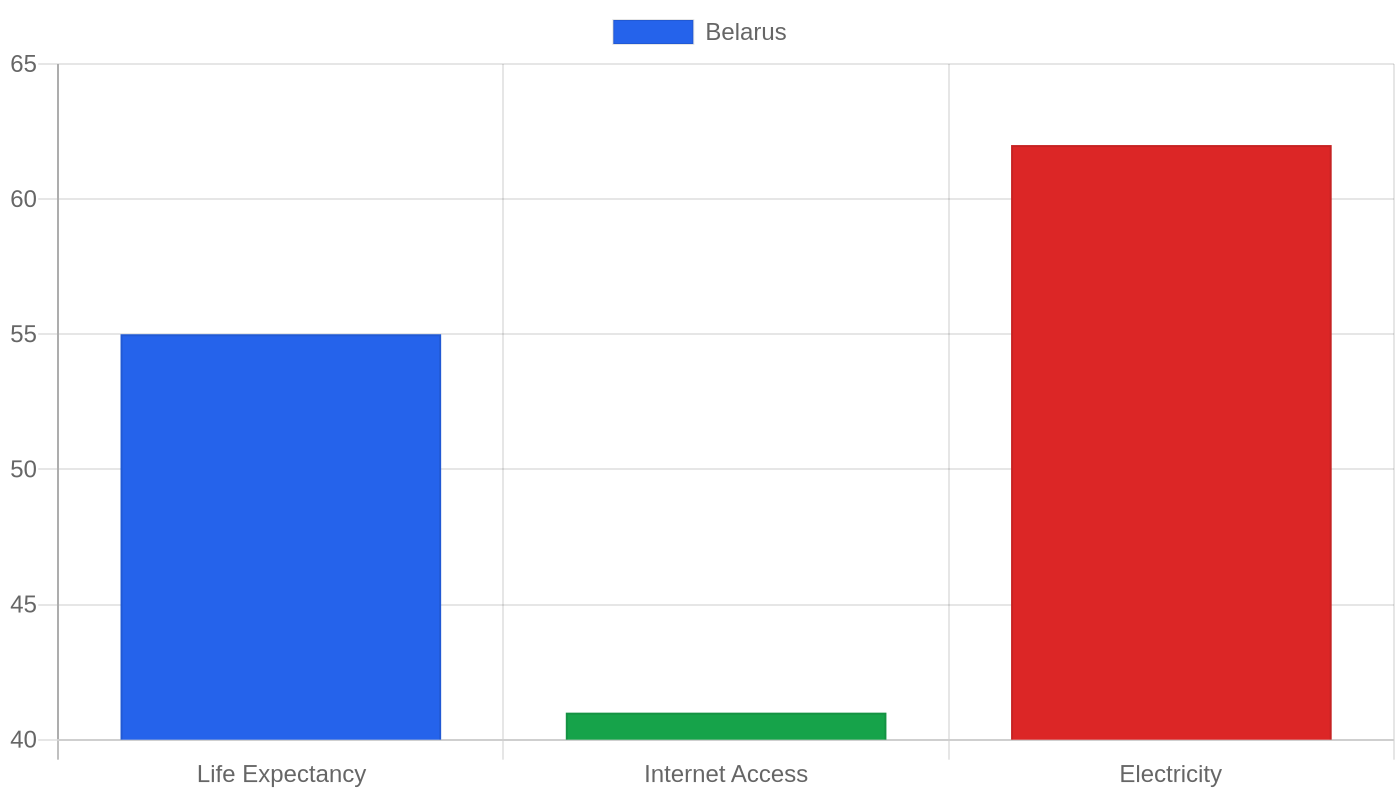
– The absence of basic economic indicators like GDP growth, inflation, and unemployment in available data itself tells a story — one of limited transparency in a tightly controlled state.
The Command Economy’s Modern Face — Industry and Output Without the Numbers
The economic story of Belarus is one of deliberate opacity. The World Bank data provides no GDP growth figure, no inflation rate, no unemployment statistic, and no GDP per capita or GNI per capita numbers. This absence is not an oversight — it is a feature of a system where information is treated as a strategic resource.
Belarus, by constitutional design a semi-presidential republic with separation of powers, has in practice been governed as what some media outlets and politicians have called “Europe’s last dictatorship,” with power concentrated ultimately in the presidency of Alexander Lukashenko.
What we do know is the industrial architecture. The country’s economic skeleton is built around massive state-owned enterprises that date back to the Soviet era. Belaruskali dominates global potash markets, making Belarus a critical player in fertilizer supply chains that affect food prices worldwide. BelAZ manufactures some of the largest mining dump trucks on earth, serving extractive industries across Russia, the CIS, and beyond.
Belarusian Railway remains a vital logistics artery connecting European and Eurasian markets. These are not nimble startups — they are industrial behemoths that employ hundreds of thousands and anchor entire cities.
The technology sector offers a contrasting narrative. The Belarus High Technologies Park has become a surprising hub for IT outsourcing and software development, attracting companies like Aliasworlds Entertainment. A1 provides telecommunications infrastructure. BelaPAN offers consumer services. But these sectors operate under the shadow of political uncertainty, with the state maintaining tight control over everything from currency flows to internet access.
Without the World Bank’s standard economic indicators, analysts must read the tea leaves: industrial output, trade flows with Russia, and anecdotal reports from the business community. The absence of data is itself the data point.
Living Under the System — Housing, Costs, and Daily Reality
The cost of living in Belarus remains a subject of guesswork for external analysts, as the World Bank data provides no specific figures. What can be inferred from the country’s economic structure is illuminating. In a state-dominated economy where Belarusbank holds primacy in financial services and major employers are government-controlled, housing markets do not operate with the same dynamics as in market economies.
State-subsidized housing programs have historically played a major role, keeping shelter costs artificially low for those connected to the system, while private market options remain limited and expensive.
Daily expenses for Belarusians are shaped by the country’s deep economic integration with Russia, its primary trade partner and political patron. Consumer goods prices, energy costs, and food prices are influenced by Russian subsidies and trade arrangements rather than global market forces alone. For the average citizen, this creates a peculiar stability — prices do not fluctuate wildly, but neither do wages.
The absence of reliable inflation data from the World Bank suggests either genuine price stability or, more likely, a reluctance to publish figures that would reveal the true cost of living erosion under managed exchange rates and controlled markets.
Investing in the Last Dictatorship — Opportunity and Risk
For the bold investor, Belarus offers a portfolio of contradictions. The top companies list reads like a who’s who of state capitalism: Belarusbank dominates finance, Belavia controls aviation, Belkommunmash manufactures public transit vehicles. These are not companies seeking venture capital — they are instruments of state policy.
Yet alongside them sits the Belarus High Technologies Park, a genuine attempt to build a 21st-century knowledge economy, and A1, a telecommunications provider that operates in a sector requiring constant innovation.
The business environment is defined by political risk of the highest order. International sanctions have targeted Belarusian entities, particularly Belaruskali, over human rights concerns and political repression. Any investor must navigate a legal system where the constitution promises separation of powers but reality delivers centralized authoritarian control.
The sectors to watch are those where Belarus has genuine competitive advantages: potash mining, heavy vehicle manufacturing, IT services, and transit logistics. But these come with strings attached — state ownership, political interference, and the constant possibility that the rules will change without notice.
Safety, Surveillance, and the Quality of Political Life
The Crime Index and Safety Index from the World Bank data are marked as unavailable, which in the Belarusian context is revealing. Street crime in Minsk has traditionally been low compared to Western European capitals, but the definition of “safety” in an authoritarian state extends far beyond physical security. Political safety — the freedom to criticize the government, organize opposition, or access independent information — is virtually nonexistent.
The political landscape, as described in the available data, shows a country that by constitution is a semi-presidential republic with separation of powers but has been led by a highly centralized and authoritarian government, often called “Europe’s last dictatorship” by some media outlets and politicians.
Quality of life in Belarus is therefore a dual reality. Material conditions for many citizens are adequate — Soviet-era apartment blocks are maintained, public transport functions, healthcare is universal if underfunded. But the psychological toll of living under what some authors and politicians have called “Europe’s last dictator” is impossible to quantify.
The happiness data that might illuminate this dimension remains absent from the World Bank figures, leaving analysts to rely on the testimony of the hundreds of thousands of Belarusians who have left the country in recent years.
Current Affairs — The System Under Strain
The most current picture of Belarus is one of a regime fighting to maintain control in a changing world. The war in Ukraine has fundamentally altered Belarus’s geopolitical position, turning it into a staging ground for Russian military operations and subjecting it to cascading Western sanctions. The industrial giants that form the economic backbone — Belaruskali, BelAZ, Belarusian Railway — now face restricted access to European markets and technology.
The Belarus High Technologies Park, once a bridge to Western clients, must navigate a landscape where many international contracts have been suspended.
Domestically, the regime continues its pattern of centralized control. The National Assembly exists as a constitutional formality, with real power concentrated in the presidency. Political repression has intensified since the 2020 protests, with opposition figures imprisoned or exiled. The economy operates under managed currency controls, with the Belarusian ruble’s value more a political statement than a market reflection.
For the average Belarusian, daily life means navigating shortages of imported goods, inflation that official statistics may understate, and a future that depends almost entirely on the trajectory of Russia’s war and the regime’s ability to maintain its grip.
The Bottom Line
Belarus is a country that demands attention from anyone interested in the intersection of authoritarian politics and industrial economics. For geopolitical strategists, it is a critical node in Russian power projection. For commodity traders, Belaruskali’s potash flows affect global food supply chains. For human rights observers, it represents a case study in how centralized control persists in 21st-century Europe. The data gaps in World Bank statistics are not errors — they are warnings.
Anyone watching Belarus must read not just the numbers that are published, but the silences between them.
Sources & Methodology
This article is authored by Economic Pulse Net for informational and research purposes. Economic Pulse Net sources its data from multilateral institutions, national statistics bureaus, and proprietary databases. All data is believed to be current as of the date of publication.
Published: July 20, 2026 | Category: Research — Belarus
Use these signals in your own platform
Economic Pulse publishes its live signal feed through a documented, read-only API. Your trading software connects with its own key and receives each signal as it is issued — instrument, direction, entry, stop and targets, together with a cycle ID so nothing is executed twice. The feed is independent of this website and cannot change it.
Signals are informational only and are not financial advice.