Economic Pulse Net | Sources: World Bank World Development Indicators, Government Sources | 2026
Key Takeaways
* Political Structure: Lesotho operates as a parliamentary constitutional monarchy where King Letsie III holds a largely ceremonial role, while Prime Minister Sam Matekane wields executive authority.
Corporate Landscape: The economy is anchored by key institutions such as the Central Bank of Lesotho, Telecom Lesotho, and consumer service providers like Lesotho Airways and Maluti Sky.
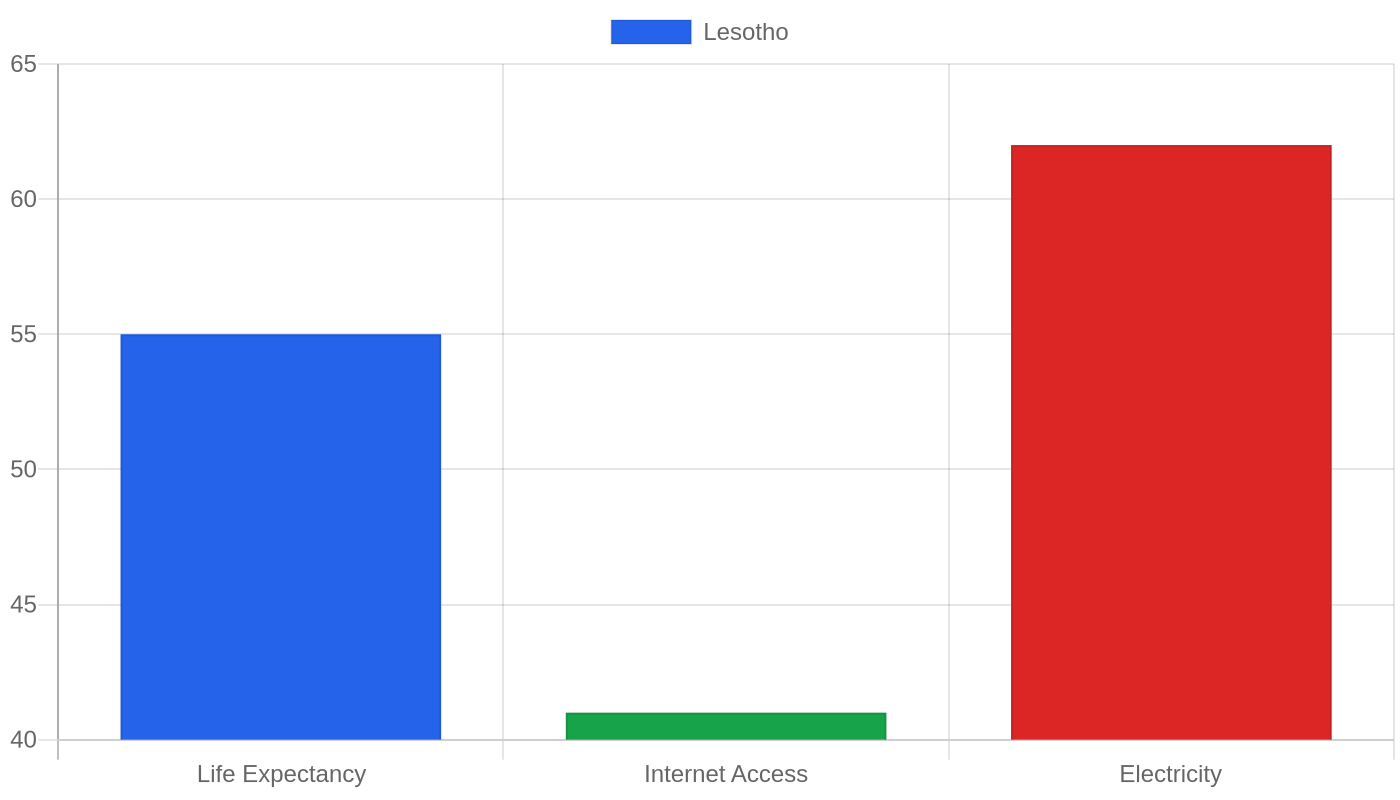
Data Transparency Gap: Current World Bank datasets indicate significant gaps in standard macroeconomic indicators, including GDP growth, inflation rates, and unemployment figures, necessitating a qualitative assessment of the business environment.
Safety and Governance: Specific crime and safety indices are currently unreported, requiring investors to rely on broader political stability metrics rather than granular security data.
The Architecture of Authority
Lesotho’s economic narrative is deeply intertwined with its unique political framework, which serves as the bedrock for all financial activity within the kingdom. As a parliamentary constitutional monarchy, the nation has established a clear division of power that shapes its regulatory and fiscal policies.
The King of Lesotho, Letsie III, serves as the head of state but performs a largely ceremonial function, having relinquished any executive authority and being prohibited from actively participating in political initiatives. This structural separation ensures that policy direction is driven by elected officials rather than monarchical decree. At the helm of this government is Prime Minister Sam Matekane, who holds the title of head of government and possesses full executive authority.
His administration’s decisions directly influence the country’s engagement with international financial bodies and domestic regulatory reforms. Understanding this dynamic is crucial for foreign entities, as it clarifies that operational permissions and strategic shifts must align with the legislative agenda set by the current prime ministerial office. The stability of this arrangement provides a predictable, albeit complex, governance structure for long-term planning.
Corporate Pillars and Industrial Foundations
While comprehensive industrial breakdowns are not fully detailed in the provided dataset, the corporate landscape reveals a concentrated ecosystem dominated by critical infrastructure and service providers. The Central Bank of Lesotho stands as a paramount institution within the financial sector, overseeing monetary policy and maintaining the integrity of the national currency system. Its role is pivotal in stabilizing the economy amidst the absence of reported GDP growth or inflation metrics.
In the telecommunications space, Telecom Lesotho serves as a vital utility, connecting the nation and facilitating the digital infrastructure necessary for modern commerce. Consumer services also play a significant role in the local economy, represented by entities such as Lesotho Airways and Maluti Sky. These companies indicate an active, albeit niche, market for aviation and travel services, suggesting that connectivity remains a priority for both domestic mobility and international linkage.
The presence of these specific top companies highlights sectors where capital concentration exists, offering potential entry points for partnerships or investments in established brands. Without explicit data on manufacturing or agricultural output, the focus remains on these service-oriented giants that form the visible spine of the daily economic life.
Navigating the Cost of Living and Housing Market
Assessing the cost of living in Lesotho presents a challenge due to the lack of specific consumer price index (CPI) data and housing cost metrics in the current reporting period. Investors and expatriates cannot rely on standard numerical benchmarks to gauge affordability or purchasing power parity. However, the existence of major service providers implies a structured market for essential utilities and transportation, which typically drive household expenses.
In the absence of concrete rent versus buy comparisons or regional averages, prospective residents must look to qualitative indicators of urban development and commercial activity. The operation of airlines like Lesotho Airways suggests that access to external markets involves tangible costs, which often trickle down into local pricing structures for imported goods. Daily expenses are likely influenced by the nation’s reliance on imports, given the limited visibility into domestic production industries.
Consequently, budgeting requires a conservative approach, acknowledging that official statistics do not currently offer a transparent window into the real-time cost pressures faced by residents.
Investment Climate and Business Environment
The business environment in Lesotho is characterized by the prominence of a few key institutional players rather than a diversified SME-heavy snapshot in the available data. For investors, the Central Bank of Lesotho represents the primary point of contact for financial regulations and banking compliance. The telecommunications sector, led by Telecom Lesotho, offers opportunities in digital infrastructure, a growing necessity in the modern global economy.
Meanwhile, the consumer services sector, featuring Lesotho Airways and Maluti Sky, indicates potential in tourism and logistics, sectors that can benefit from improved connectivity. The lack of reported unemployment or GDP figures means that labor market dynamics and overall economic expansion rates remain opaque to outside observers. This opacity requires due diligence to go beyond headline numbers and engage directly with local chambers of commerce or industry-specific reports.
Nevertheless, the established nature of these top companies provides a degree of market maturity, suggesting that core services are well-organized and regulated. Businesses entering this market should prioritize partnerships with these incumbent leaders to navigate the regulatory landscape effectively.
Safety, Politics, and Quality of Life
Security and political stability form the backdrop against which quality of life is measured in Lesotho. Currently, specific crime indices and safety scores are not available in the provided data sets, leaving a gap in quantifiable risk assessment for travelers and businesses. Despite this statistical void, the political landscape offers a clear picture of governance stability.
The constitutional monarchy model, with King Letsie III in a ceremonial role and Prime Minister Sam Matekane exercising executive power, creates a defined chain of command. This separation helps mitigate the risk of arbitrary political interference in daily affairs, as the monarch is barred from active political participation. While happiness data and detailed crime statistics are absent, the structured nature of the government suggests a level of institutional predictability.
Potential residents and investors must therefore weigh the known political framework against the unknown variables of personal safety and social cohesion. The absence of hard data on crime does not necessarily imply high risk, but it does demand heightened situational awareness and localized intelligence gathering.
What’s Happening Now: The Matekane Era
The current political climate is defined by the tenure of Prime Minister Sam Matekane, who continues to shape the nation’s trajectory through his executive authority. As the head of government, his administration is the focal point for any recent policy shifts or economic reforms aimed at stimulating growth. Although specific recent news items regarding immediate crises or breakthroughs are not detailed in the source text, the emphasis on his executive role suggests an active phase of governance.
The King’s continued adherence to a non-participatory stance reinforces the primacy of the parliament and the prime minister’s office in decision-making processes. This political continuity is likely influencing the operational strategies of major entities like the Central Bank and Telecom Lesotho, which must adapt to the prevailing administrative directives.
For observers, the key indicator is the implementation of Matekane’s policy agenda, which will eventually reflect in the macroeconomic data that is currently missing. The interplay between this strong executive leadership and the ceremonial monarchy creates a unique dynamic that drives the country’s forward momentum.
The Bottom Line
Lesotho presents a complex profile for economic analysis, defined more by its political structure and key institutional players than by robust macroeconomic statistics. Stakeholders should focus on the stability offered by the parliamentary constitutional monarchy and the established presence of major firms in finance and telecommunications.
While the lack of GDP, inflation, and safety data requires caution, the clear delineation of power under Prime Minister Sam Matekane provides a reliable framework for engagement. Investors and researchers must rely on qualitative assessments and direct local insights to fill the quantitative gaps left by current reporting limitations.
Sources & Methodology
This article is authored by Economic Pulse Net for informational and research purposes. Economic Pulse Net sources its data from multilateral institutions, national statistics bureaus, and proprietary databases. All data is believed to be current as of the date of publication.
Published: October 22, 2026 | Category: Research — Lesotho
Use these signals in your own platform
Economic Pulse publishes its live signal feed through a documented, read-only API. Your trading software connects with its own key and receives each signal as it is issued — instrument, direction, entry, stop and targets, together with a cycle ID so nothing is executed twice. The feed is independent of this website and cannot change it.
Signals are informational only and are not financial advice.