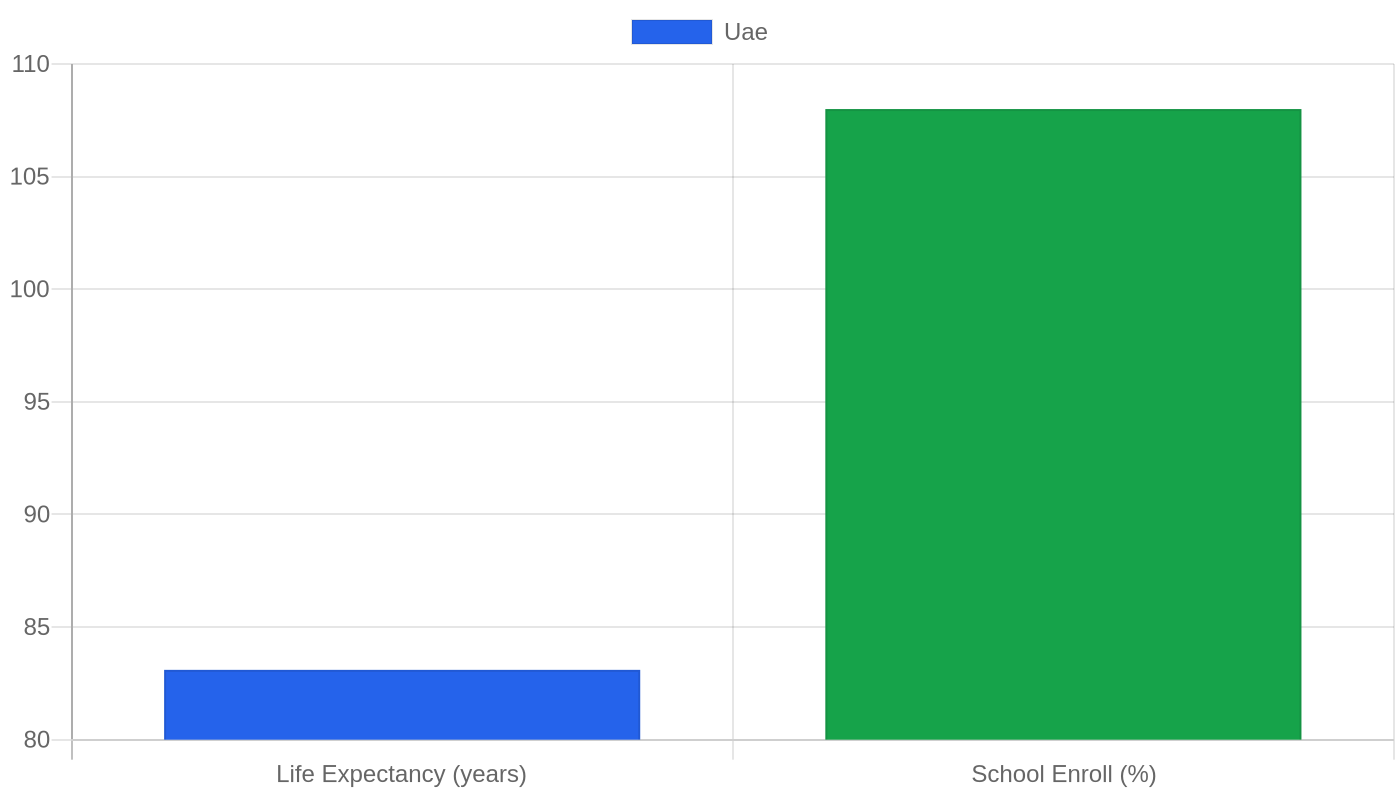
Economic Pulse Net | Sources: World Bank World Development Indicators, Government Sources | 2026
Key Takeaways
– The UAE’s economy grew at a steady 3.99% in 2024, according to the World Bank, demonstrating resilience despite global headwinds and regional volatility.
– Inflation remains remarkably subdued at just 1.25%, one of the lowest rates in the Gulf region, providing a stable backdrop for consumer spending and investment.
– Unemployment sits at an enviable 2.17%, reflecting a labor market that continues to absorb both local talent and expatriate workers in a diversifying economy.
– With a GDP per capita of $79,344 (PPP) and a GNI per capita of $51,550, the UAE ranks among the world’s wealthiest nations, but the question of sustainable, non-oil growth looms large.
– The country’s unique political structure — a federation of seven hereditary sheikhdoms under a semi-constitutional monarchy — provides stability but also concentrates decision-making power in a small circle of ruling families.
The Growth Paradox — Low Inflation, High Ambition
The United Arab Emirates posted GDP growth of 3.99% in 2024, according to the World Bank. For most countries, that number would be cause for modest celebration. For the UAE, it represents something more complex: a measured pace in an economy that has long been accustomed to breakneck expansion. The figure suggests a maturing economy, one that is shifting from the adrenaline-fueled construction booms of the past toward a more sustainable, service-oriented model.
What makes this growth particularly noteworthy is the inflation environment. Consumer prices rose just 1.25% in 2024, a figure that would be the envy of central bankers worldwide. The World Bank data paints a picture of an economy where demand is strong enough to generate growth but not so overheated as to spark price instability.
This low-inflation, steady-growth combination provides the UAE with policy space that many other emerging economies lack — the ability to invest in infrastructure, technology, and human capital without the constant pressure of runaway prices.
The unemployment rate of 2.17% is, by any measure, extraordinarily low. Even accounting for the fact that the UAE’s labor force is heavily skewed toward expatriate workers who can be shed more easily during downturns, this figure signals an economy operating near full capacity. The challenge, however, lies beneath the surface.
The UAE has been aggressively pursuing “Emiratisation” — policies to increase private-sector employment of local citizens — and the low headline unemployment figure masks the ongoing tension between a workforce that expects public-sector-style benefits and a private sector that demands flexibility.
The GDP per capita figure of $79,343 (PPP) places the UAE in the same league as Switzerland and Norway. Yet this wealth is not evenly distributed. The GNI per capita of $51,550 tells a slightly different story — one where a significant portion of economic output flows to foreign workers and investors who send remittances abroad. For the Emirati citizen, the state remains a generous benefactor, but the era of unlimited handouts is giving way to a more performance-oriented model.
The Price of Paradise — Housing, Living Costs, and the Expatriate Equation
Dubai’s skyline is a monument to ambition, but behind the glass and steel lies a housing market that has become a global bellwether for luxury real estate. The cost of living in the UAE, particularly in Dubai and Abu Dhabi, has risen steadily as the country positions itself as a hub for wealthy expatriates, remote workers, and investors fleeing instability in other regions.
Rent remains the single largest expense for most residents, with villa communities and waterfront apartments commanding premium prices that rival London, Singapore, and New York.
The rental market operates on a fundamentally different logic than in most Western economies. Yearly lease contracts are standard, and tenants often pay with a series of post-dated cheques — a practice that reflects both the banking system’s efficiency and the landlord-friendly legal framework. Buying property, once the exclusive domain of UAE nationals, has opened to foreigners in designated freehold areas, creating a dual market where expatriates can own but not necessarily feel permanent.
Daily expenses for the average resident tell a story of two economies. Imported goods carry significant markups, and dining out at Western-style restaurants can cost as much as in any global capital. Yet the absence of income tax — a cornerstone of the UAE’s appeal — offsets many of these costs. For the middle-class expatriate, the arithmetic works: higher housing costs are balanced by zero taxation and access to world-class infrastructure.
For lower-income workers, particularly those in construction and domestic service, the equation is far less favorable.
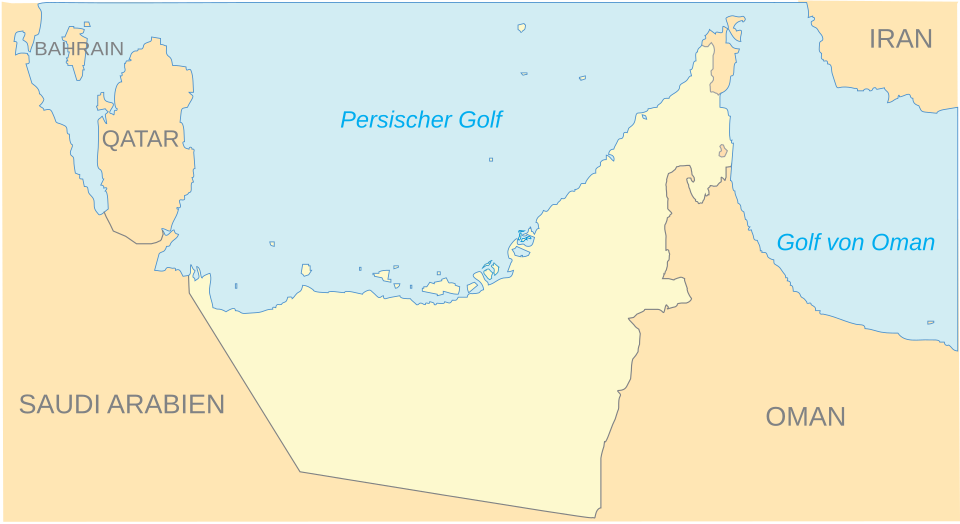
The Business Oasis — Where Capital Flows and Companies Thrive
The UAE has built its modern economy on a simple proposition: if you build the infrastructure, the talent and capital will come. The country’s top companies span sectors from energy to aviation to real estate, reflecting a deliberate strategy of diversification that has accelerated since the 2014 oil price crash. The Abu Dhabi National Oil Company (ADNOC) remains the backbone of the economy, but it is increasingly joined by globally recognized brands in logistics, tourism, and financial services.
The business environment is defined by free zones — designated areas where foreign investors can enjoy 100% ownership, tax exemptions, and streamlined visa processes. These zones have been the engine of the UAE’s non-oil growth, attracting multinational corporations and startups alike.
The recent relaxation of onshore ownership rules, allowing foreign investors to own 100% of companies outside free zones, represents a significant liberalization of an economy that has historically guarded local ownership rights.
Sectors to watch include renewable energy, where the UAE is making ambitious bets on solar and hydrogen; technology, with Dubai positioning itself as a hub for artificial intelligence and blockchain; and logistics, capitalizing on the country’s geographic position between Asia, Europe, and Africa. The success of Expo 2020 Dubai demonstrated that the UAE can host global events at a scale that few other nations can match, and the legacy infrastructure from that event continues to attract business and tourism.
Stability in an Unstable Region — Politics, Safety, and the Social Contract
The UAE’s political structure is a study in controlled stability. As a federation of seven hereditary sheikhdoms under a semi-constitutional monarchy, the country operates through a Federal Supreme Council composed of the ruling families of Abu Dhabi, Ajman, Dubai, Fujairah, Ras Al Khaimah, Sharjah, and Umm Al Quwain. This system, while undemocratic by Western standards, has delivered remarkable continuity and predictability in a region marked by upheaval.
The social contract is straightforward: the state provides generous benefits, world-class infrastructure, and personal safety in exchange for political quiescence. Crime rates are among the lowest in the world, and the streets of Dubai and Abu Dhabi feel safe at any hour — a fact that contributes significantly to the country’s appeal for families and businesses. The legal system, a blend of civil law and Sharia principles, is efficient but can be opaque, particularly for those unfamiliar with its procedures.
Quality of life for the wealthy and middle class is exceptional. Healthcare is modern and accessible, though expensive without insurance. Education options range from state-funded institutions to a vast array of international schools catering to expatriate communities. The cultural landscape has evolved rapidly, with museums, galleries, and performance venues transforming the UAE into a regional arts destination.
Yet this openness has limits: freedom of expression is constrained, political parties are banned, and the security apparatus maintains tight control over public discourse.
The Next Chapter — Reforms, Vision, and the Race to 2030
The UAE is in the midst of its most ambitious transformation since the discovery of oil. The government has announced a series of economic and social reforms designed to position the country for a post-hydrocarbon future. Visa reforms, including long-term “golden visas” for investors and talented professionals, have made the UAE more attractive as a destination for permanent relocation rather than temporary employment.
The corporate tax introduced in 2023 — a 9% rate on profits above a certain threshold — marked a significant departure from the UAE’s historic zero-tax model. While the rate remains low by international standards, the move signals a recognition that the era of unlimited state spending cannot last forever. The government has also been streamlining regulations, digitizing government services, and investing in education to build a workforce capable of competing in a knowledge-based economy.
On the geopolitical front, the UAE has pursued an independent foreign policy, balancing relationships with the United States, China, Russia, and regional powers. The normalization of ties with Israel through the Abraham Accords has opened new economic opportunities, particularly in technology and finance. Yet the war in Gaza and ongoing tensions with Iran remind investors that the UAE operates in a neighborhood where stability can never be taken for granted.
The most pressing challenge for the UAE is the same one facing all Gulf monarchies: how to transition from a rentier state built on oil revenues to a diversified economy that can generate enough jobs and opportunities for a growing population. The headline numbers — low inflation, high growth, minimal unemployment — suggest the transition is on track.
But beneath the surface, the UAE is engaged in a race against time, betting that its combination of infrastructure, stability, and strategic location can sustain the miracle long after the last barrel of oil is exported.
The Bottom Line
The UAE remains one of the most compelling economic stories in the world — a small federation that has leveraged its oil wealth to build a platform for global commerce, tourism, and innovation. Investors should watch this country for its stability, its low-tax environment, and its aggressive pursuit of diversification. But the real test lies ahead: can the UAE maintain its growth trajectory while navigating regional tensions, climate change, and the inevitable decline of fossil fuel revenues?
For now, the numbers suggest a country managing the transition with skill. The next decade will reveal whether that management is enough.
Sources & Methodology
This article is authored by Economic Pulse Net for informational and research purposes. Economic Pulse Net sources its data from multilateral institutions, national statistics bureaus, and proprietary databases. All data is believed to be current as of the date of publication.
Published: July 18, 2026 | Category: Research — UAE
Use these signals in your own platform
Economic Pulse publishes its live signal feed through a documented, read-only API. Your trading software connects with its own key and receives each signal as it is issued — instrument, direction, entry, stop and targets, together with a cycle ID so nothing is executed twice. The feed is independent of this website and cannot change it.
Signals are informational only and are not financial advice.