Economic Pulse Net | Sources: World Bank World Development Indicators, Government Sources | 2026
Key Takeaways
* Political Transition: Tunisia remains the only democracy in North Africa, though it has experienced significant democratic backsliding since 2021, shifting from its post-Arab Spring peak.
Financial Sector Dominance: The corporate landscape is heavily skewed toward financial institutions, with banks dominating the list of top companies and the local stock exchange playing a central role.
Structural Data Gaps: Current World Bank metrics for GDP growth, inflation, and unemployment are not available, requiring investors to rely on structural and political indicators rather than immediate macroeconomic snapshots.
Constitutional Framework: The nation operates under a presidential republic system with a bicameral parliament and civil law courts, grounded in the 2014 Constitution which guarantees specific rights while establishing Islam as the state religion.
Economic Landscape: Navigating the Unknown
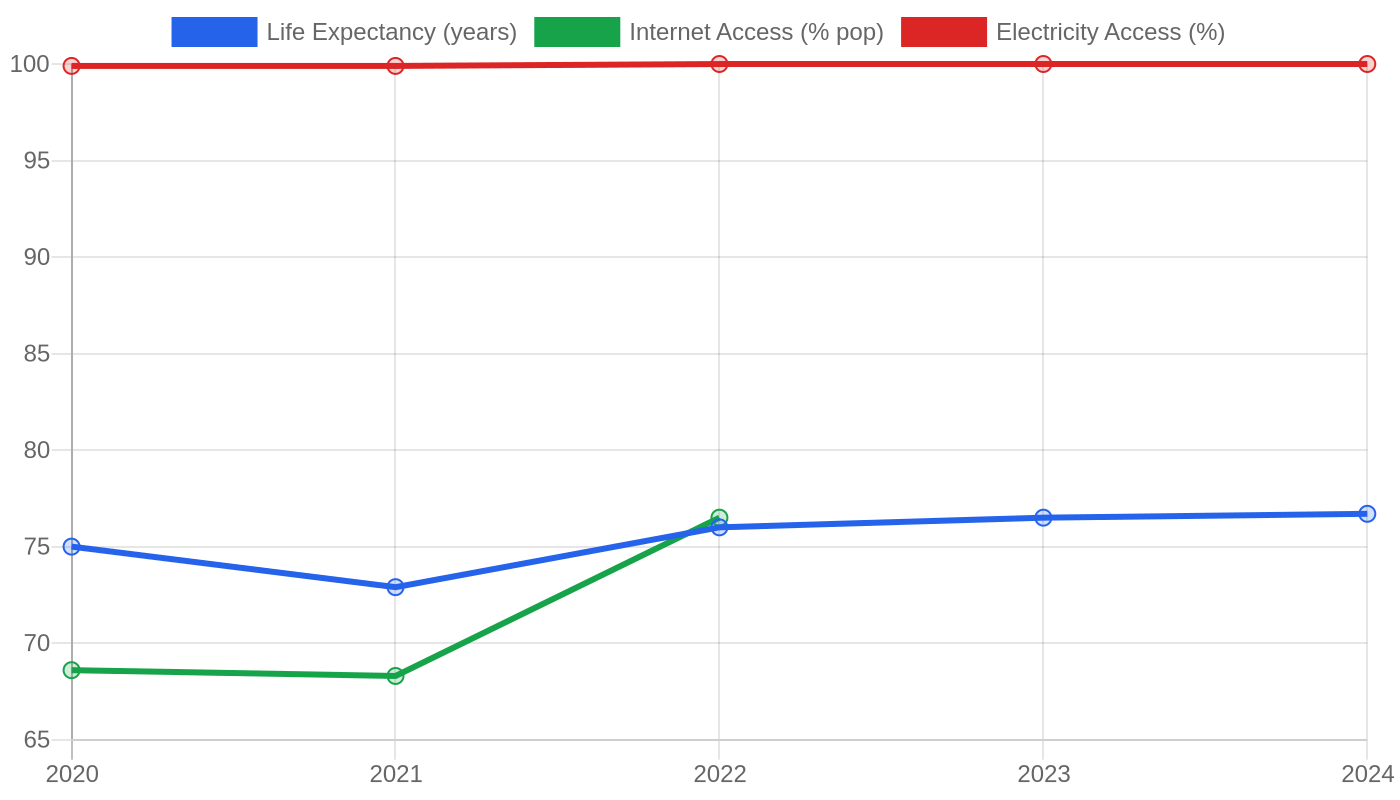
The economic narrative of Tunisia is currently defined by a lack of recent data points rather than visible volatility. According to the World Bank, figures for GDP growth, inflation CPI, and unemployment rates are listed as N/A, meaning that traditional barometers of economic health are currently obscured. This absence of real-time macroeconomic data makes it challenging to assess the immediate pulse of the economy, such as whether the country is expanding or contracting at a specific percentage.
Similarly, the total GDP in USD, GDP per capita in PPP terms, and GNI per capita are unavailable, leaving a void in understanding the sheer scale of economic output and individual purchasing power. Without these critical numbers, analysts cannot easily compare Tunisia’s current performance against historical benchmarks or regional peers using standard quantitative models.
Consequently, the economic discussion must shift from hard statistics to structural realities, such as the composition of the main industries, which remain unspecified in the provided dataset. This gap highlights the importance of qualitative assessment over quantitative precision when evaluating the country’s current fiscal standing. Investors and policymakers are left to infer trends through political stability and sector-specific developments rather than aggregate national income figures.
The inability to cite specific growth percentages or inflation rates underscores the need for caution and deeper, primary-source investigation before making high-stakes financial decisions.
Cost of Living: A Blank Canvas for Expatriates
Assessing the cost of living in Tunisia presents a unique challenge due to the complete absence of data in the provided text. There are no figures available regarding housing costs, rental prices, or general daily expenses, which prevents a direct comparison to regional averages or other North African nations. For an expatriate or business traveler, this lack of information means that budgeting must be based on anecdotal evidence or localized inquiries rather than standardized indices.
One cannot determine if rent is affordable relative to income, nor can one gauge whether the price of basic goods has surged due to currency fluctuations or supply chain issues. The silence on these metrics suggests that either data collection is inconsistent or the information has not been aggregated into a publicly accessible format at this time. Therefore, prospective residents should prepare for a period of discovery, where personal experience will dictate the understanding of local affordability.
This uncertainty extends to all aspects of daily life, from transportation to dining, creating an environment where financial planning requires flexibility and adaptability. Until concrete data emerges, the cost of living remains a variable that must be assessed case-by-case rather than through a generalized national profile.
Investment & Business Climate: The Banking Giants
The business environment in Tunisia is distinctly characterized by the overwhelming presence of financial institutions among its top companies. A review of the leading entities reveals a market dominated by banking and finance, with Adwya standing out as the sole major player in the health care sector. The list includes a robust array of financial firms, such as Amen Bank, Arab Tunisian Bank, Banque de l’Habitat, and Banque de Tunisie et des Emirats, indicating a mature and competitive banking sector.
Other key players like Banque Internationale Arabe de Tunisie, Banque Nationale Agricole, and Banque Zitouna further illustrate the depth of capital markets within the country. The inclusion of the Bourse de Tunis (Tunis Stock Exchange) confirms that there is an active platform for equity trading and investment, serving as a hub for corporate activity.
This concentration suggests that foreign investors looking to enter the market may find the most established infrastructure and regulatory frameworks within the financial services industry. While other sectors are represented, the prominence of banks implies that credit availability and financial intermediation are likely central to broader economic operations. Companies outside of finance must navigate a landscape where capital flows are managed by these dominant institutional players.
Understanding the interplay between these banks and the broader industrial base is crucial for any strategic market entry.
Safety, Politics & Quality of Life: A Complex Heritage
Tunisia’s political structure offers a glimpse into its historical significance as a beacon of liberal governance in the region. It is a presidential republic featuring a president as head of state and a prime minister as head of government, supported by a bicameral parliament and a civil law court system. The Constitution of Tunisia, adopted on January 26, 2014, serves as the foundational legal document, guaranteeing rights for women and stipulating that the President’s religion shall be Islam.
This constitutional framework was tested during the first elections held in October 2014, which took place under the new rules following the Arab Spring. Notably, Tunisia was recognized as the only democracy in North Africa until 2021, marking a period of relative political openness and reform. However, the country has since undergone democratic backsliding, complicating its status and raising questions about the resilience of its institutions.
Despite these shifts, the legal and political architecture remains distinct from its neighbors, maintaining a unique identity in the Maghreb. Crime and safety indices are currently listed as N/A, meaning that security assessments must rely on general travel advisories rather than statistical crime rates. The quality of life, therefore, is intertwined with both the enduring legacy of its democratic experiment and the uncertainties of its current political trajectory.
Citizens and residents operate within a system that balances Islamic tradition with civil liberties, albeit under increasing pressure.
What’s Happening Now: The Post-2021 Shift
The most critical development in Tunisia’s recent history is the transition away from its status as the sole democracy in North Africa. Since 2021, the country has experienced democratic backsliding, a term that suggests a gradual erosion of democratic norms and institutions. This shift occurred after the landmark elections of October 2014, which were celebrated as a triumph of the Arab Spring spirit.
The period following 2021 has likely seen changes in executive power dynamics, given the presidential system described in the constitution. While specific details of recent reforms or policy shifts are not detailed in the provided data, the mention of backsliding indicates a move toward more centralized or authoritarian governance styles. This political evolution impacts the business climate, as regulatory certainty and rule of law are often linked to political stability.
Investors and observers are watching how the bicameral parliament and civil court system function under this new political reality. The absence of recent election data or new constitutional amendments in the snippet suggests that the current administration is consolidating power rather than initiating new democratic processes. This era marks a departure from the optimistic post-revolutionary phase, replacing it with a more complex and potentially volatile political environment.
The focus now is on how the state manages dissent and maintains order within the existing legal framework.
The Bottom Line
Tunisia remains a country of significant historical and geopolitical importance, particularly as the former democratic anchor of North Africa. However, potential stakeholders must navigate a landscape where critical economic data is missing and political stability is evolving. The dominance of the financial sector offers clear opportunities for those interested in banking and capital markets.
Ultimately, Tunisia is a case study in resilience and transition, where the future depends on how the current political adjustments reshape the economic and social fabric.
Sources & Methodology
This article is authored by Economic Pulse Net for informational and research purposes. Economic Pulse Net sources its data from multilateral institutions, national statistics bureaus, and proprietary databases. All data is believed to be current as of the date of publication.
Published: October 21, 2026 | Category: Research — Tunisia
Use these signals in your own platform
Economic Pulse publishes its live signal feed through a documented, read-only API. Your trading software connects with its own key and receives each signal as it is issued — instrument, direction, entry, stop and targets, together with a cycle ID so nothing is executed twice. The feed is independent of this website and cannot change it.
Signals are informational only and are not financial advice.