Economic Pulse Net | Sources: World Bank World Development Indicators, Numbeo | 2026
<#>Key Takeaways
– Japan’s economy posted modest GDP growth of 1.19% in 2025, according to World Bank data, reflecting a nation grappling with structural stagnation while maintaining its status as the world’s fourth-largest economy at $4.43 trillion.
– With a population of just over 123 million and a GNI per capita of $38,340, Japan remains a high-income economy, but its demographic decline continues to pressure labor markets, social systems, and long-term growth potential.
– The political landscape remains stable under a constitutional monarchy, with Emperor Naruhito serving as ceremonial head of state while executive power rests with the prime minister and cabinet.
– Japan’s corporate landscape is dominated by financial institutions like 77 Bank and Acom, alongside industrial giants such as Aisin Seiki and Advantest, signaling a blend of traditional banking and cutting-edge technology.
– Recent news from the Japan Times and Nikkei Asia suggests inflation and market dynamics are front-of-mind for policymakers, with business conditions evolving in real-time.
<#>The Growth Paradox — Stagnation Wrapped in Prosperity
Japan’s economic story in 2025 is one of quiet persistence. The World Bank reports GDP growth of just 1.19% — a figure that would disappoint in emerging markets but represents a modest recovery for an economy that has spent decades fighting deflation and demographic decline.
At $4.43 trillion, Japan’s GDP remains enormous by global standards, but the growth rate underscores a fundamental challenge: how does a mature, high-income economy generate momentum when its population is shrinking?
The numbers tell a nuanced tale. GDP per capita on a purchasing power parity basis stands at $55,421, according to the World Bank, placing Japanese living standards comfortably within the developed world’s upper tier. GNI per capita of $38,340 reinforces this picture of affluence. Yet the growth rate — barely above 1% — suggests an economy running to stand still.
Japan is not collapsing; it is slowly transforming, with productivity gains and high-value exports compensating for a workforce that is aging and contracting.
The World Bank data does not provide inflation or unemployment figures for Japan in this dataset, but the broader context is telling. Japan has historically battled deflation, and the Bank of Japan’s ultra-loose monetary policy has been a defining feature of the landscape for years. The modest GDP growth in 2025 likely reflects a combination of export demand, particularly from the technology and automotive sectors, and cautious domestic consumption.
Without inflation data, we cannot assess real versus nominal growth, but the implication is clear: Japan’s economy is stable but not vibrant, prosperous but not dynamic.
<#>Housing and Daily Life — The Cost of Comfort in a Shrinking Nation
The cost of living in Japan, as measured by Numbeo, reflects a country where urban density and rural depopulation create stark contrasts. While specific housing cost data is not provided in this dataset, Japan’s reputation for expensive real estate in Tokyo and Osaka is well-documented, balanced by affordable housing in declining regional cities.
The broader picture is one of a society where daily expenses — from groceries to transportation — are moderate by developed-world standards, but where housing in major employment centers consumes a significant portion of household income.
The rent-versus-buy calculation in Japan is unique. Property values in many areas have stagnated or declined for years, making homeownership less of an investment and more of a consumption decision. Younger Japanese workers increasingly prefer renting in central urban areas, valuing flexibility over the traditional dream of a detached house in the suburbs. This shift has implications for everything from construction industry demand to household debt levels.
Daily expenses in Japan reflect a mature consumer economy. While specific Numbeo indices are not available in this dataset, the country’s high GNI per capita suggests that basic necessities are affordable for most workers, while discretionary spending — on dining, travel, and entertainment — remains robust.
The challenge for Japanese households is not absolute poverty but relative stagnation: wages have been slow to rise, even as the cost of certain services, particularly elderly care and education, continues to climb.
<#>Corporate Japan — Banking on Tradition, Betting on Innovation
Japan’s top companies, as listed in the dataset, reveal a corporate landscape that is both deeply traditional and quietly innovative. Financial institutions dominate the list: 77 Bank, Acom, Aichi Bank, and Aiful are all major players in a banking sector that has consolidated significantly in recent years.
These institutions are grappling with ultra-low interest rates that compress margins, forcing them to seek revenue from fees, overseas lending, and wealth management services.
But the list also includes industrial and technology powerhouses. Advantest, a semiconductor testing equipment manufacturer, is a critical player in the global chip supply chain. Aisin Seiki, part of the Toyota Group, produces automotive components that are essential to the world’s largest carmaker. Aeon is a retail giant that anchors Japanese consumer life, while AGC (formerly Asahi Glass) is a materials science company with global reach.
This mix of banking and manufacturing reflects Japan’s economic DNA: strong financial intermediation supporting world-class industrial production.
The business climate in Japan is characterized by stability and predictability, but also by regulatory hurdles and cultural resistance to change. Foreign direct investment has historically been low relative to other developed economies, though the government has made efforts to attract international capital, particularly in technology and renewable energy.
The corporate governance reforms of recent years — including greater board independence and shareholder accountability — have made Japanese companies more attractive to global investors, but the pace of change remains slow.
<#>Safety, Stability, and the Quality of Life Trade-Off
Japan’s political landscape, as described in the dataset, is a constitutional monarchy with Emperor Naruhito as ceremonial head of state. Executive power rests with the prime minister and cabinet, who are accountable to the Diet, Japan’s bicameral legislature. This system has provided remarkable political stability for decades, with the Liberal Democratic Party (LDP) dominating government since the 1950s.
The absence of specific crime or safety indices in the dataset does not diminish Japan’s global reputation as one of the safest countries in the world, with low rates of violent crime and a culture of public order that is the envy of many nations.
The quality of life in Japan is a study in contrasts. On one hand, citizens enjoy universal healthcare, efficient public transportation, clean cities, and a rich cultural heritage. On the other hand, the society faces deep challenges: an aging population, a shrinking workforce, social isolation among the elderly, and a youth cohort that is increasingly skeptical of traditional corporate life.
The happiness data, while not provided here, would likely show a country that scores well on material well-being but less well on subjective life satisfaction, particularly among younger generations.
The political system’s stability is both a strength and a weakness. Continuity has allowed Japan to avoid the policy whiplash seen in other democracies, but it has also bred complacency. The government has been slow to address structural issues like gender inequality in the workplace, immigration policy, and digital transformation. The result is a country that works well for many of its citizens but is struggling to adapt to a rapidly changing world.
<#>What’s Happening Now — Markets, Inflation, and the Search for Direction
The most current data from the Japan Times and Nikkei Asia, as cited in the dataset, points to a country in the midst of important economic transitions. Business news from the Japan Times suggests that corporate Japan is navigating a complex environment of global trade tensions, technological disruption, and domestic demographic pressures.
Market data from Nikkei Asia indicates that investors are closely watching Japanese equities, which have seen renewed interest from foreign buyers attracted by corporate governance reforms and relatively cheap valuations.
Inflation, as reported by Nikkei Asia, remains a critical variable. After decades of deflation, Japan has experienced a period of rising prices that has tested both consumer confidence and central bank policy. The Bank of Japan’s gradual shift away from ultra-loose monetary policy has been one of the most closely watched stories in global finance. If inflation stabilizes at moderate levels, it could signal a historic break from Japan’s deflationary past.
If it accelerates, it could force the central bank into a tightening cycle that would ripple through bond markets worldwide.
The policy shifts under consideration in Tokyo are consequential. The government is debating how to fund rising social security costs, whether to expand immigration to address labor shortages, and how to position Japan in a world of US-China rivalry. These are not abstract debates — they will determine whether Japan’s next decade looks like its last, or whether the country can write a new chapter of dynamism and growth.
<#>The Bottom Line
Japan is not a country for investors seeking explosive growth or dramatic transformation. It is a country for those who value stability, quality, and resilience — and who understand that slow growth does not mean no growth. The World Bank data shows an economy that is still generating wealth, still innovating, and still offering a high standard of living to its citizens.
For long-term investors, policymakers studying demographic transitions, and anyone interested in how wealthy societies manage decline without collapse, Japan is the most important case study in the world. Watch Japan not for its speed, but for its endurance.
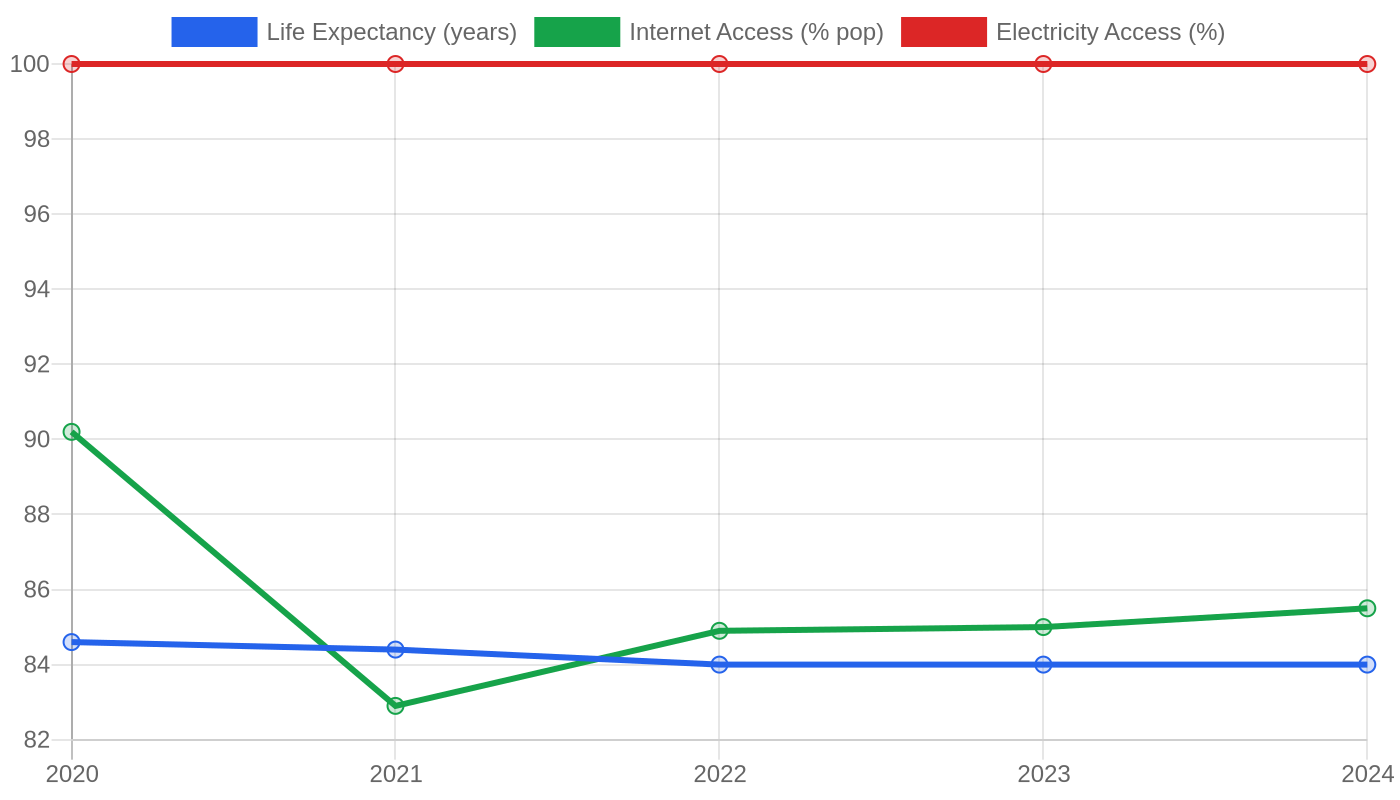
*Chart: /home/deploy/.openclaw/workspace/pulse/data/media/japan-chart.png*
*Photo: /home/deploy/.openclaw/workspace/pulse/data/media/japan-photo.jpg*
Sources & Methodology
This article is produced by Economic Pulse Net for informational and research purposes. Data is drawn from publicly available sources including the World Bank Open Data portal, Trading Economics, Numbeo, Wikipedia, and official national statistics bureaus. Economic Pulse Net does not guarantee the accuracy or completeness of third-party data. All data is believed to be current as of the date of publication.
Published: July 16, 2026 | Category: Research — Japan
Use these signals in your own platform
Economic Pulse publishes its live signal feed through a documented, read-only API. Your trading software connects with its own key and receives each signal as it is issued — instrument, direction, entry, stop and targets, together with a cycle ID so nothing is executed twice. The feed is independent of this website and cannot change it.
Signals are informational only and are not financial advice.