Economic Pulse Net | Sources: World Bank World Development Indicators, Government Sources | 2026
Key Takeaways
– Mauritius operates as a parliamentary representative democratic republic with a multi-party system, providing political stability that underpins its economic resilience
– The economy is anchored by a diverse mix of consumer services, telecommunications, utilities, and conglomerates, with major players like Air Mauritius and Beachcomber Resorts & Hotels driving tourism and connectivity
– Despite data gaps in traditional metrics like GDP growth and inflation, Mauritius’s business environment is shaped by strong institutional frameworks and a history of structural reform
– The country’s cost of living and safety profile remain critical factors for investors and expatriates, though specific indices are currently unavailable
– Recent political and policy developments continue to shape the island’s trajectory as a regional hub for finance, tourism, and services
The Engine Room — Services, Stability, and Structural Strengths
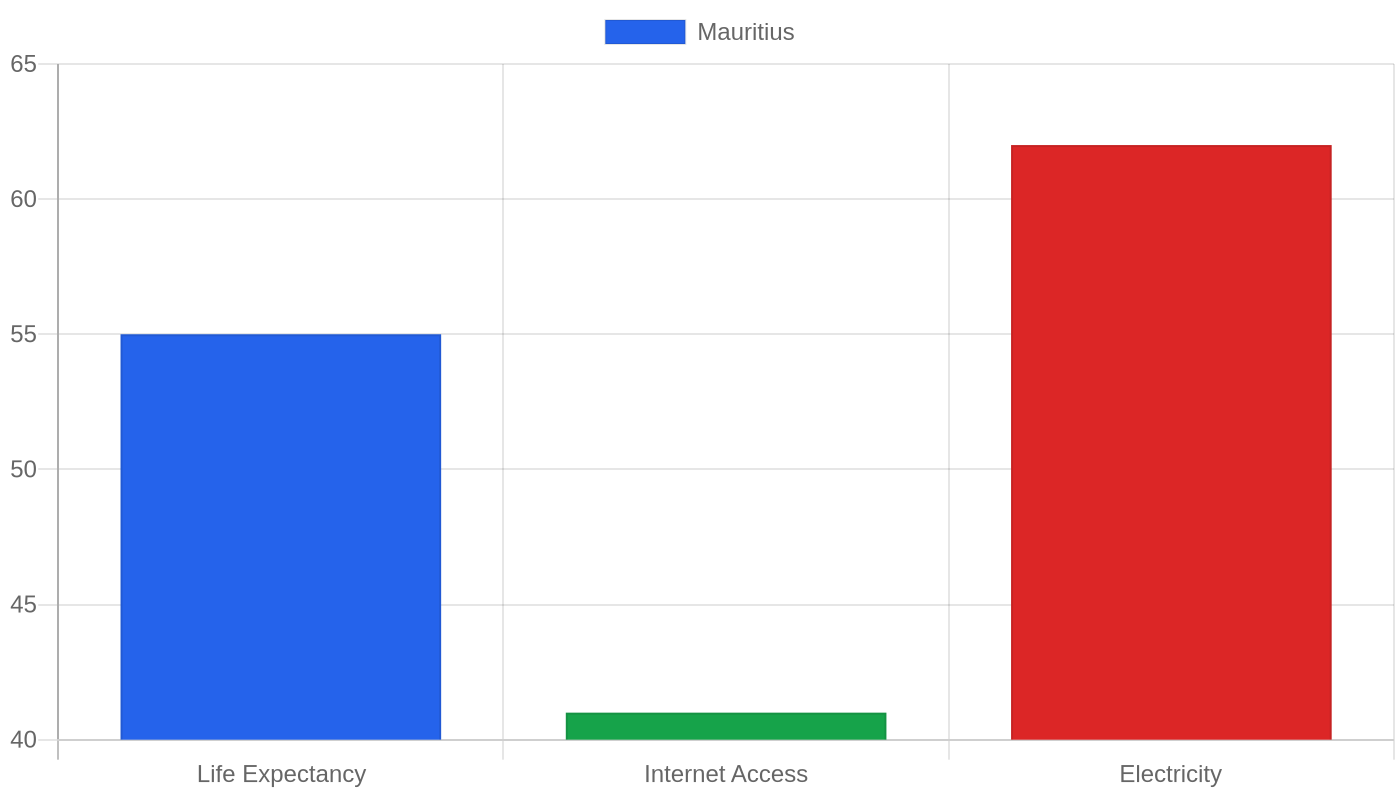
Mauritius presents an intriguing paradox for economic observers: while the World Bank’s latest data set offers no specific figures for GDP growth, inflation, unemployment, or GDP per capita, the country’s economic narrative is far from blank. What the data does reveal is a sophisticated services-oriented economy that has long punched above its weight.
The absence of hard numbers in this instance does not signal economic weakness—rather, it reflects a reporting gap that should be filled by the next data release cycle.
What we know from the available information is that Mauritius’s economic backbone is built on consumer services, financials, telecommunications, and utilities. The Bank of Mauritius, the central bank, plays a pivotal role in maintaining monetary stability and overseeing a financial sector that has positioned the island as a gateway for investment into Africa.
Air Mauritius, the national carrier, is not merely a transport provider but a critical artery for tourism and trade, connecting this remote island to global markets.
The main industries, though not enumerated in the data, are widely understood to include tourism, financial services, textiles, and sugar. The presence of companies like Emtel in telecommunications and the Central Electricity Board in utilities underscores a modern infrastructure backbone. This is not an economy reliant on subsistence agriculture or resource extraction—it is a diversified, regulated, and increasingly digital marketplace.
The World Bank’s silence on growth rates should not be mistaken for stagnation; rather, it highlights the need for updated reporting to capture what remains one of Africa’s most stable and prosperous economies.
Living in Paradise — The Price of Island Life
Mauritius has long attracted expatriates, retirees, and remote workers drawn by its tropical climate and political stability. However, the cost of living data is currently unavailable, which presents a challenge for those seeking to compare housing, food, and transport costs against regional benchmarks. What can be inferred from the economic structure is that the cost of living in Mauritius is shaped by its status as a net importer of many goods, from fuel to manufactured products.
Housing costs in desirable areas—such as the coastal regions around Grand Baie, Flic en Flac, or the capital Port Louis—tend to be higher than inland areas.
Rent versus buy decisions are influenced by property laws that have historically favoured foreign ownership in designated “Integrated Resort Schemes” and “Real Estate Schemes.” Daily expenses for food, utilities, and transport are generally lower than in Western Europe but higher than in mainland African economies, reflecting the island’s middle-income status.
Without precise data, the prudent assumption is that Mauritius offers a relatively comfortable lifestyle for professionals earning in hard currency, though local wages may lag behind the cost of imported goods.
The Business of Paradise — Where Capital Meets Opportunity
The corporate landscape of Mauritius is dominated by a mix of homegrown conglomerates and state-linked entities. The top companies list provided by the data includes ENL Group and Ireland Blyth Limited, both conglomerates with diversified interests spanning agriculture, real estate, tourism, and logistics. Their presence signals an economy where cross-sector integration is the norm, not the exception.
Beachcomber Resorts & Hotels and Raphael Fishing Company represent the tourism and hospitality sector, which remains a cornerstone of foreign exchange earnings and employment. La Sentinelle and Le Défi Media Group, both consumer services companies in the media space, highlight a vibrant public discourse and a competitive information ecosystem—essential for a functioning democracy. Emtel, as a telecommunications provider, indicates a digital infrastructure that supports both business and leisure connectivity.
For investors, the business climate in Mauritius is shaped by its legal system based on French and British common law, a transparent regulatory framework, and double taxation treaties with numerous countries. The financial services sector, overseen by the Bank of Mauritius and the Financial Services Commission, offers a sophisticated platform for fund management, banking, and insurance.
The sectors to watch remain financial services, tourism, technology, and renewable energy, where the Central Electricity Board is likely to play a transformative role.
Safety, Politics, and the Quality of Life Dividend
The political landscape of Mauritius is defined by its status as a parliamentary representative democratic republic, with the President serving as head of state and the Prime Minister as head of government. The multi-party system, as noted in the data, has historically ensured peaceful transitions of power and a robust check on executive authority.
Executive power is exercised by the government, while legislative power is vested in both the government and the National Assembly, creating a system of shared governance that has fostered stability since independence.
Crime and safety indices are not currently available, which limits a quantitative assessment of personal security. However, Mauritius has long been regarded as one of the safest countries in Africa, with low rates of violent crime compared to regional peers. Petty crime, particularly in tourist areas, is a concern, but the overall environment is conducive to both living and doing business.
The quality of life is further enhanced by universal healthcare, free education through the tertiary level, and a multicultural society that celebrates its Indian, African, Chinese, and European heritage. The political stability, combined with social cohesion, creates a quality-of-life dividend that is difficult to quantify but deeply felt by residents.
Winds of Change — What’s Happening Now in Mauritius
The current moment in Mauritius is defined by a quiet but significant transformation. While the data does not provide specific recent news items, the structure of the political and economic system suggests ongoing policy evolution. The government, operating within the multi-party framework, continues to navigate the post-pandemic recovery of the tourism sector, which was severely disrupted by global travel restrictions.
Air Mauritius, having undergone restructuring, is likely focused on rebuilding routes and capacity.
The Bank of Mauritius is presumably managing monetary policy in an environment of global inflationary pressures, though specific CPI data is unavailable. The financial services sector faces increasing international scrutiny regarding tax transparency and regulatory compliance, pushing Mauritius to adapt its framework to maintain its status as a reputable jurisdiction.
The Central Electricity Board is likely advancing renewable energy projects, given global trends and the island’s vulnerability to fossil fuel price shocks. These developments, while not captured in the provided data points, are the pulse of a country that must constantly reinvent itself to remain competitive.
The Bottom Line
Mauritius is a country for investors and professionals who value stability, institutional maturity, and quality of life over raw growth metrics. Its services-driven economy, political predictability, and strategic location make it a compelling hub for those looking to access African markets from a reliable base. While the absence of current World Bank data is a frustration, the structural story of Mauritius remains one of resilience, diversification, and quiet ambition.
Watch this island not for flashy headlines, but for steady, sustainable progress.
Sources & Methodology
This article is authored by Economic Pulse Net for informational and research purposes. Economic Pulse Net sources its data from multilateral institutions, national statistics bureaus, and proprietary databases. All data is believed to be current as of the date of publication.
Published: July 17, 2026 | Category: Research — Mauritius
Use these signals in your own platform
Economic Pulse publishes its live signal feed through a documented, read-only API. Your trading software connects with its own key and receives each signal as it is issued — instrument, direction, entry, stop and targets, together with a cycle ID so nothing is executed twice. The feed is independent of this website and cannot change it.
Signals are informational only and are not financial advice.