Economic Pulse Net | Sources: World Bank World Development Indicators, Government Sources | 2026
Key Takeaways
– Ghana’s inflation remains stubbornly high at 14.2%, according to World Bank data, squeezing household purchasing power and complicating the central bank’s policy path.
– Unemployment is officially just under 3%, but this figure masks widespread underemployment in the informal sector that dominates the economy.
– The political landscape is stable but intensely competitive, with power alternating between the NDC and NPP in a system that has held since the return to civilian rule in 1993.
– Ghana’s GNI per capita stands at $2,630, positioning it as a lower-middle-income economy with significant infrastructure and social development needs.
– The corporate landscape is diverse, spanning banking, aviation, brewing, and mining, with Ashanti Goldfields representing the country’s historic wealth in precious metals.
The Growth Paradox — Why 14% Inflation Matters More Than Missing GDP Data
The World Bank’s latest data set presents an incomplete picture of Ghana’s economic output, with GDP growth figures listed as unavailable. What is clear, however, is that the headline story of the Ghanaian economy right now is inflation. At 14.2%, according to the World Bank, consumer prices are rising at a pace that erodes real incomes and complicates business planning.
For a country where a significant portion of the workforce operates in informal markets, this inflation figure is not an abstract statistic — it is the difference between affording dinner and going without.
Ghana’s unemployment rate of just under 3%, as reported by the World Bank, is remarkably low by global standards. But this number requires careful interpretation. In economies like Ghana’s, low unemployment often reflects the absence of a formal social safety net — people cannot afford to be unemployed, so they take whatever work they can find, often in low-productivity, low-wage informal sector jobs.
The real economic challenge is not joblessness in the Western sense, but rather the quality and stability of employment that exists.
The country’s GNI per capita of $2,630, according to World Bank figures, places Ghana firmly in the lower-middle-income bracket. This is a nation that has made significant developmental progress over the past two decades but remains vulnerable to external shocks — commodity price fluctuations, weather patterns affecting agriculture, and global financial conditions that influence capital flows and debt servicing costs.
The missing GDP growth data is itself a telling detail: it suggests either reporting lags or the kind of statistical volatility that often accompanies periods of economic stress and structural adjustment.
The Cost of Living Crunch — Where 14 Cents on Every Cedi Goes
When inflation runs at 14.2%, as the World Bank data confirms, the cost of living is not a theoretical concern — it is a daily reality that shapes how Ghanaians move through the world. Rent, food, transportation, and utilities consume an increasingly large share of household income. For the average Ghanaian earning in cedis, the purchasing power erosion is relentless. A basket of goods that cost 100 cedis a year ago now costs more than 114 cedis, and wages rarely keep pace.
Housing in Ghana’s major urban centers, particularly Accra and Kumasi, has become a source of financial strain. The gap between what people earn and what adequate housing costs continues to widen. For many, the choice is not between renting and buying — homeownership is out of reach for a large portion of the population — but between acceptable rental accommodation and more marginal, overcrowded arrangements.
The World Bank data does not provide specific housing cost figures, but the inflation number alone tells the story: when the cost of everything rises, shelter becomes both more expensive and harder to secure.
Transportation costs add another layer of pressure. Ghana’s urban transport system relies heavily on informal minibus networks and shared taxis, and fuel price fluctuations feed directly into fare increases. Food inflation, a major component of the CPI basket, hits hardest at lower-income households who spend a larger share of their budget on staples like maize, rice, cassava, and plantains. The cumulative effect is a population that feels poorer even as the headline employment numbers look healthy.
Business in Ghana — Gold, Beer, and the Battle for Confidence
Ghana’s corporate landscape, as reflected in the list of top companies provided, tells a story of both tradition and transition. Ashanti Goldfields Corporation, a name synonymous with the country’s mineral wealth, anchors the basic materials sector. Alongside it, companies like Aluworks and African Champion Industries represent Ghana’s industrial ambitions in metals and manufacturing. These are not marginal players — they are the backbone of formal sector employment and export revenues.
The financial sector is well-represented, with Agricultural Development Bank of Ghana and AmalBank providing banking services to a population that remains underbanked by global standards. The presence of multiple aviation companies — Aerogem Aviation, Afra Airlines, Africa World Airlines, and Antrak Air — signals both the importance of domestic and regional connectivity and the competitive dynamics of a sector that has seen its share of turbulence.
Accra Brewery Company, in the consumer goods space, taps into Ghana’s vibrant social culture and the steady demand for beverages that cuts across income groups.
For investors, Ghana offers a familiar set of opportunities and risks. The political stability that has characterized the Fourth Republic is a genuine asset in a region where governance can be unpredictable. The two-party system, dominated by the NDC and NPP, provides a predictable electoral cycle. But doing business in Ghana also means navigating infrastructure gaps, currency volatility, and the regulatory complexities that come with a lower-middle-income economy.
The companies that succeed here are those that understand the local market deeply and can manage the gap between formal policy and on-the-ground reality.
Democracy Delivers, But Can It Deliver Prosperity?
Ghana’s political system is a source of genuine pride and a regional outlier. Since the transition to the Fourth Republic in January 1993, as the political landscape data notes, the country has alternated between civilian and military governments no more. The 1992 constitution established a unitary presidential constitutional democracy with a parliamentary multi-party system, and the system has held.
Power has changed hands between the National Democratic Congress and the New Patriotic Party in elections that, while fiercely contested, have been broadly accepted as legitimate.
This political stability is not merely a matter of good governance — it has direct economic consequences. Investors value predictability, and Ghana’s democratic track record provides a degree of certainty that many of its neighbors cannot offer. The commander-in-chief of the Ghana Armed Forces serves as both head of state and symbol of civilian control over the military, a crucial safeguard in a region where coups remain a threat.
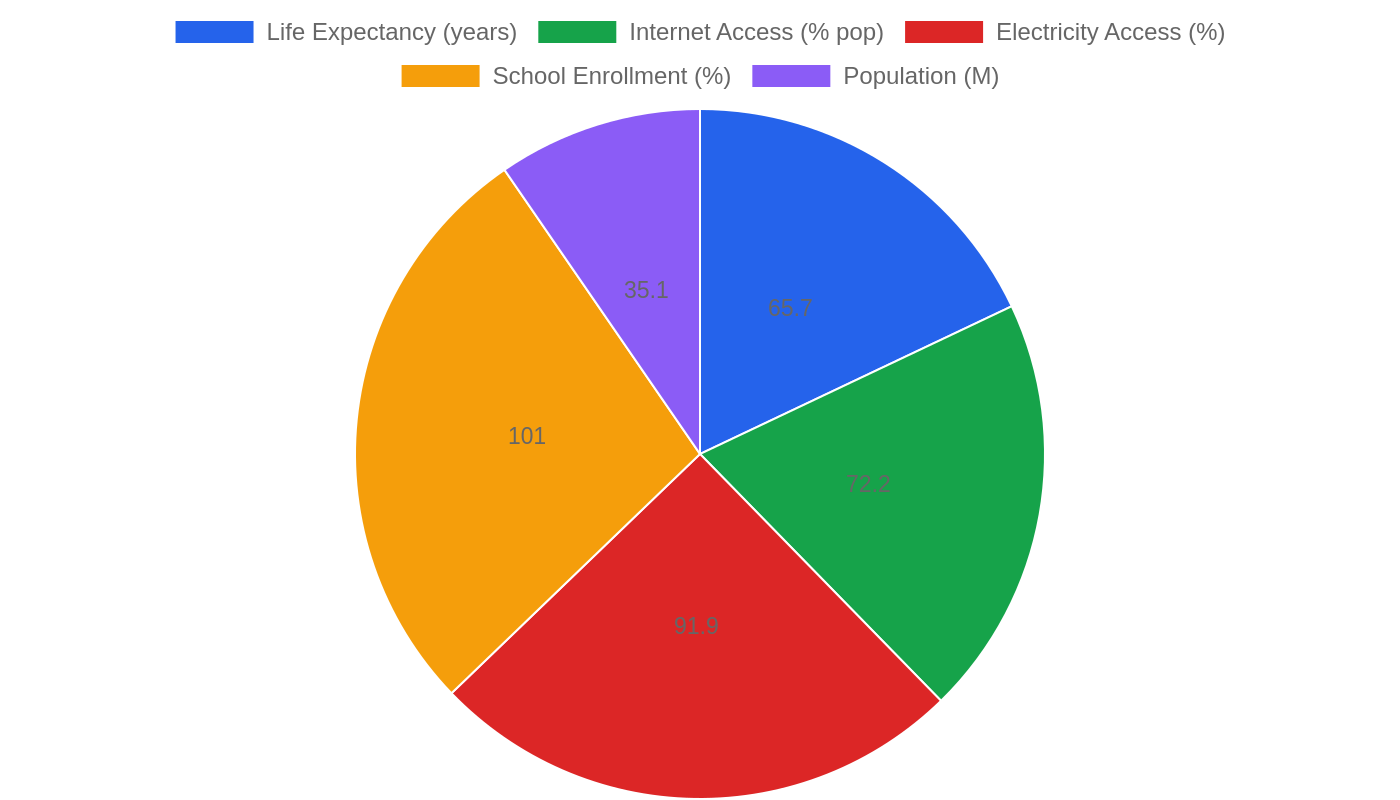
But stability does not automatically translate into prosperity. The political system, for all its strengths, has struggled to deliver the kind of transformative economic growth that would lift the 35 million Ghanaians — the World Bank’s population figure — into higher living standards. Corruption remains a concern. Public services, from healthcare to education to electricity supply, often fall short of what citizens expect and deserve.
The democracy that Ghanaians have built is real and valuable, but it is also a work in progress, tested daily by the gap between political rights and economic realities.
The Moment of Truth — Inflation, Debt, and the Path Ahead
This is the story that matters most right now. Ghana is navigating a period of economic adjustment that will define its trajectory for years to come. The 14.2% inflation figure from the World Bank is not a historical footnote — it is a live indicator of the pressure the economy is under. The central bank has responded with interest rate increases, a standard tool for cooling demand and stabilizing prices, but these moves also slow economic activity and make borrowing more expensive for businesses and households.
The fiscal picture is equally challenging. Ghana has been working through a debt restructuring process, seeking to bring its public finances back to a sustainable path. This involves difficult negotiations with external creditors and painful adjustments at home. Spending cuts, revenue mobilization measures, and reforms to state-owned enterprises are all part of the conversation. The political implications are significant: governments that ask citizens to bear the costs of adjustment risk losing the next election.
On the positive side, Ghana’s fundamentals remain intact. The country has a young, growing population of over 35 million people, according to the World Bank. It has natural resources, agricultural potential, and a services sector that continues to expand. The democratic system, while imperfect, provides mechanisms for accountability and peaceful political change.
The question is whether these strengths can be mobilized quickly enough to address the immediate crisis of confidence and the longer-term challenge of building an economy that works for everyone.
The Bottom Line
Ghana is a country to watch for anyone with an interest in African economic development, democratic governance, or commodity markets. The current period of adjustment is painful, but the foundations — political stability, institutional continuity, a diverse corporate sector — are stronger than in many comparable economies. Investors and policymakers should pay attention not because Ghana is a simple story, but because it is a revealing one.
How Ghana navigates its inflation challenge and debt restructuring will offer lessons for the entire continent. The country matters, and its choices matter.
Sources & Methodology
This article is authored by Economic Pulse Net for informational and research purposes. Economic Pulse Net sources its data from multilateral institutions, national statistics bureaus, and proprietary databases. All data is believed to be current as of the date of publication.
Published: July 17, 2026 | Category: Research — Ghana
Use these signals in your own platform
Economic Pulse publishes its live signal feed through a documented, read-only API. Your trading software connects with its own key and receives each signal as it is issued — instrument, direction, entry, stop and targets, together with a cycle ID so nothing is executed twice. The feed is independent of this website and cannot change it.
Signals are informational only and are not financial advice.