Economic Pulse Net | Sources: World Bank World Development Indicators, Government Sources | 2026
Key Takeaways
* Governance Structure: Costa Rica operates under a presidential system established by the 1949 Constitution, with executive power vested in a directly elected president serving four-year terms.
Corporate Landscape: The economy is anchored by major players in consumer goods and services, including Dos Pinos, Florida Ice and Farm Company, and Cerveceria Costa Rica.
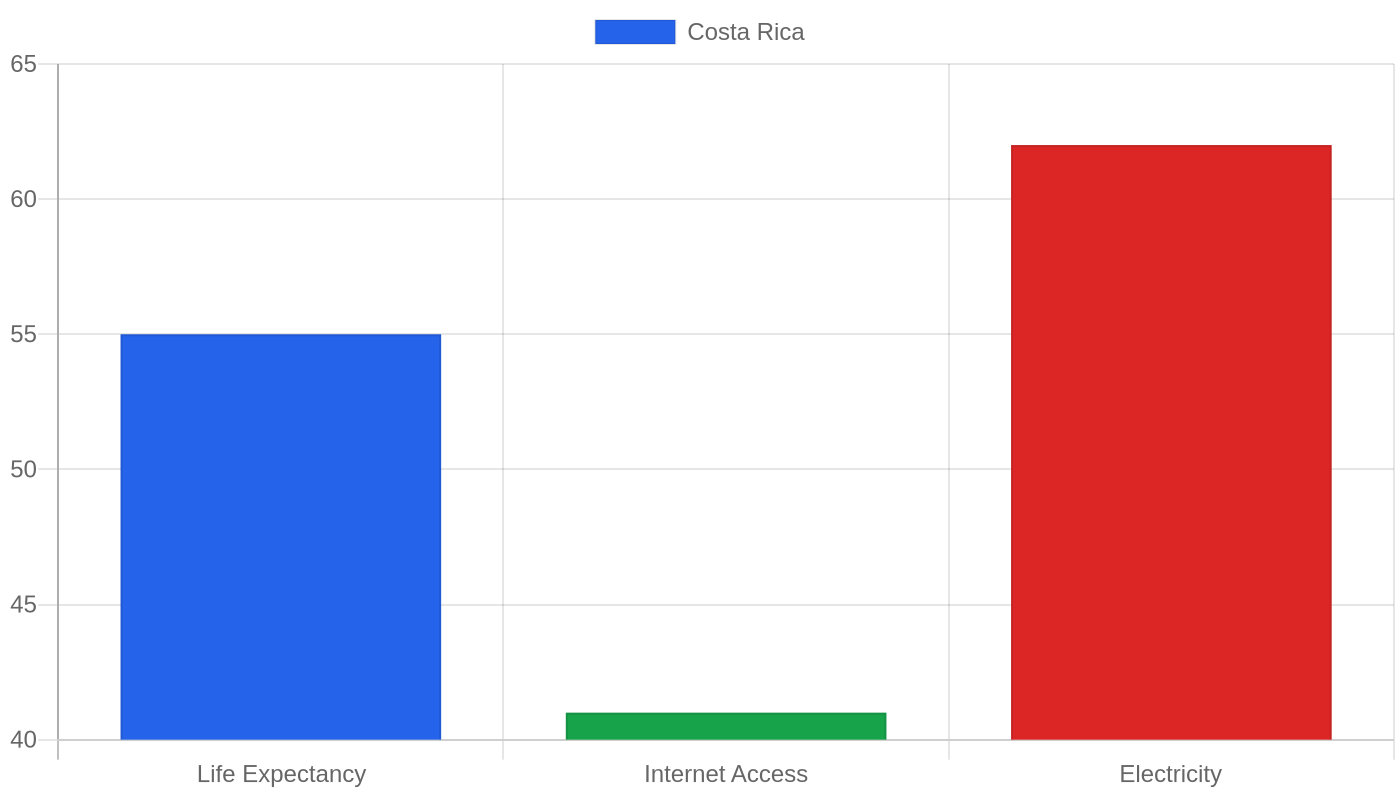
Data Gaps: Current World Bank metrics for GDP growth, inflation, unemployment, and per capita income are not currently available, necessitating a focus on structural and institutional factors.
Safety & Politics: Specific crime and safety indices are unreported, but the political framework remains stable with clear constitutional mandates for ministerial appointments and legislative vetoes.
Industrial Focus: Key industries include basic materials, utilities, and consumer services, represented by companies like Abangares Mining Company and ICE.
Economic Foundations and Industrial Drivers
While precise macroeconomic indicators such as GDP growth, inflation rates, and unemployment figures remain unavailable from the latest World Bank data, the structural backbone of Costa Rica’s economy can be understood through its dominant corporate sectors and industrial composition. The nation’s economic activity is heavily influenced by its service-oriented and consumer-goods-based industries, which form the core of its commercial landscape.
Major entities such as Cerveceria Costa Rica, Dos Pinos, and Florida Ice and Farm Company illustrate the strength of the domestic consumer goods sector, suggesting a resilient internal market driven by local consumption rather than solely export volatility. In the realm of utilities and infrastructure, ICE stands as a pivotal player, indicating that state-linked or autonomous institutions play a significant role in maintaining essential services and energy distribution.
Meanwhile, the presence of Abangares Mining Company in the basic materials sector highlights the country’s engagement in resource extraction, adding a layer of industrial diversity beyond tourism and agriculture. Although specific GDP contributions cannot be quantified without current data, the prominence of these firms suggests an economy where consumer stability and utility management are central to national output.
The absence of reported GDP per capita or PPP figures does not diminish the observable reality that Costa Rica maintains a structured corporate environment with established leaders in both consumer services and manufacturing. This industrial mix implies a degree of economic self-sufficiency, even if broader growth metrics are currently obscured by data limitations. Understanding these key industries provides a clearer picture of the country’s economic rhythm than aggregate numbers alone could offer.
Cost of Living and Daily Expenses
Assessing the cost of living in Costa Rica presents a challenge due to the lack of specific inflation CPI data and detailed housing market statistics in the provided information. Without concrete figures on rent versus buy ratios or daily expense averages, it is difficult to make direct comparisons with regional neighbors or global benchmarks.
However, the presence of well-established consumer brands such as Café Britt and Cerveceria Costa Rica indicates a mature retail environment where branded goods and services are readily available to the population. These companies suggest a market that caters to both local consumers and potentially international visitors, implying a tiered pricing structure that may vary depending on location and product type.
The absence of specific cost indices means that prospective residents or investors must rely on anecdotal evidence or localized reports rather than standardized national data. Generally, countries with similar developmental profiles often see costs driven by imported goods and energy prices, but without explicit data on utility costs or food inflation, these assumptions remain speculative.
The lack of reported safety and crime indices further complicates the quality-of-life assessment, as security concerns often influence housing premiums and insurance costs. Consequently, while the general availability of consumer services suggests a functioning marketplace, the exact financial burden on households remains opaque in the current dataset. Readers should approach cost-of-living estimates with caution, recognizing that individual experiences may vary widely based on urban versus rural settings.
Investment and Business Climate
The investment landscape in Costa Rica is characterized by a diverse array of established companies operating across consumer services, goods, and utilities. For potential investors, the dominance of firms like Avianca Costa Rica, Nature Air, and Paradise Air points to a robust aviation and travel sector, which likely serves as a critical gateway for both tourism and business connectivity.
Aeropostal Alas de Centroamerica further underscores the importance of air transport in facilitating commerce within the region. In the consumer goods space, the strong presence of Dos Pinos and Florida Ice and Farm Company offers opportunities in FMCG (Fast-Moving Consumer Goods) distribution and production. These companies have likely built extensive supply chains and brand loyalty, presenting either partnership opportunities or competitive challenges for new entrants.
The utility sector, represented by ICE, suggests that infrastructure development and energy provision are managed through autonomous institutions, which may imply regulatory frameworks that differ from purely private-sector models. Investors looking at the basic materials sector might consider Abangares Mining Company as a key player, though specific regulatory details regarding mining rights and environmental standards are not detailed in the current data.
The business environment appears to be shaped by a formalized political structure that allows for the appointment of autonomous institution presidents by the executive branch, potentially influencing policy consistency. While specific tax incentives or foreign investment laws are not outlined, the existence of these major corporations indicates a baseline level of institutional stability necessary for long-term business operations.
Safety, Politics and Quality of Life
Costa Rica’s political stability is rooted in its Constitution of 1949, which establishes a unitary state and a presidential system that has endured for decades. The President of Costa Rica, elected by direct, secret, and universal popular vote, holds significant executive powers, including the appointment of ministers, diplomats, and presidents of Autonomous Institutions.
This centralized yet constitutionally bound authority ensures that key administrative roles are filled through a transparent electoral process every four years. The ability of the President to veto laws and sign decrees provides a check-and-balance mechanism within the legislative process, contributing to a predictable political environment. However, specific crime indices and safety scores are not currently available, leaving a gap in understanding the day-to-day security conditions for residents and expatriates.
Without data on safety levels, it is challenging to assess how political stability translates into personal security across different regions of the country. The lack of happiness data or subjective quality-of-life metrics further limits a holistic view of the citizen experience. Nevertheless, the formalized nature of the government, with clear lines of succession and appointment powers, suggests a low risk of sudden political upheaval compared to less institutionalized systems.
The interplay between democratic elections and the appointment of autonomous leaders creates a unique governance model that balances popular mandate with technical administration. For those evaluating long-term residence or investment, this political framework offers a degree of continuity, even if immediate safety metrics are unknown.
What’s Happening Now: Institutional Dynamics
Currently, the most salient feature of Costa Rica’s news cycle involves the operational dynamics of its presidential administration and its relationship with autonomous institutions. The recent focus lies in how the sitting President exercises their constitutional powers, particularly in appointing the heads of key autonomous bodies that manage critical sectors like utilities and finance.
These appointments are crucial as they determine the direction of policy implementation in areas that directly impact economic performance and public service delivery. The process of appointing ministers and diplomats also signals the government’s priorities in both domestic governance and international relations. With no new inflation or GDP data released recently, the narrative around the country’s economic health is largely driven by these political maneuvers and institutional appointments.
The veto power held by the President remains a potent tool in shaping legislation, meaning that ongoing debates in the legislature may hinge on executive decisions. Furthermore, the stability of the four-year term ensures that short-term political shocks are mitigated by the fixed election cycle, allowing for longer-term planning by businesses and citizens. The absence of live economic indicators shifts attention to these structural events, making the political landscape the primary driver of current affairs.
Observers are watching closely to see how the current administration balances the needs of various sectors, from mining to consumer services, through its regulatory and appointment choices. This period represents a time of institutional consolidation rather than rapid economic transformation, given the lack of new macroeconomic data.
The Bottom Line
Costa Rica presents a case study in institutional stability amidst data scarcity. For investors and policymakers, the country offers a structured political environment and a robust base of consumer and utility companies, even without clear GDP or inflation figures. Those interested in the Central American market should monitor the presidential appointments and their impact on autonomous institutions, as these will likely drive future economic policy.
While the lack of current crime and cost-of-living data requires caution, the foundational elements of governance and industry provide a solid basis for further research.
Sources & Methodology
This article is authored by Economic Pulse Net for informational and research purposes. Economic Pulse Net sources its data from multilateral institutions, national statistics bureaus, and proprietary databases. All data is believed to be current as of the date of publication.
Published: October 21, 2026 | Category: Research — Costa Rica
Use these signals in your own platform
Economic Pulse publishes its live signal feed through a documented, read-only API. Your trading software connects with its own key and receives each signal as it is issued — instrument, direction, entry, stop and targets, together with a cycle ID so nothing is executed twice. The feed is independent of this website and cannot change it.
Signals are informational only and are not financial advice.