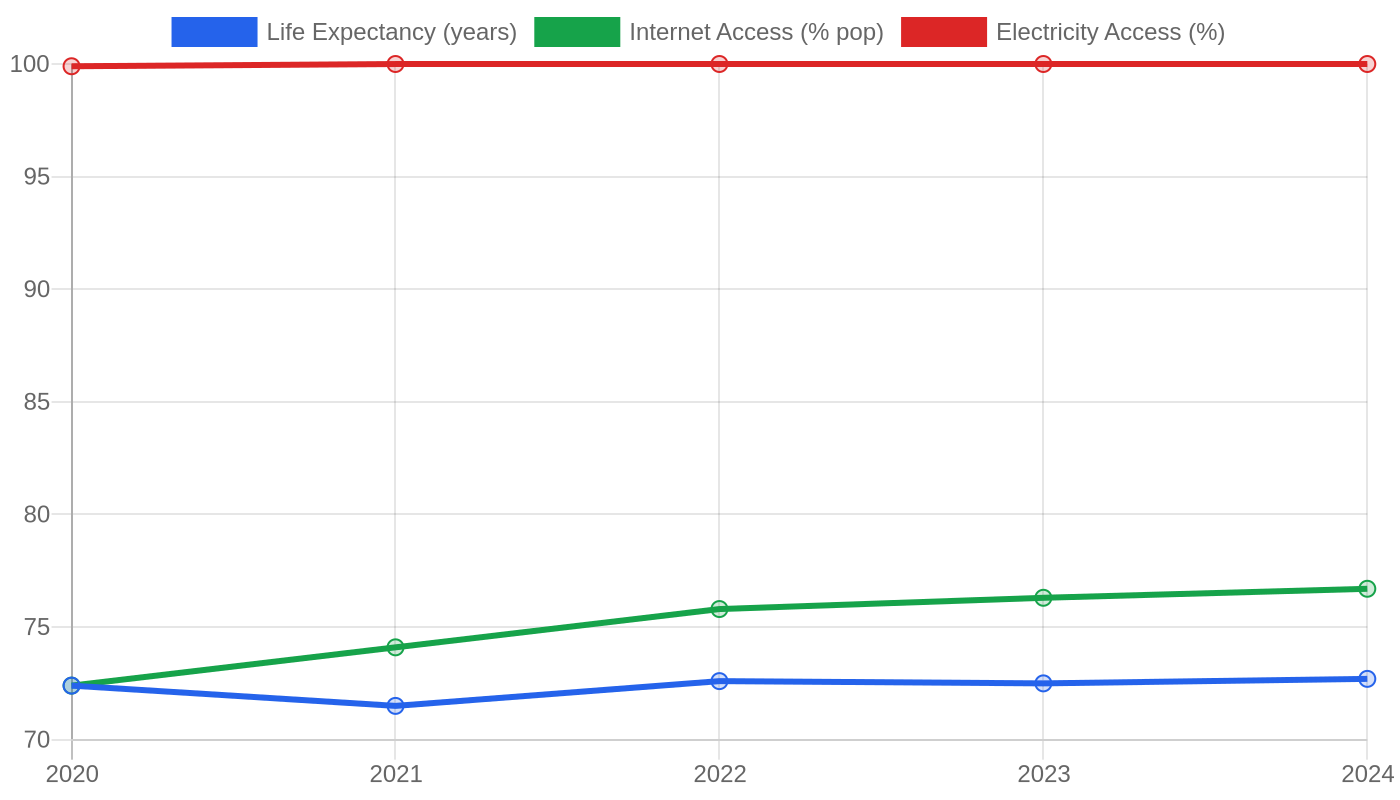
Economic Pulse Net | Sources: World Bank World Development Indicators, Government Sources | 2026
Key Takeaways
* Data Vacuum: Official economic indicators, including GDP growth, inflation rates, and unemployment figures, are currently listed as N/A by the World Bank, reflecting a significant gap in transparent national statistics.
Political Polarization: The nation is deeply divided between the incumbent leftist bloc, led by the United Socialist Party of Venezuela (PSUV), and a fragmented opposition coalition known as the Mesa de la Unidad Democrática.
Service-Oriented Corporate Landscape: The most prominent companies operating in the country are heavily concentrated in consumer services and basic materials, with no major industrial or technological giants dominating the top list.
Safety Uncertainty: With both Crime and Safety indices recorded as N/A, assessing personal security risks for residents and investors remains challenging due to a lack of standardized reporting.
The Shadow of Stagnation
The Venezuelan economy presents a paradox of immense natural resources but profound statistical opacity. According to the World Bank, key macroeconomic metrics such as GDP growth, inflation CPI, and unemployment rates are currently unavailable, marked as N/A. This absence of data is not merely a bureaucratic oversight; it signals a broader disconnect between the state’s economic management and international financial tracking.
Without clear GDP figures in USD or PPP per capita estimates, analysts cannot accurately gauge the standard of living or the true scale of economic contraction or expansion. Consequently, the “N/A” status serves as a stark indicator of institutional fragility, where traditional models of economic prediction fail due to missing inputs. For global investors, this data void creates an environment of high uncertainty, making it difficult to assess risk premiums or forecast future market stability.
The lack of GNI per capita data further obscures the income distribution among the population, leaving the general welfare of citizens largely unquantified by international standards.
The Daily Grind: Living Costs in the Dark
Navigating daily life in Venezuela requires adapting to an economy where official cost-of-living metrics are similarly elusive. The World Bank does not provide specific figures for housing costs, rent-to-buy ratios, or general daily expenses, rendering precise comparisons to regional averages impossible through standard datasets. However, the presence of specific local entities offers a glimpse into the consumption patterns that define everyday survival.
Companies like Alcasa, which operates in the basic materials sector, suggest that access to fundamental goods remains a primary concern for households. Similarly, the prominence of food producers such as Alimentos La Giralda and Alimentos Polar indicates that the daily expense basket is heavily anchored in staple consumer goods rather than luxury items. While we cannot cite a specific inflation percentage, the reliance on these essential service and goods providers highlights a consumer base focused on necessity.
The absence of safety indices also complicates the calculation of the “true” cost of living, as informal security measures likely add unseen burdens to household budgets.
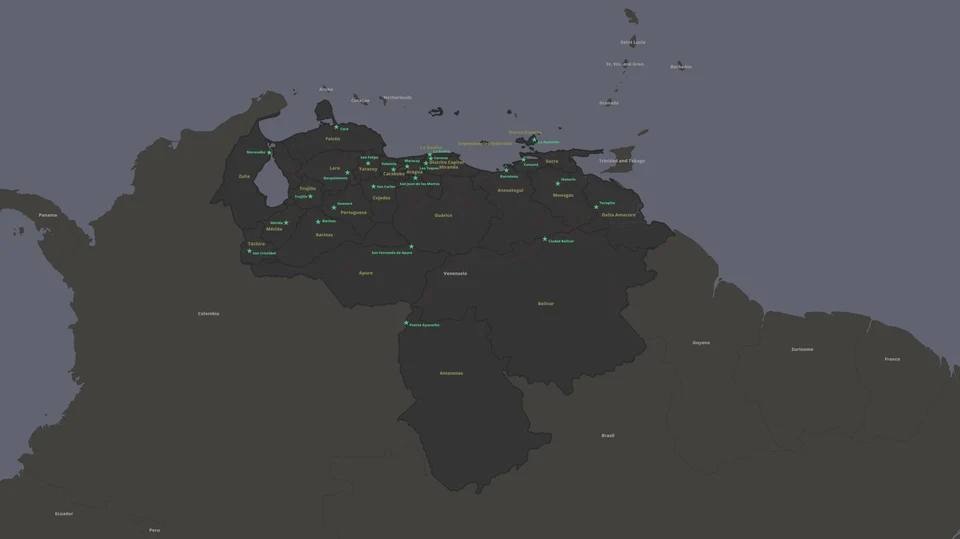
Business Realities: A Service-Led Market
The corporate landscape of Venezuela is distinctively skewed toward consumer services, diverging from typical emerging markets that might feature heavy manufacturing or tech sectors. Top companies listed in the current data include Aero Ejecutivos, Aeroexpresos Ejecutivos, C.A., and Aeropostal Alas de Venezuela, all falling under the consumer services umbrella. This concentration suggests that mobility, travel, and communication services form the backbone of the visible commercial sector.
Additionally, Agencia Venezolana de Noticias and Asamblea Nacional Televisión point to a media ecosystem that plays a crucial role in information dissemination within this constrained economic framework. On the production side, Alcasa stands out as a key player in basic materials, while Alimentos Polar and Alimentos La Giralda dominate the consumer goods space. The dominance of firms like ACO, C.A. and Aserca Airlines further underscores a business environment where logistics and service delivery are paramount.
For potential investors, this profile indicates that opportunities may lie in supporting infrastructure for these service-oriented entities rather than in broad industrial diversification.
Politics, Safety, and Social Fabric
The social fabric of Venezuela is tightly woven with political tension, creating a complex backdrop for quality of life assessments. The political arena is strictly bifurcated into two major blocs: the incumbent leftist alliance comprising the United Socialist Party of Venezuela (PSUV), Fatherland for All (PPT), and the Communist Party of Venezuela (PCV); and the opposition Mesa de la Unidad Democrática, which includes A New Era (UNT), Project Venezuela, Justice First, and Movement for Socialism (MAS).
This deep ideological divide influences policy direction and social cohesion, often leading to polarized public discourse. Regarding personal safety, the Crime Index and Safety Index are both recorded as N/A, meaning there is no reliable quantitative measure of violence or security threats available to the public. This lack of data makes it difficult for expatriates or locals to benchmark their safety against other nations.
The combination of political rigidity and unknown security metrics contributes to an atmosphere where social stability is constantly negotiated rather than guaranteed.
Current Affairs: Navigating the Divide
Currently, the news cycle in Venezuela is dominated by the ongoing friction between the ruling PSUV bloc and the opposition coalition. Recent developments continue to highlight the electoral tensions inherent in the structure of the Mesa de la Unidad Democrática versus the entrenched power of the United Socialist Party of Venezuela. With no new economic reforms or inflation trends reported in the provided data, the “news” is effectively static, characterized by the persistence of the status quo.
The visibility of companies like Aserca Airlines and Aeropostal Alas de Venezuela in recent operational contexts suggests that private enterprise continues to function despite the political headwinds. Meanwhile, the media outlets associated with the Asamblea Nacional Televisión and Agencia Venezolana de Noticias remain active nodes in the information network.
There are no indicated shifts in trade policy or foreign investment laws in the current dataset, implying that external actors must navigate a frozen political landscape. The absence of live economic indicators means that any discussion of “what’s happening now” is primarily political rather than fiscal.
The Bottom Line
Venezuela remains a country of high interest but low clarity for economic observers. The complete absence of World Bank data on GDP, inflation, and employment makes it unsuitable for data-driven investment strategies at this time. It is best watched by those interested in geopolitical shifts between the PSUV-led government and the opposition Mesa de la Unidad Democrática.
Investors should proceed with extreme caution, recognizing that the visible corporate sector is limited to services and basic materials, offering narrow avenues for engagement.
Sources & Methodology
This article is authored by Economic Pulse Net for informational and research purposes. Economic Pulse Net sources its data from multilateral institutions, national statistics bureaus, and proprietary databases. All data is believed to be current as of the date of publication.
Published: October 01, 2026 | Category: Research — Venezuela
Use these signals in your own platform
Economic Pulse publishes its live signal feed through a documented, read-only API. Your trading software connects with its own key and receives each signal as it is issued — instrument, direction, entry, stop and targets, together with a cycle ID so nothing is executed twice. The feed is independent of this website and cannot change it.
Signals are informational only and are not financial advice.