Economic Pulse Net | Sources: World Bank World Development Indicators, Government Sources | 2026
Key Takeaways
* Financial Sector Dominance: The corporate landscape is heavily skewed toward banking, with major players like Bank of South Sudan and KCB Bank leading the financial services sector.
Constitutional Framework: The nation operates under a transitional constitution ratified by the Southern Sudan Legislative Assembly, signed by President Salva Kiir Mayardit on Independence Day, July 9, 2011.
Aviation Connectivity: Consumer services are anchored by key airlines, including Feeder Airlines and Southern Star Airlines, which provide critical transport links in a region with limited infrastructure.
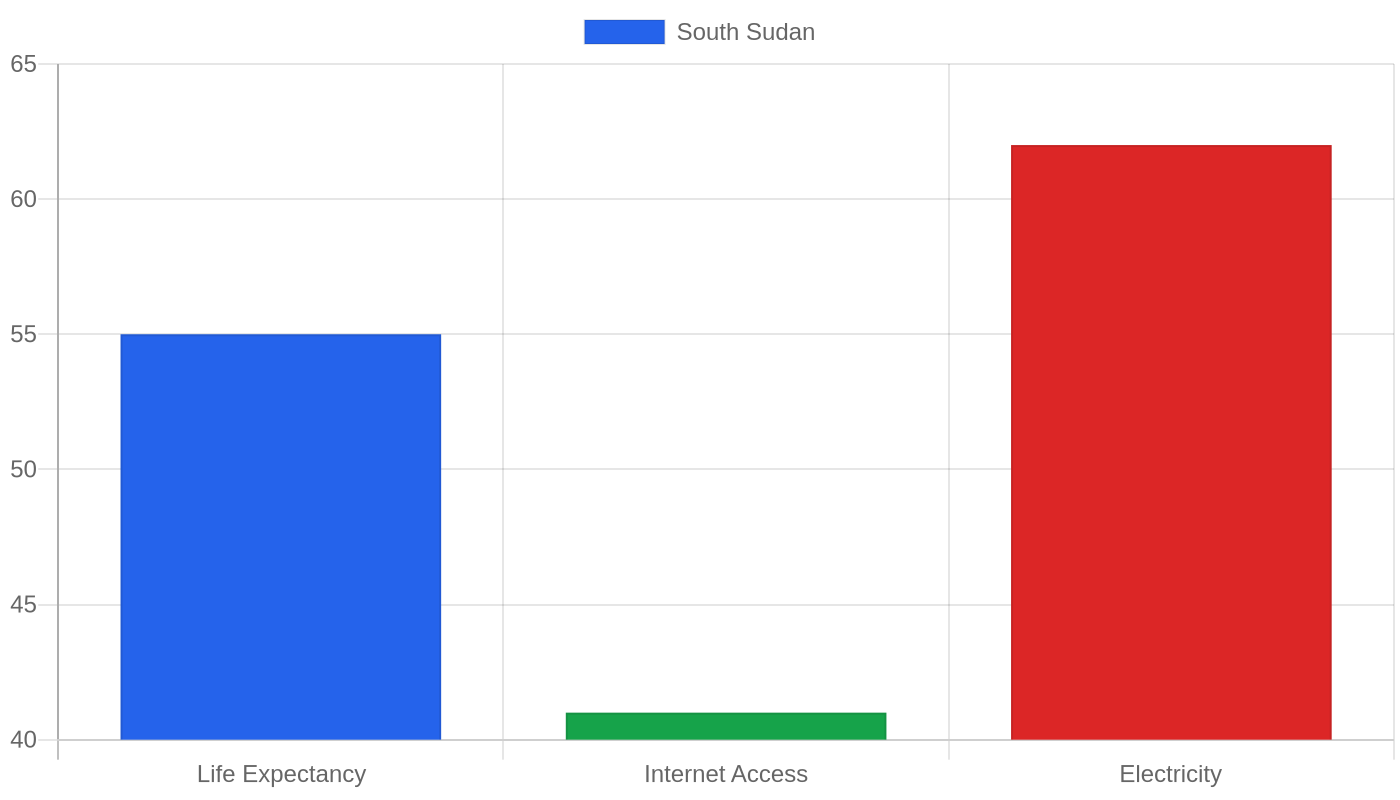
Data Gaps in Macro Metrics: Comprehensive economic indicators such as GDP growth, inflation rates, and unemployment figures are currently unreported, highlighting challenges in data collection and statistical transparency.
Security and Political Stability: Specific crime and safety indices are not available, while political stability rests on the supreme law established at independence, superseding previous interim agreements.
Economic Architecture and Industrial Base
The macroeconomic profile of South Sudan presents a complex picture defined as much by what is missing as what is present. According to the World Bank, critical metrics such as GDP growth, inflation CPI, and unemployment rates are listed as N/A, indicating significant gaps in real-time economic monitoring or reporting capabilities. This absence of hard data makes it difficult to assess the velocity of money or the health of consumer spending within the national economy.
However, the structure of the economy can be inferred through its main industries and corporate presence. The financial sector appears robust relative to other sectors, evidenced by the prominence of institutions like the Bank of South Sudan, Buffalo Commercial Bank, and Equity Bank South Sudan Limited. These entities suggest a growing reliance on formal banking services for capital movement and savings, although the lack of GNI per capita data obscures the actual wealth distribution among citizens.
Without concrete GDP figures in USD, it is challenging to determine the total size of the market, but the presence of multiple commercial banks implies a baseline level of commercial activity that requires liquidity management and credit facilities. The economy likely remains vulnerable to external shocks given the inability to track standard inflationary pressures, leaving policymakers and investors without clear signals on price stability.
Consequently, economic planning must rely on qualitative assessments of industrial output rather than quantitative growth trends.
Cost of Living and Daily Expenses
For residents and expatriates alike, understanding the cost of living in South Sudan involves navigating an environment where standardized pricing data is scarce. With no specific figures provided for general consumer prices or housing costs, potential residents must prepare for a market that may operate differently from regional averages in East Africa.
The availability of services is concentrated in urban centers, particularly those served by aviation companies like Feeder Airlines and Southern Star Airlines, which facilitate the movement of goods and people. This logistical dependency often translates to higher costs for imported goods and daily necessities, as supply chains are longer and more susceptible to disruption.
While we cannot cite exact rent-to-income ratios or utility bills, the presence of a structured banking sector suggests that financial transactions are becoming more formalized, potentially offering some protection against extreme price volatility. However, the lack of a published Safety Index or Crime Index complicates the assessment of personal security expenses, such as insurance premiums or private security measures, which are often significant in emerging markets.
Residents are advised to budget conservatively for essentials, as the informal nature of many transactions may lead to unpredictable pricing structures. The overall cost burden is likely influenced more by access and logistics than by transparent market competition, requiring careful financial planning for those establishing long-term residence.
Investment Landscape and Corporate Players
The investment climate in South Sudan is characterized by a concentration of capital within the financial and consumer service sectors. A review of top companies reveals a heavy emphasis on banking, with entities such as Ivory Bank, Mountain Trade and Development Bank, Nile Commercial Bank, and Cooperative Bank of South Sudan actively operating in the space. This dominance suggests that finance is the primary engine for business development, providing the necessary infrastructure for trade and commerce.
In the consumer services domain, Feeder Airlines and Southern Star Airlines play pivotal roles, connecting remote regions and facilitating both passenger travel and cargo transport. For investors, these sectors offer visibility into the operational backbone of the country, though the absence of detailed industry breakdowns limits deeper strategic analysis.
The entry of regional players like KCB Bank South Sudan Limited and Equity Bank South Sudan Limited indicates confidence in the market’s potential, despite the broader economic uncertainties. Business owners should note that while the legal framework is established, the practical ease of doing business may be impacted by the underlying data voids that hinder risk assessment.
Opportunities exist in supporting these core industries, whether through technology integration, logistics optimization, or customer service enhancements. Investors must proceed with caution, recognizing that the current corporate roster reflects resilience rather than rapid expansion, given the static nature of the reported economic indicators.
Political Stability and Social Environment
South Sudan’s political landscape is anchored by its foundational legal documents, which continue to shape governance and social order. The transitional constitution, ratified by the now defunct Southern Sudan Legislative Assembly shortly before independence, serves as the supreme law of the land. Signed by President Salva Kiir Mayardit on Independence Day, July 9, 2011, this document superseded the Interim Constitution of 2005, marking a definitive shift in the nation’s legal trajectory.
This constitutional framework provides a degree of institutional continuity, even as the political body that created it has ceased to exist. Regarding social well-being, specific crime and safety indices are not available, making it difficult to quantify the day-to-day risks faced by citizens and visitors. The lack of a Crime Index or Safety Index means that perceptions of security may vary widely based on location and community dynamics.
Without happiness data or quality-of-life metrics, assessing the social fabric requires looking at structural stability rather than subjective well-being. The political environment remains focused on the implementation of the transitional provisions, with the presidency holding central authority in interpreting and enforcing the supreme law. Stakeholders should monitor developments in constitutional interpretation and governance practices, as these will directly impact the rule of law and investor confidence.
Current Affairs and Emerging Trends
The current affairs in South Sudan are deeply intertwined with the legacy of its founding documents and the ongoing evolution of its state institutions. As the nation moves forward from its independence era, the focus remains on solidifying the authority of the transitional constitution signed by President Salva Kiir Mayardit.
While recent news updates do not provide specific live indicators on inflation or policy shifts, the continued reference to the 2011 constitutional ratification highlights the enduring importance of this legal milestone. The business community continues to adapt to the existing regulatory environment, with banks and airlines maintaining their operations as key pillars of economic activity.
There is an implicit need for updated data collection mechanisms, as the absence of GDP and inflation figures hinders effective policy-making and international aid allocation. Observers should watch for any amendments or clarifications to the transitional constitution that might affect governance structures or property rights. The role of major corporations like Buffalo Commercial Bank and Southern Star Airlines will likely expand as the country seeks to improve connectivity and financial inclusion.
Until comprehensive economic data becomes available, the narrative will remain one of cautious observation, focusing on institutional stability over rapid economic transformation.
The Bottom Line
South Sudan represents a unique case study in post-conflict state-building, where institutional frameworks are established but economic metrics remain elusive. Investors and analysts should watch this country not for immediate high-growth returns, but for signs of improved data transparency and infrastructural development. The strength of the banking sector and the clarity of the constitutional foundation provide a baseline for engagement, albeit with significant risks due to information gaps.
Ultimately, patience and a focus on fundamental institutional stability are required for anyone considering involvement in this young nation’s economy.
Sources & Methodology
This article is authored by Economic Pulse Net for informational and research purposes. Economic Pulse Net sources its data from multilateral institutions, national statistics bureaus, and proprietary databases. All data is believed to be current as of the date of publication.
Published: October 21, 2026 | Category: Research — South Sudan
Use these signals in your own platform
Economic Pulse publishes its live signal feed through a documented, read-only API. Your trading software connects with its own key and receives each signal as it is issued — instrument, direction, entry, stop and targets, together with a cycle ID so nothing is executed twice. The feed is independent of this website and cannot change it.
Signals are informational only and are not financial advice.