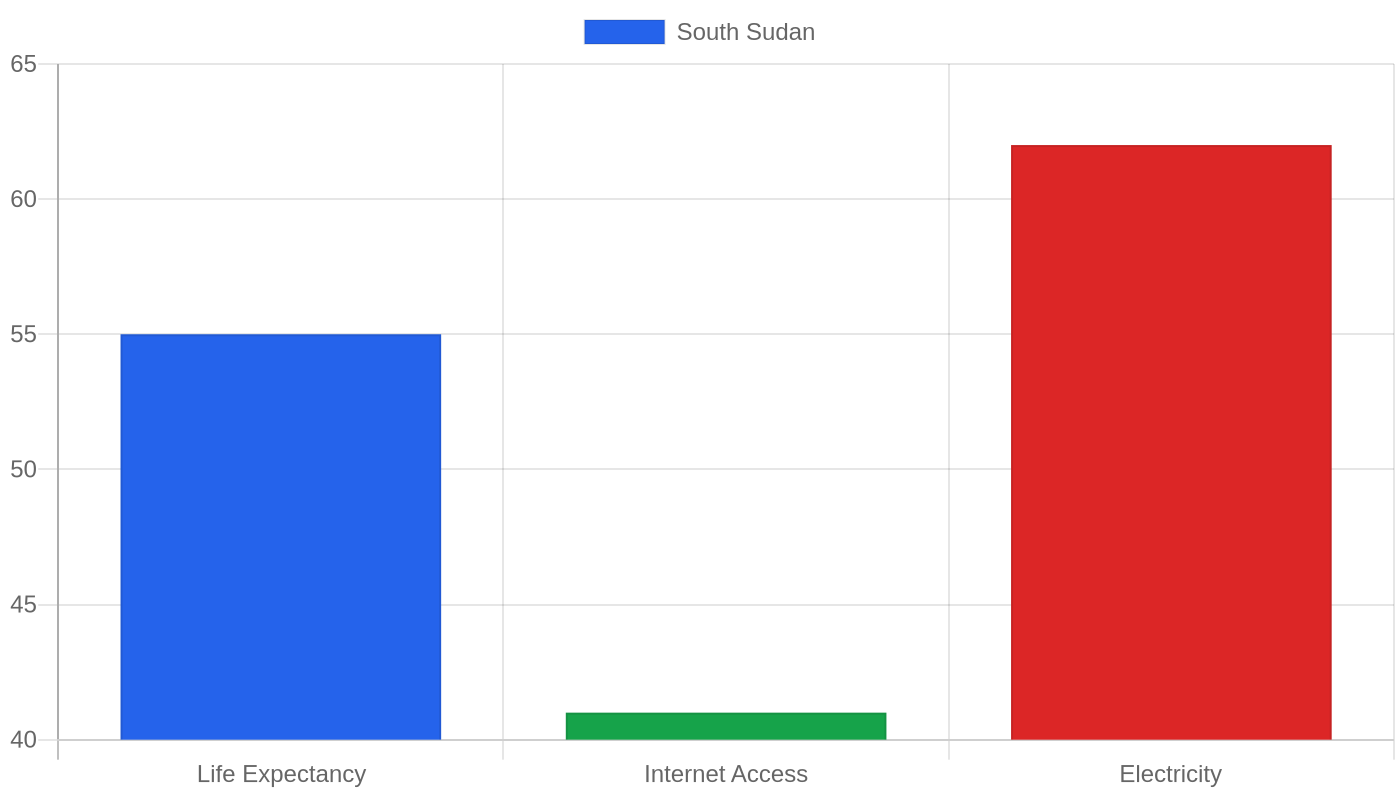
Economic Pulse Net | Sources: World Bank World Development Indicators, Government Sources | 2026
Key Takeaways
* Political Framework Established: The nation operates under a transitional constitution ratified shortly before independence in July 2011, signed by President Salva Kiir Mayardit, which serves as the supreme law superseding previous interim agreements.
Financial Sector Dominance: The corporate landscape is heavily skewed toward financial services, with major institutions like Bank of South Sudan and KCB Bank South Sudan Limited leading the market.
Data Scarcity Challenge: Official macroeconomic indicators such as GDP growth, inflation rates, and unemployment figures are currently listed as N/A, highlighting significant gaps in statistical infrastructure.
Limited Consumer Services: Beyond banking, the consumer services sector is represented primarily by aviation entities such as Feeder Airlines and Southern Star Airlines, indicating a narrow industrial base.
Safety and Crime Metrics Unavailable: Reliable indices for crime and safety are not currently quantified, complicating risk assessments for expatriates and foreign investors.
Economic Architecture and Structural Gaps
The economic profile of South Sudan presents a unique challenge for analysts and investors alike, characterized more by structural questions than definitive answers. According to the World Bank, key macroeconomic metrics including GDP growth, inflation (CPI), and unemployment rates are currently recorded as N/A. This absence of data does not imply stability; rather, it reflects the immense difficulty in measuring an economy that has only recently emerged from decades of conflict and civil strife.
Without concrete figures on GDP per capita or national income levels, traditional models of economic forecasting struggle to gain traction. However, the presence of specific industries and top companies provides a glimpse into where capital is flowing. The dominance of the financial sector suggests that banking and credit services remain the primary engines of formal economic activity.
As the country attempts to stabilize its post-independence trajectory, the lack of transparent economic data remains a critical barrier to international investment and policy formulation. Understanding this void is essential for any stakeholder looking to engage with the South Sudanese market.
Cost of Living and Daily Expenses
For residents and expatriates navigating life in Juba and other urban centers, the cost of living is shaped by import dependencies and logistical challenges rather than standardized housing markets. While specific rental yields or average home prices are not provided in current datasets, the general expense structure is likely influenced by the scarcity of local manufacturing and reliance on imported goods.
Daily expenses for food, utilities, and transportation must be considered against the backdrop of limited domestic supply chains. In the absence of official inflation tracking, households often face volatility in pricing due to currency fluctuations and supply chain disruptions. Comparing these costs to regional averages is difficult without precise CPI data, but the premium on basic necessities is typically high in conflict-affected regions with weak infrastructure.
Consequently, budgeting for daily life requires flexibility and often relies on informal networks or international support structures. The lack of comprehensive cost-of-living indices means that personal financial planning is largely based on real-time market observations rather than historical trends.
Investment Landscape and Corporate Players
The business environment in South Sudan is currently defined by a concentrated group of institutional players, particularly within the financial services industry. An analysis of the top companies reveals a heavy reliance on banking sectors, with entities such as Bank of South Sudan, Buffalo Commercial Bank, and Equity Bank South Sudan Limited forming the core of the financial ecosystem.
Other notable financial institutions include the Cooperative Bank of South Sudan, Ivory Bank, Mountain Trade and Development Bank, Nile Commercial Bank, and KCB Bank South Sudan Limited. These banks serve as the primary conduits for commerce, facilitating transactions in an economy where digital payment infrastructure may still be developing.
Outside of finance, the consumer services sector is anchored by aviation companies like Feeder Airlines and Southern Star Airlines, which are crucial for connecting remote regions and facilitating travel. This concentration suggests that opportunities for diversification are limited, and new entrants must navigate a market dominated by established financial giants.
For investors, the key takeaway is that engagement will likely need to start through partnerships with these existing financial pillars to ensure liquidity and regulatory compliance.
Safety, Politics, and Quality of Life
Navigating the political and social fabric of South Sudan requires a deep understanding of its constitutional foundations and security realities. Politically, the nation’s framework was solidified when the now defunct Southern Sudan Legislative Assembly ratified a transitional constitution shortly before independence on 9 July 2011.
This document was signed by President Salva Kiir Mayardit on Independence Day, coming into force as the supreme law of the land and effectively superseding the Interim Constitution of 2005. This legal transition marked a pivotal moment in asserting national sovereignty, though the long-term stability of this governance model remains a subject of ongoing scrutiny. On the ground, safety metrics present a significant blind spot; both the Crime Index and Safety Index are listed as N/A.
This lack of quantifiable data on crime and personal safety makes it difficult to provide a clear assessment of risk for residents. The quality of life is therefore influenced more by political developments and security dynamics than by measurable social indicators. Stakeholders must remain vigilant regarding political shifts, as the implementation of the transitional constitution continues to shape the broader societal landscape.
Current Affairs and Emerging Trends
The most pressing narrative in South Sudan today revolves around the consolidation of its political identity and the gradual building of institutional capacity. Since the ratification of the transitional constitution in 2011, the government has been focused on establishing the rule of law under President Salva Kiir Mayardit’s leadership.
While specific recent reforms or election cycles are not detailed in the current dataset, the emphasis on the constitution as the supreme law indicates a continued effort to move past the interim arrangements of 2005. The business community, led by major banks and airlines, is adapting to this evolving legal environment, seeking to establish operational precedents that align with the new statutory framework.
There are no immediate reports of sudden policy shifts or economic shocks in the provided data, suggesting a period of cautious stabilization rather than rapid transformation. However, the absence of updated economic indicators implies that monitoring the situation requires qualitative observation of political announcements and corporate announcements rather than quantitative data releases.
Investors and observers should watch for any amendments to the transitional constitution or new directives from the presidency that could impact regulatory frameworks.
The Bottom Line
South Sudan represents a high-risk, high-potential frontier for those willing to navigate its complexities. The country offers a unique opportunity to engage with a young nation building its legal and economic foundations from scratch. However, the severe lack of macroeconomic data and safety indices demands extreme caution and thorough due diligence.
Interested parties should focus on the established financial and aviation sectors while closely monitoring political developments surrounding the transitional constitution. Success in this market will depend less on traditional financial modeling and more on adaptive strategy and local partnership.
Sources & Methodology
This article is authored by Economic Pulse Net for informational and research purposes. Economic Pulse Net sources its data from multilateral institutions, national statistics bureaus, and proprietary databases. All data is believed to be current as of the date of publication.
Published: October 01, 2026 | Category: Research — South Sudan
Use these signals in your own platform
Economic Pulse publishes its live signal feed through a documented, read-only API. Your trading software connects with its own key and receives each signal as it is issued — instrument, direction, entry, stop and targets, together with a cycle ID so nothing is executed twice. The feed is independent of this website and cannot change it.
Signals are informational only and are not financial advice.