Economic Pulse Net | Sources: World Bank World Development Indicators, Government Sources | 2026
Key Takeaways
* Robust Economic Scale: The United States maintains its position as a global economic powerhouse with a GDP exceeding $30.7 trillion, supported by a high per capita income of nearly $90,000 under PPP metrics.
Balanced Growth Indicators: As of 2025, the economy demonstrates healthy stability with GDP growth at approximately 2.16%, unemployment hovering near 4.2%, and inflation controlled around 2.95%.
Federal Structure & Global Influence: As the world’s oldest surviving federation, the U.S.
political system continues to serve as a model for newly independent states, anchoring its sovereignty over 50 states and several territories.
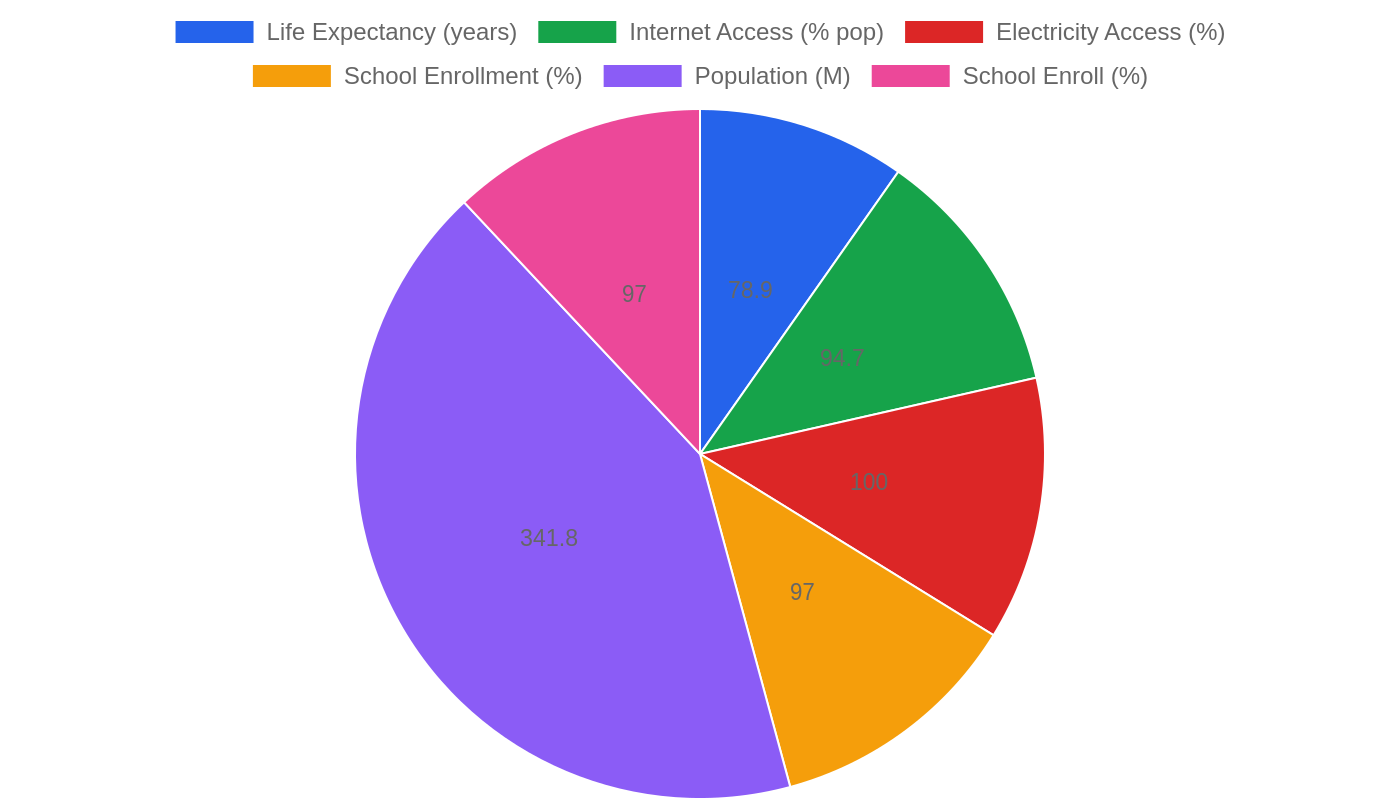
High Standard of Living: With a GNI per capita of $88,810 and a population nearing 342 million, the nation offers significant purchasing power and economic opportunity for its citizens.
Economic Engine: Stability in a Giant Market
The United States economy is currently exhibiting signs of resilient maturity, balancing substantial growth with manageable price pressures. According to World Bank data, the nation’s Gross Domestic Product (GDP) stands at an impressive $30.77 trillion, underscoring its status as the largest or among the largest economies globally.
For 2025, GDP growth is projected at 2.16%, a figure that indicates steady expansion without overheating, suggesting a healthy alignment between production capacity and consumer demand. This growth is supported by a robust labor market, where the unemployment rate sits at 4.198%, reflecting tight labor conditions that typically empower workers while keeping wage inflation in check.
Meanwhile, the Consumer Price Index (CPI) inflation rate is recorded at 2.95%, signaling that monetary policies are effectively curbing excessive price hikes while allowing for normal economic circulation. The sheer scale of this economy is further highlighted by a GDP per capita (PPP) of $90,026.52, which illustrates the high average standard of living and purchasing power available to individuals within this vast market.
These figures collectively paint a picture of an economy that is not just large, but structurally sound, capable of absorbing external shocks while maintaining internal momentum.
Cost of Living: The Premium on American Life
Living in the United States comes with a distinct financial profile characterized by high nominal incomes but also elevated costs across various sectors. While specific housing rent-to-buy ratios are not detailed in the current dataset, the high GDP per capita of $90,026.52 suggests that consumers have significant disposable income relative to many other nations.
However, this purchasing power must be weighed against the national inflation rate of 2.95%, which impacts daily expenses and erodes the value of savings if not managed properly. The GNI per capita of $88,810 provides a strong baseline for household earnings, yet the disparity in cost of living between urban hubs like New York or San Francisco and rural areas remains a critical factor for residents.
Without specific regional breakdowns, it is clear that the aggregate data points to a high-cost environment where wages are competitive but the threshold for maintaining a middle-class lifestyle is steep. Consequently, financial planning for both residents and expatriates requires a nuanced understanding of local market dynamics rather than relying solely on national averages.
Investment & Business Climate: A Landscape of Scale
For investors and business leaders, the United States offers unparalleled access to a massive consumer base and deep capital markets. The country’s federal republic structure, consisting of 50 states and a federal district, creates a complex but unified regulatory environment that can facilitate cross-border trade and domestic commerce alike.
Although specific top companies are not listed in the provided data, the sheer size of the GDP implies the presence of multinational giants driving innovation in technology, finance, and services. The political landscape, described as the world’s oldest surviving federation, provides a degree of institutional continuity that attracts long-term foreign direct investment. Furthermore, the adoption of the U.S.
presidential system by many other states highlights the global confidence in its governance models, which often correlate with stable legal frameworks for business operations. Investors should note that while the crime and safety indices are marked as N/A, the overall economic stability derived from consistent growth and low unemployment reduces systemic risk. The business climate is thus defined by scale, regulatory complexity, and a highly educated workforce contributing to high productivity levels.
Safety, Politics & Quality of Life: The Federal Foundation
The political architecture of the United States is built on a Constitution that serves as the cornerstone of its federal government, asserting sovereignty over its 50 states and five unincorporated territories. This enduring political framework contributes to a sense of national identity and stability, although it also entails intricate checks and balances that can slow rapid policy implementation.
Regarding quality of life, the high GNI per capita of $88,810 correlates with advanced healthcare, education, and infrastructure standards, though these benefits are distributed unevenly across the population. Crime and safety indices are currently listed as N/A, meaning that granular data on public safety varies significantly by locality and is not captured in this broad overview.
Nevertheless, the overall macroeconomic health supports a high level of personal security and social mobility for those who participate in the formal economy. The federal nature of the state allows individual states to tailor certain laws and services, creating diverse living experiences from coast to coast. Ultimately, the political landscape remains a key determinant of future economic direction, with the federal system acting as a buffer against extreme political volatility.
What’s Happening Now: Navigating 2025 Trends
As we look at the current economic trajectory for 2025, the United States is navigating a period of measured growth and inflation control. The GDP growth rate of 2.16% suggests that the economy is avoiding recessionary pitfalls while still expanding at a moderate pace. Inflation, sitting at 2.95%, indicates that central bank policies are likely having their intended effect, bringing prices down from previous highs without stifling consumer spending.
The unemployment rate of 4.198% reflects a labor market that remains resilient, providing steady income streams for millions of households. These indicators suggest that businesses are adapting to new economic realities, focusing on efficiency and innovation rather than aggressive expansion. Policy shifts in recent months appear to be aimed at sustaining this delicate balance, ensuring that growth is inclusive and sustainable.
Observers should watch for any adjustments in fiscal policy that could impact the federal budget and national debt levels, given the scale of the $30.77 trillion GDP. The interplay between political decisions and economic outcomes will remain a focal point for analysts throughout the year.
The Bottom Line
The United States remains a critical destination for investors and a benchmark for global economic health, offering a blend of massive scale and structured stability. Its strong GDP growth, coupled with controlled inflation and low unemployment, presents a favorable environment for long-term strategic positioning. However, the high cost of living and complex federal regulations require careful navigation by both domestic and international actors.
For stakeholders seeking exposure to a mature, high-income market, the U.S. continues to offer compelling opportunities despite the inherent complexities of its size and political structure.
Sources & Methodology
This article is authored by Economic Pulse Net for informational and research purposes. Economic Pulse Net sources its data from multilateral institutions, national statistics bureaus, and proprietary databases. All data is believed to be current as of the date of publication.
Published: October 21, 2026 | Category: Research — United States
Use these signals in your own platform
Economic Pulse publishes its live signal feed through a documented, read-only API. Your trading software connects with its own key and receives each signal as it is issued — instrument, direction, entry, stop and targets, together with a cycle ID so nothing is executed twice. The feed is independent of this website and cannot change it.
Signals are informational only and are not financial advice.