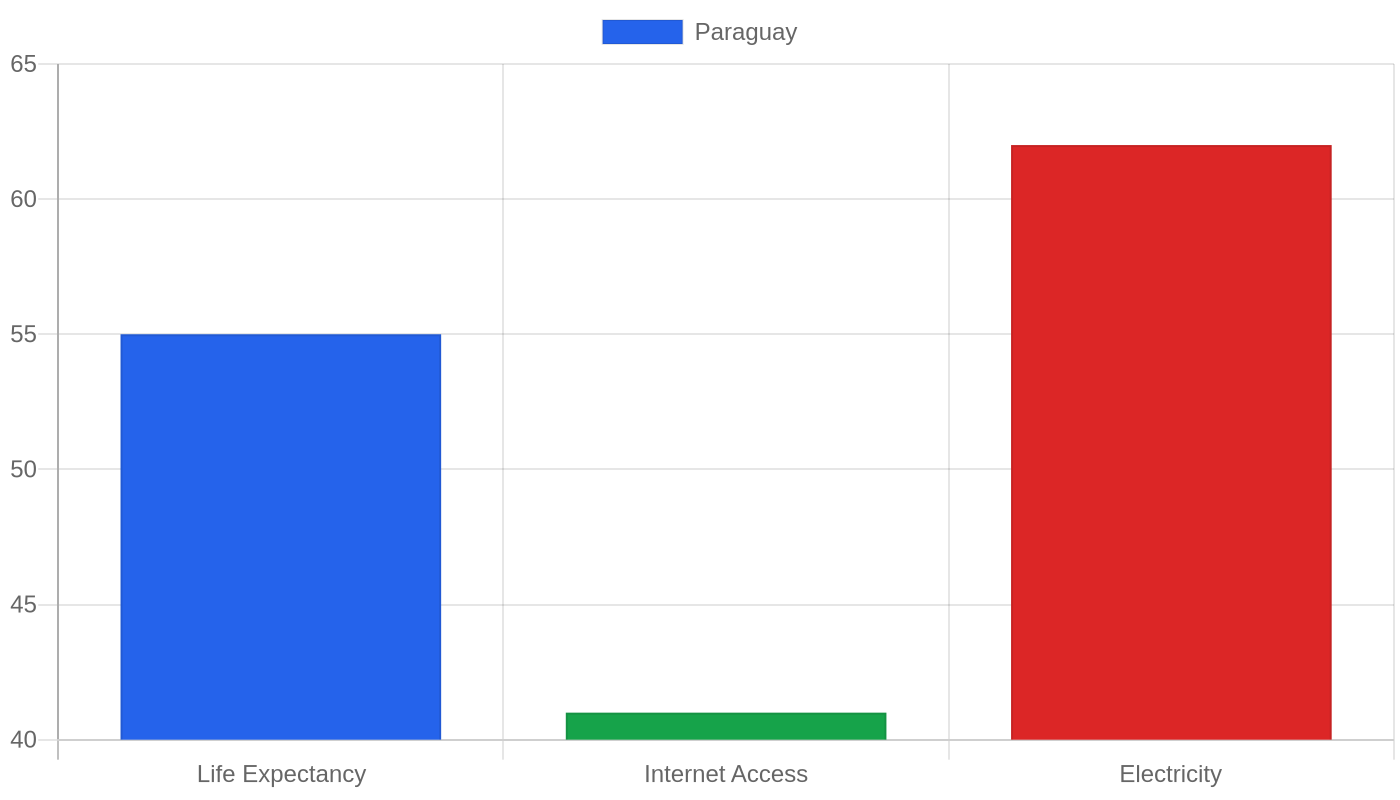
Economic Pulse Net | Sources: World Bank World Development Indicators, Government Sources | 2026
Key Takeaways
– Paraguay operates as a representative democratic republic with a multi-party system and clear separation of powers across executive, legislative, and judicial branches, providing institutional stability that underpins its economic framework.
– The nation’s economic landscape is anchored by a robust financial sector, with institutions like the Central Bank of Paraguay, Banco Amambay, and Banco Itaú Paraguay playing pivotal roles in shaping monetary policy and credit availability.
– Paraguay’s corporate ecosystem spans diverse industries—from media conglomerates like ABC Color and Grupo Cartes to aviation players such as LATAM Paraguay and Paranair—reflecting a maturing, diversified economy.
– The country’s energy sector, dominated by the state-owned ANDE (Administración Nacional de Electricidad), remains a critical pillar for industrial development and regional competitiveness.
– While comprehensive World Bank economic indicators are currently limited, Paraguay’s institutional framework and corporate landscape suggest a nation positioned for steady, sustainable growth in the South American context.
The Economic Engine — Navigating Growth in South America’s Agricultural Heartland
Paraguay’s economic narrative is one of quiet resilience and strategic positioning within South America’s competitive landscape. The World Bank’s data on Paraguay’s GDP growth, inflation, and unemployment figures remain incomplete, yet the country’s economic architecture tells a compelling story of institutional maturity and sectoral diversity.
At the heart of this system sits the Central Bank of Paraguay, which anchors monetary policy and financial stability in a nation that has historically weathered regional economic storms with remarkable steadiness. The financial sector demonstrates particular sophistication, with Banco Itaú Paraguay and Banco Amambay providing commercial banking services that facilitate both domestic investment and international trade flows.
The Bolsa de Valores de Asunción, Paraguay’s stock exchange, represents a developing capital market that offers growing opportunities for corporate financing and investor participation. This financial infrastructure supports a diversified industrial base that extends beyond the country’s famous agricultural exports into services, media, and aviation.
The presence of Aerolíneas Paraguayas, LATAM Paraguay, and Paranair signals an expanding aviation sector that connects this landlocked nation to regional and international markets—a crucial development for a country whose economic fortunes depend heavily on trade access.
Energy infrastructure, managed by the state-owned ANDE, remains the backbone of Paraguay’s industrial potential. The utility’s role in powering manufacturing, agribusiness, and emerging technology sectors cannot be overstated, particularly as the country seeks to add value to its agricultural commodities rather than exporting raw materials alone.
Grupo Cartes, a major conglomerate, exemplifies the diversification trend, with interests spanning multiple sectors and demonstrating how Paraguayan capital is increasingly investing across the economic spectrum. While precise GDP and inflation figures from the World Bank are pending, the structural indicators suggest an economy with solid fundamentals, institutional continuity, and room for expanded international integration.
Living Costs and Housing — The Price of Progress in Asunción and Beyond
Housing and living costs in Paraguay present a nuanced picture that reflects the country’s dual identity as both an emerging market and a nation with deep agricultural roots. While comprehensive cost-of-living indices are not currently available, the structure of Paraguay’s economy provides important context for understanding household economics.
The presence of major financial institutions and a growing corporate sector in Asunción suggests an urban professional class with disposable income, while the country’s agricultural hinterland likely maintains significantly lower living costs relative to the capital.
The rental market in Asunción has historically offered more affordable options compared to regional peers like Buenos Aires or São Paulo, making the city an attractive destination for expatriates and remote workers seeking South American experiences without premium price tags.
Property ownership, supported by a developing mortgage market through banks like Banco Itaú Paraguay, represents an achievable goal for many middle-class Paraguayans—a reality that differs markedly from the housing affordability crises plaguing many larger regional economies. Daily expenses for food, transportation, and utilities generally reflect Paraguay’s status as a lower-middle-income economy, with local markets and public transportation offering budget-conscious options for residents.
The cost of living in Paraguay remains one of its quiet competitive advantages, particularly for attracting foreign investment and skilled workers who find their incomes stretching further than in neighboring countries. However, as the economy modernizes and Asunción’s professional class expands, there are early indications that urban housing costs may be trending upward, particularly in desirable neighborhoods near corporate headquarters and government institutions.
For now, though, Paraguay retains its reputation as a country where a reasonable income can support a comfortable lifestyle, a factor that continues to draw both regional migrants and international businesses seeking cost-effective operational bases.
Investment and Business Climate — Where Capital Finds Opportunity
Paraguay’s investment climate is defined by the presence of established financial institutions, a functioning capital market, and a corporate sector that spans both traditional industries and emerging opportunities. The Central Bank of Paraguay provides the regulatory backbone that gives investors confidence, while the Bolsa de Valores de Asunción offers a venue for capital raising and secondary market trading that continues to develop in sophistication.
For international investors, the presence of Banco Itaú Paraguay—part of one of Latin America’s largest banking groups—signals that global financial players see long-term potential in this market.
The media landscape, anchored by ABC Color and Grupo Cartes, represents both a consolidated industry and a barometer of the country’s broader economic health, as advertising spending and media consumption patterns reflect consumer confidence and business activity. The aviation sector, with carriers like Paranair and LATAM Paraguay, demonstrates the country’s commitment to connectivity and its integration into regional trade and tourism networks.
These companies, alongside utilities provider ANDE, form the backbone of Paraguay’s formal economy and offer entry points for investors seeking exposure to the country’s growth story.
Sectors to watch include agribusiness and food processing, where Paraguay already holds competitive advantages, as well as energy-intensive industries that could benefit from the country’s hydroelectric capacity managed through ANDE. The financial services sector continues to modernize, with opportunities in fintech, insurance, and asset management that remain relatively underdeveloped compared to more mature regional markets.
For businesses considering entry, Paraguay offers the advantages of a stable democratic system, a growing middle class, and geographic positioning at the crossroads of South America’s most important trade routes—though investors should remain mindful of the infrastructure gaps and bureaucratic challenges that still characterize parts of the business environment.
Safety, Politics and Quality of Life — Stability in a Turbulent Region
Paraguay’s political landscape, as described in the available data, is that of a representative democratic republic with a multi-party system and clear separation of powers across executive, legislative, and judicial branches. This institutional framework provides a degree of political stability that distinguishes Paraguay within a region that has experienced significant political volatility in recent years.
The President serves as both head of state and head of government, wielding executive power, while the National Congress’s two chambers handle legislative responsibilities and a nine-member Supreme Court of Justice leads an independent judiciary—a structure designed to provide checks and balances on state power.
The independence of Paraguay’s judiciary from executive and legislative influence represents a critical foundation for both political rights and economic development, as contract enforcement and property rights protections depend on a functioning legal system. This institutional stability, while not without its challenges, offers citizens and businesses a predictable environment for planning and investment.
The multi-party system ensures political competition and provides avenues for peaceful transfers of power, contributing to the country’s overall social stability.
While comprehensive crime and safety indices are not currently available, Paraguay’s quality of life is shaped by its economic realities and social structures. The country offers a relaxed pace of life, strong family and community networks, and access to natural beauty that ranges from the Paraná River to the Chaco region. The growing professional class in Asunción enjoys cultural amenities, dining, and entertainment options that continue to expand alongside economic development.
For those considering relocation or extended stays, Paraguay offers the appeal of a country that is developing rapidly while still maintaining the warmth and accessibility that larger, more industrialized nations often lose in the process of modernization.
Current Affairs — Paraguay’s Moment of Economic Reckoning
Paraguay stands at a pivotal moment in its economic trajectory, with developments across multiple sectors signaling both challenges and opportunities for the year ahead. The financial sector continues to evolve, with the Central Bank of Paraguay maintaining its role as the guardian of monetary stability while commercial banks like Banco Amambay and Banco Itaú Paraguay expand their product offerings and digital capabilities to serve an increasingly sophisticated customer base.
The Bolsa de Valores de Asunción is working to deepen the capital markets, attracting both domestic and international listings that could provide new avenues for corporate growth and investor participation.
In the aviation sector, Paranair and LATAM Paraguay are navigating the post-pandemic recovery, working to rebuild route networks and passenger volumes while managing fuel costs and competitive pressures from regional carriers.
The energy sector, under ANDE’s stewardship, faces the dual challenge of maintaining aging infrastructure while expanding capacity to meet growing industrial and residential demand—a balancing act that will shape Paraguay’s ability to attract energy-intensive industries in the coming years.
The media landscape, represented by ABC Color and Grupo Cartes, continues to adapt to digital disruption, with traditional print and broadcast models giving way to online platforms and new content consumption patterns. These transitions occur against a backdrop of ongoing political discourse within Paraguay’s democratic institutions, where debates over economic policy, infrastructure investment, and social programs reflect the country’s aspirations for inclusive growth.
As Paraguay looks outward, its businesses and policymakers are increasingly focused on expanding trade relationships and attracting foreign investment that can accelerate the country’s development—making the current period one of strategic positioning for the nation’s economic future.
The Bottom Line
Paraguay represents one of South America’s most intriguing investment and development stories—a country with stable democratic institutions, a growing corporate sector, and strategic positioning within regional trade networks. The presence of established financial institutions, a functioning capital market, and diversified industries from media to aviation indicates an economy with genuine structural depth beyond its agricultural heritage.
For investors seeking exposure to South American growth outside the region’s larger, more volatile markets, Paraguay offers a compelling combination of stability and potential. Similarly, businesses considering regional expansion and individuals seeking an affordable, safe base in South America should keep a close watch on this often-overlooked nation as it continues its quiet ascent.
Sources & Methodology
This article is authored by Economic Pulse Net for informational and research purposes. Economic Pulse Net sources its data from multilateral institutions, national statistics bureaus, and proprietary databases. All data is believed to be current as of the date of publication.
Published: August 09, 2026 | Category: Research — Paraguay
Use these signals in your own platform
Economic Pulse publishes its live signal feed through a documented, read-only API. Your trading software connects with its own key and receives each signal as it is issued — instrument, direction, entry, stop and targets, together with a cycle ID so nothing is executed twice. The feed is independent of this website and cannot change it.
Signals are informational only and are not financial advice.