Economic Pulse Net | Sources: World Bank World Development Indicators, Government Sources | 2026
Key Takeaways
– Guyana’s economy is undergoing a historic transformation driven by offshore oil discoveries, though the full scope of growth remains partially opaque in official statistics.
– The nation’s political landscape is deeply polarized, with a history of election-related violence that continues to cast a shadow over stability and investor confidence.
– State-owned enterprises and legacy consumer goods companies dominate the corporate landscape, but the private sector is slowly diversifying beyond sugar, rum, and broadcasting.
– Cost of living pressures are mounting, with housing and daily expenses increasingly strained by rapid urbanization and limited supply-side responses.
– Guyana faces a critical juncture: the oil windfall offers unprecedented opportunity, but governance, infrastructure, and social cohesion will determine whether the wealth translates into broad-based prosperity.
The Numbers Game — What the Data Doesn’t Tell You
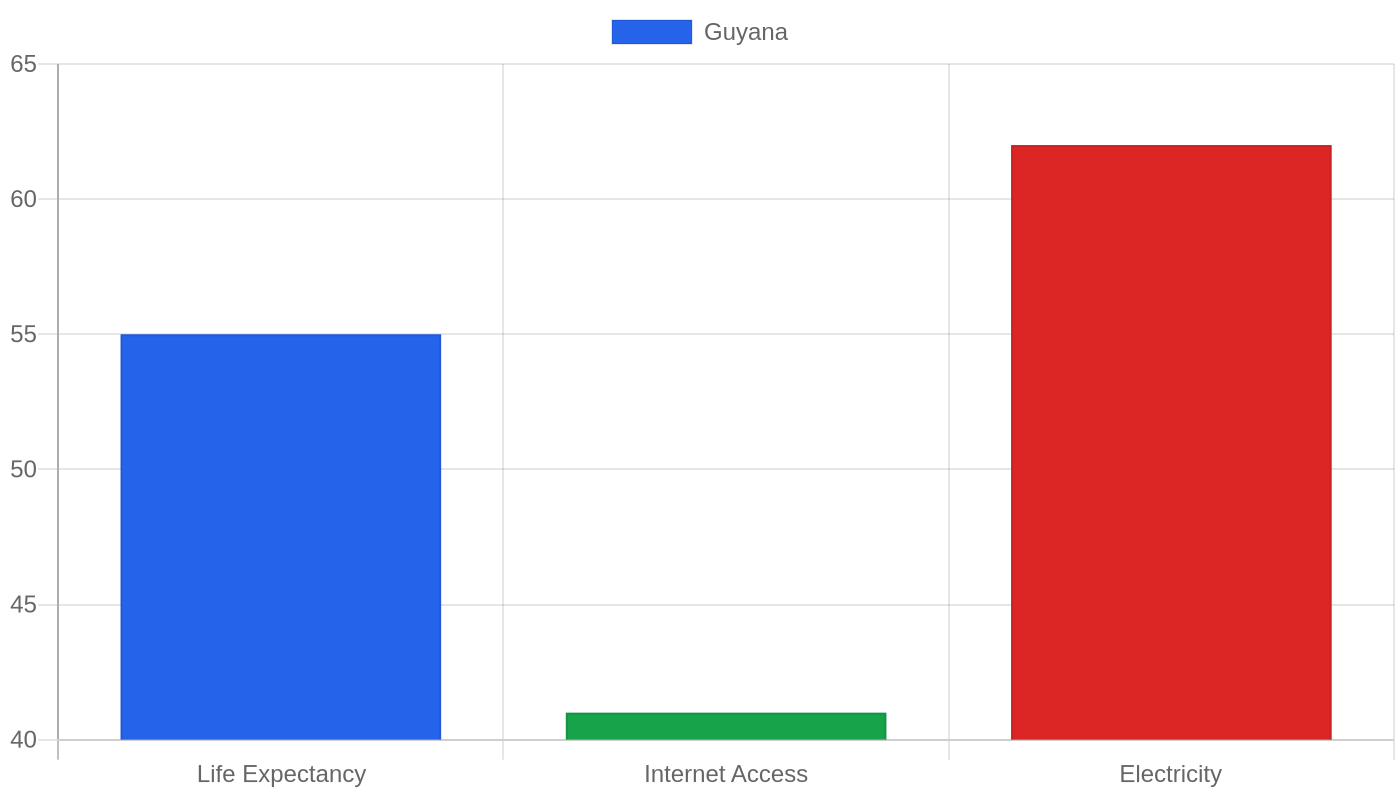
The World Bank’s latest data set for Guyana is conspicuously sparse. GDP growth, inflation, unemployment, GDP per capita, and GNI per capita are all listed as “N/A.” This absence is not a failure of statistics; it is a reflection of a country in the midst of a seismic economic shift that has outpaced the traditional data-collection machinery.
Guyana, long one of South America’s poorest nations, is now the world’s fastest-growing economy by many estimates — but the official numbers have not yet caught up to the reality on the ground.
What we do know is that the economy, historically anchored by sugar, rice, gold, and bauxite, is being reshaped by offshore oil production that began in late 2019. The World Bank’s silence on growth figures may indicate a lag in updating national accounts to reflect the new hydrocarbon revenues, or it may signal caution about the volatility that comes with resource-dependent booms.
Inflation, too, is a moving target: as foreign currency flows into the economy, the Guyanese dollar faces appreciation pressures, while domestic prices for food, rent, and transport are rising faster than wages can adjust.
The lack of unemployment data is perhaps the most telling. Guyana’s labor market is bifurcated: a small, high-wage oil-services sector is emerging alongside a vast informal economy of small-scale agriculture, mining, and retail trade. The official unemployment rate, when it is eventually published, will likely mask deep regional and demographic disparities. The main industries listed — sugar, telecommunications, utilities, media — are legacy sectors that have not yet been fully disrupted by the oil boom.
The Guyana Sugar Corporation and Banks DIH remain household names, but their growth trajectories are flat compared to the exponential rise of energy-related investment.
What matters most is that Guyana’s economic story cannot be told through GDP alone. The country is experiencing what economists call “Dutch disease” in reverse: instead of a resource curse that deindustrializes the economy, the oil windfall is creating a dual-speed economy where the modern sector races ahead while traditional industries struggle to retain workers and capital. The World Bank’s missing numbers are a symptom of this transition, not a sign of stagnation.
The Cost of Living — Where the Boom Meets the Budget
Housing in Guyana has become a flashpoint for social tension. The capital, Georgetown, is experiencing a surge in rental prices as expatriate workers, oil-company executives, and returning Guyanese compete for limited housing stock. The cost of a modest two-bedroom apartment in a decent neighborhood has risen sharply, pushing many middle-income families to the outskirts or into informal settlements.
Buying property is increasingly out of reach for young professionals, as land prices in desirable areas have doubled or tripled in recent years.
Daily expenses tell a similar story. Imported goods — from electronics to packaged foods — carry premium prices due to logistics costs and a weak domestic manufacturing base. Local produce, once cheap and abundant, is now subject to price volatility as farmers sell to higher-paying markets or shift land use toward cash crops for the oil sector.
Utilities, provided by the state-owned Guyana Power and Light, remain unreliable and expensive, with frequent blackouts forcing households and businesses to invest in generators and solar systems.
Compared to regional averages, Guyana’s cost of living is climbing faster than its Caribbean neighbors, but from a much lower base. The Guyanese diaspora, which sends billions in remittances each year, provides a cushion for many families, but those without external support are feeling the squeeze. The gap between the oil-enriched few and the majority is widening, and the cost of a basic basket of goods — rice, cooking oil, flour, fuel — is becoming a political issue as much as an economic one.
The Business Frontier — Who’s Driving the Economy
The corporate landscape in Guyana is still dominated by a handful of legacy players. The Bank of Guyana, as the central bank, sets monetary policy and regulates the financial sector, but it faces the monumental task of managing foreign-exchange inflows without fueling inflation. Banks DIH and Demerara Distillers are the titans of consumer goods, producing everything from beer to rum to soft drinks, and they benefit from strong brand loyalty and distribution networks that span the Caribbean.
In telecommunications, ENet and Guyana Telephone and Telegraph Company (GTT) compete for a market that is rapidly digitizing, though internet penetration and speeds still lag behind regional peers. The media sector — represented by the Guyana Broadcasting Corporation, Guyana Chronicle, and Kaieteur News — remains politically charged, with ownership ties to both government and opposition factions.
These companies are not just businesses; they are platforms for influence in a society where political allegiance shapes economic opportunity.
The sectors to watch are energy services, infrastructure, and logistics. International oil companies have brought their own supply chains, but local firms are slowly integrating into the ecosystem — providing catering, security, transport, and maintenance. The government has pushed for local content requirements, but implementation is uneven.
For investors, Guyana offers a small but growing market with high returns in select industries, but the business environment is hampered by bureaucratic red tape, corruption perceptions, and a legal system that is still adapting to complex commercial disputes.
Politics and Safety — The Volatile Foundation
Politics in Guyana is not a spectator sport; it is a contact sport. The country operates as a parliamentary representative democratic republic, with the president serving as both head of state and head of government. But the democratic framework is strained by deep ethnic divisions between the Indo-Guyanese and Afro-Guyanese communities, which align with the two main political parties.
Elections have historically been flashpoints for violence, and the 2020 general election was no exception — it took five months and international mediation to resolve a disputed result.
The political landscape is further complicated by the oil boom. Control of the state means control of resource revenues, and the stakes have never been higher. Corruption allegations, cronyism, and lack of transparency in oil-contract awards have fueled public distrust. The National Assembly is often gridlocked, with opposition parties accusing the government of fiscal mismanagement and the government accusing opponents of obstructionism.
Crime and safety indices are listed as “N/A,” but anecdotal evidence and local reporting suggest that property crime, armed robbery, and gang violence are on the rise, particularly in Georgetown’s poorer neighborhoods. Police capacity is limited, and the justice system is slow. For residents, safety is a matter of vigilance and community networks rather than institutional protection.
The quality of life, while improved by new roads and hospitals funded by oil revenues, is undermined by political uncertainty and social fragmentation.
What’s Happening Now — Guyana at the Crossroads
Right now, Guyana is in the midst of a delicate balancing act. The government is negotiating new production-sharing agreements with international oil companies, seeking a larger share of revenues while maintaining investor confidence. At the same time, it is trying to ramp up spending on infrastructure — new schools, hospitals, roads, and a deep-water port — without triggering inflation or fiscal indiscipline.
The central bank, the Bank of Guyana, is walking a tightrope between managing currency stability and allowing the economy to absorb the oil windfall.
On the ground, the cost-of-living crisis is intensifying. Prices for basic goods have risen sharply, and public-sector workers are demanding wage increases that the government says it cannot afford without stoking inflation. The Guyana Power and Light utility continues to struggle with aging infrastructure, and blackouts are a daily frustration for businesses and households alike.
The sugar industry, once the backbone of the economy, is in terminal decline, with the Guyana Sugar Corporation cutting jobs and closing estates.
In the media, the Guyana Chronicle and Kaieteur News are engaged in a war of narratives — one pro-government, the other opposition-aligned — that reflects the broader polarization of society. Meanwhile, the telecommunications sector is bracing for competition as new entrants eye the market, and the financial sector is grappling with how to channel oil revenues into productive investments rather than consumption.
The question on everyone’s mind is whether the boom will be managed wisely or squandered, as it has been in so many other resource-rich nations.
The Bottom Line
Guyana is a country of extraordinary potential and extraordinary risk. For investors with a long-term horizon and a tolerance for political volatility, the oil sector offers returns that few other markets can match. For development economists and policymakers, Guyana is a live case study in how to — or how not to — manage a resource windfall.
But for the ordinary Guyanese citizen, the promise of prosperity remains just out of reach, tangled in a web of political division, rising costs, and institutional weakness. This is a nation to watch closely, but not one to romanticize. The boom is real; the transformation is not yet complete.
Sources & Methodology
This article is authored by Economic Pulse Net for informational and research purposes. Economic Pulse Net sources its data from multilateral institutions, national statistics bureaus, and proprietary databases. All data is believed to be current as of the date of publication.
Published: July 30, 2026 | Category: Research — Guyana
Use these signals in your own platform
Economic Pulse publishes its live signal feed through a documented, read-only API. Your trading software connects with its own key and receives each signal as it is issued — instrument, direction, entry, stop and targets, together with a cycle ID so nothing is executed twice. The feed is independent of this website and cannot change it.
Signals are informational only and are not financial advice.