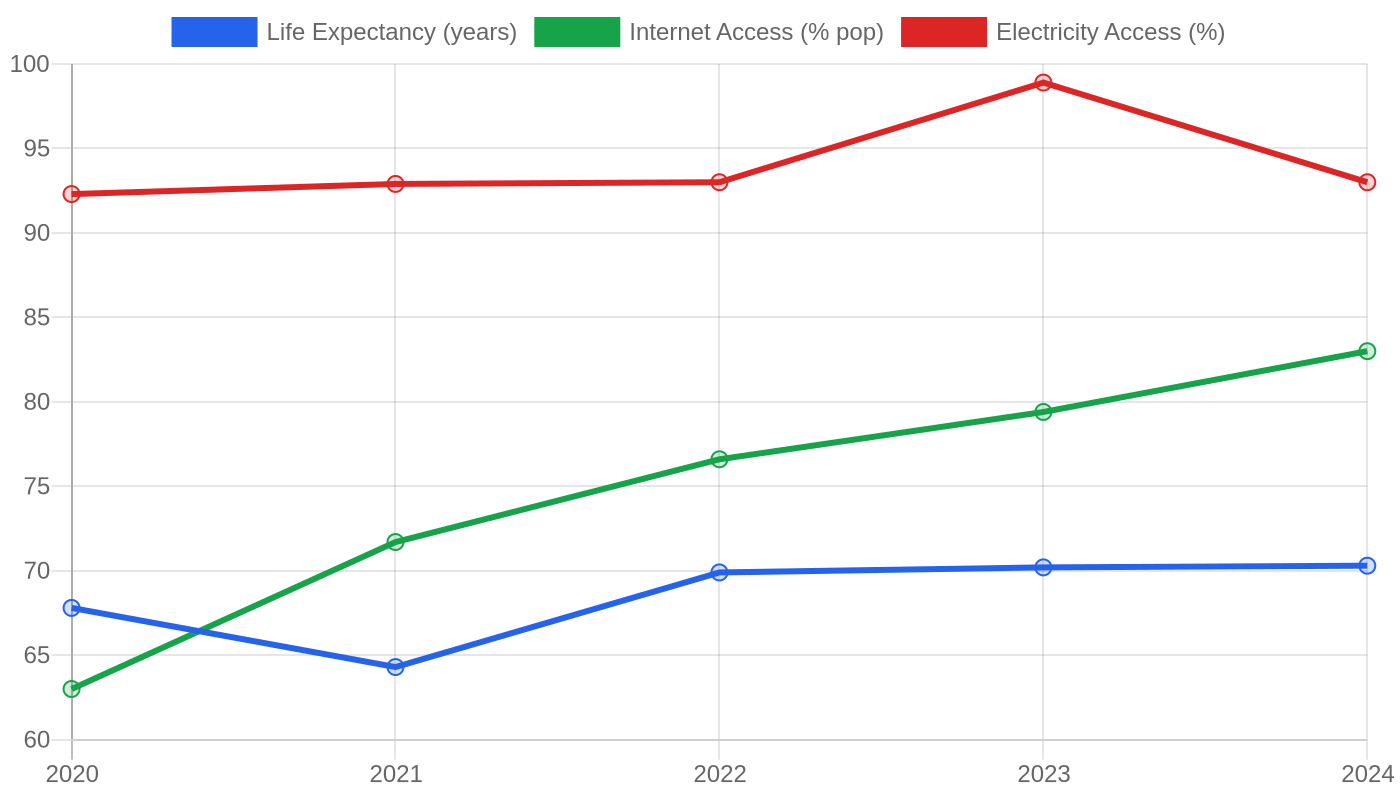
Economic Pulse Net | Sources: World Bank World Development Indicators, Government Sources | 2026
Key Takeaways
– Guyana is undergoing one of the most dramatic economic transformations in the Western Hemisphere, driven by massive offshore oil discoveries, yet the benefits remain unevenly distributed.
– The country’s political landscape remains deeply polarized, with historical election-related violence casting a shadow over its democratic institutions.
– Traditional industries like sugar and rum continue to operate alongside a booming energy sector, creating a dual economy with distinct winners and losers.
– Cost of living pressures are mounting even as GDP figures surge, raising questions about whether ordinary Guyanese are feeling the promised prosperity.
– Infrastructure and utilities remain significant bottlenecks, with state-owned enterprises like Guyana Power and Light struggling to keep pace with rapid change.
The Great Oil Gamble — Growth Without Guarantees
The economic story of Guyana is one of staggering potential and profound uncertainty. According to data from the World Bank, the country’s GDP growth figures are not currently available in standardised form, but the narrative on the ground is unmistakable: this is an economy in hyper-drive. The discovery of vast offshore oil reserves has transformed what was once one of South America’s poorest nations into a frontier of global energy investment.
Yet the World Bank’s absence of updated inflation and unemployment data tells its own story — the statistical infrastructure has not kept pace with the economic revolution.
What makes Guyana’s situation unique is the coexistence of a pre-industrial agricultural sector with a cutting-edge hydrocarbon industry. The main industries listed in the data — sugar, rum, telecommunications, utilities — represent the old economy, the one that employed the majority of Guyanese before oil. The Guyana Sugar Corporation, a state-owned behemoth, still operates as a major employer and consumer goods producer, even as its global competitiveness has been challenged for decades.
Meanwhile, Demerara Distillers and Banks DIH continue to produce for domestic and export markets, representing the resilient face of traditional manufacturing.
The macroeconomic challenge is clear: how do you manage Dutch disease — the phenomenon where a resource boom drives up the currency and destroys other export industries — while ensuring that oil revenues translate into broad-based development? The World Bank’s data gaps suggest that even basic economic monitoring is struggling to keep up with the speed of change.
Inflation pressures are widely reported anecdotally, particularly in housing and imported goods, even if the official CPI figures are not captured in the available data. The unemployment rate, also absent from the World Bank dataset, is likely to be a political hot potato — with job creation in the oil sector highly skilled and capital-intensive, while traditional sectors shed labour.
The Housing Crunch — Where Oil Money Meets Reality
The cost of living in Guyana has become a defining political and social issue, even without precise data points from the World Bank. Housing, in particular, has emerged as a flashpoint. The influx of expatriate workers, consultants, and oil industry personnel has driven up rental prices in Georgetown and other urban centres to levels that would be considered steep even by Caribbean standards.
For ordinary Guyanese, the dream of homeownership is slipping further away, as construction costs rise and land prices in desirable areas skyrocket.
The rent-versus-buy calculation has shifted dramatically. While mortgage rates are not specified in the available data, the anecdotal evidence from local media coverage suggests that financing has become more accessible for those with connections to the oil economy, but more difficult for everyone else. Daily expenses — food, transportation, utilities — have all risen, partly due to global inflation and partly due to local demand pressures created by the oil boom.
The Guyana Power and Light company, a state-owned utility, continues to struggle with reliability issues, meaning many households and businesses must invest in generators, adding another layer to the cost of living.
Comparatively, Guyana’s cost of living is now converging with other Caribbean nations that have long been more expensive, such as Barbados and Trinidad and Tobago. But the crucial difference is that those countries have established social safety nets and more diversified economies. In Guyana, the rapid increase in prices has not been matched by a corresponding rise in wages for the majority of workers outside the oil sector.
The result is a growing sense of inequality, visible in the contrast between new luxury housing developments and the persistent inadequacy of public infrastructure.
Business on the Boil — Who Wins in the New Guyana?
The corporate landscape of Guyana is a study in contrasts, as revealed by the list of top companies. On one side stand the traditional giants: Banks DIH, Demerara Distillers, and the Guyana Sugar Corporation, all deeply rooted in the country’s history and identity. On the other side are the utilities and telecommunications firms — Guyana Power and Light, Guyana Telephone and Telegraph Company, ENet — which represent the backbone of modernisation but are often criticised for poor service and high costs.
The Bank of Guyana, the central bank, sits at the centre of this ecosystem, tasked with managing monetary policy in an environment of unprecedented capital inflows.
For investors, the business climate is a tale of two Guyanas. The oil and gas sector offers extraordinary returns for those with the capital and connections to participate. But for small and medium enterprises, the environment remains challenging. Infrastructure bottlenecks, an unreliable power grid, and a shortage of skilled labour are persistent complaints.
The telecommunications sector, dominated by Guyana Telephone and Telegraph and ENet, has seen some liberalisation but still lags behind regional peers in terms of speed and affordability.
The sectors to watch are those that support the oil industry — logistics, construction, hospitality, and professional services — as well as those that might benefit from downstream processing. There is also growing interest in agribusiness, as investors look to modernise the sugar and rice sectors to supply the new population of high-income consumers. However, the dominance of state-owned enterprises in utilities and key industries creates a mixed picture for private sector development.
The government remains heavily involved in the economy, and navigating the regulatory environment requires patience and local knowledge.
Politics, Polarisation, and the Price of Peace
The political landscape of Guyana, as described in the data, operates within a framework of a parliamentary representative democratic republic, where the president serves as both head of state and head of government in a multi-party system. But the dry institutional description belies a much more volatile reality.
The data explicitly notes that “historically, politics is a source of tension in the country, and violent riots have often broken out during elections.” This is not a minor footnote — it is the central political fact of modern Guyana.
The ethnic divide between the Indo-Guyanese and Afro-Guyanese communities has historically mapped onto party affiliation, with the People’s Progressive Party (PPP) drawing support primarily from the Indo-Guyanese population and the People’s National Congress Reform (PNCR) from the Afro-Guyanese community. This cleavage has made every election a zero-sum contest, and the discovery of oil has raised the stakes exponentially.
Control of the state means control of oil revenues, and the losing side fears permanent marginalisation.
The crime and safety indices are not available in the data, but the political context provides a framework for understanding public safety concerns. Election periods are particularly tense, and the security forces have at times been accused of partisanship. For the average citizen, quality of life is shaped not just by economic conditions but by this underlying political uncertainty. The promise of oil wealth has not yet translated into a social contract that feels stable or inclusive.
Trust in institutions remains fragile, and the capacity of the state to deliver services is uneven.
Current Affairs — The Pulse Right Now
This is the moment of truth for Guyana. The oil boom is no longer theoretical — production is ramping up, revenues are flowing, and the government is under immense pressure to show results. The Bank of Guyana is grappling with the challenge of managing foreign exchange inflows without causing excessive appreciation of the currency, which would damage the non-oil export sector.
Inflation remains a persistent concern, even if official figures are not captured in the available data, as the cost of basic goods continues to climb.
In the political arena, the government is pursuing an ambitious infrastructure agenda, but implementation has been slow. The Guyana Power and Light company remains a weak link, with blackouts and high costs constraining economic activity. There are ongoing debates about how to use the oil revenues — whether to invest in physical infrastructure, human capital, or a sovereign wealth fund for future generations.
The telecommunications sector is seeing gradual liberalisation, with ENet and others pushing for more competition, but the incumbent Guyana Telephone and Telegraph Company remains dominant.
The sugar industry, long a symbol of Guyana’s colonial past and post-colonial struggles, continues its decline. The Guyana Sugar Corporation has been restructured and downsized, but the social consequences are severe in rural communities that depended on the industry. Meanwhile, the construction sector is booming, driven by both oil-related investment and a surge in housing demand.
The question on everyone’s mind is whether this boom can be sustained and whether its benefits can be spread beyond the narrow circle of those directly connected to the oil industry.
The Bottom Line
Guyana is a country of extraordinary opportunity and profound risk. For energy investors and commodity traders, it represents one of the last great frontier markets. For development economists and political risk analysts, it is a laboratory for the challenges of managing resource wealth in a fragile democracy.
The ordinary Guyanese citizen, however, is living through a moment of both hope and anxiety — watching their country transform before their eyes, but wondering whether the promised prosperity will ever reach their doorstep. This is a nation to watch closely, not just for its oil, but for the test it represents of whether natural resource wealth can truly be a blessing rather than a curse.
Sources & Methodology
This article is authored by Economic Pulse Net for informational and research purposes. Economic Pulse Net sources its data from multilateral institutions, national statistics bureaus, and proprietary databases. All data is believed to be current as of the date of publication.
Published: July 22, 2026 | Category: Research — Guyana
Use these signals in your own platform
Economic Pulse publishes its live signal feed through a documented, read-only API. Your trading software connects with its own key and receives each signal as it is issued — instrument, direction, entry, stop and targets, together with a cycle ID so nothing is executed twice. The feed is independent of this website and cannot change it.
Signals are informational only and are not financial advice.