Economic Pulse Net | Sources: World Bank World Development Indicators, Government Sources | 2026
Key Takeaways
* Resilient but Slowing Growth: Chile’s economy is projected to expand by approximately 2.46% in 2025, a moderate pace that reflects both structural stability and lingering headwinds.
Inflationary Pressures Persist: With the Consumer Price Index (CPI) hovering around 4.21%, the central bank faces an ongoing challenge in balancing price stability with economic recovery.
Labor Market Tightness: An unemployment rate of nearly 9% suggests a labor market that is recovering but has not yet returned to full efficiency, impacting consumer confidence.
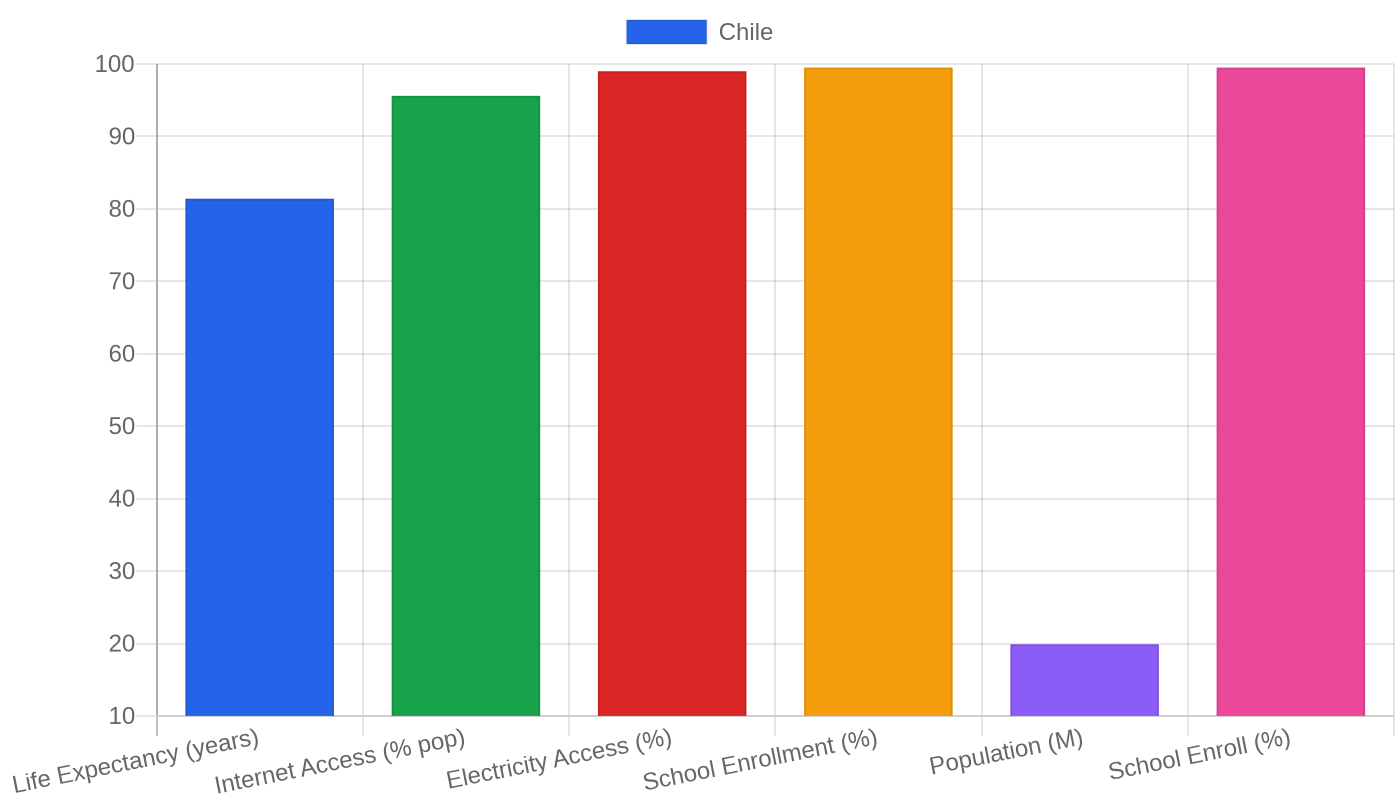
Wealth Disparity Visible: A stark contrast exists between high GDP per capita PPP figures ($37,774) and lower GNI per capita ($16,960), highlighting significant distributional challenges within the population of roughly 19.8 million.
Economic Pulse: Navigating Moderate Expansion
Chile’s economic trajectory in 2025 presents a complex picture of modest expansion amidst broader global uncertainties. According to World Bank data, the nation’s Gross Domestic Product (GDP) is expected to grow by 2.459% this year, a figure that underscores a cautious optimism rather than a boom. This growth is underpinned by a substantial total GDP of approximately $357.37 billion USD, reflecting the country’s status as one of South America’s more developed economies.
However, the velocity of this growth is tempered by inflationary pressures; the CPI stands at 4.21%, indicating that while prices are stabilizing compared to peak crisis years, purchasing power remains under strain for average households. The labor market offers a mixed signal: while unemployment sits at 8.974%, suggesting that job creation is outpacing labor force participation slightly, it also points to a segment of the workforce still excluded from formal employment opportunities.
These metrics matter because they reveal an economy that is no longer relying solely on commodity exports but is attempting to diversify, even as it manages the social costs of transition. The disparity between GDP per capita PPP of $37,774 and GNI per capita of $16,960 further illustrates that national wealth is not uniformly distributed, requiring policymakers to focus on inclusive growth strategies rather than aggregate totals alone.
Living Standards: The Cost of Daily Life
For residents and investors alike, understanding the cost of living in Chile requires looking beyond headline inflation numbers to the tangible realities of housing and daily expenses. While specific rental indices are not provided in the current dataset, the overall CPI of 4.21% suggests that essential goods and services are becoming progressively more expensive, eroding the real value of wages.
With a population of nearly 19.86 million people concentrated in urban centers like Santiago, demand for housing remains high, likely keeping property prices resilient despite economic slowdowns. For expatriates or remote workers, the high GDP per capita PPP indicates that Chile offers a relatively high standard of living compared to many regional peers, provided income levels match local benchmarks.
However, the gap between nominal GDP figures and actual GNI per capita implies that the “middle-class” experience may be increasingly fragile, with everyday expenses consuming a larger share of household budgets. Investors should note that while the macroeconomic environment supports a robust consumer sector, micro-level affordability issues could dampen discretionary spending in the near term.
Investment & Business Climate: Corporate Powerhouses
Chile’s business landscape is dominated by a mix of industrial giants and specialized service providers, creating a diversified ecosystem for potential investment. The corporate registry highlights key players such as Antofagasta PLC in basic materials, which continues to leverage Chile’s rich mineral resources, and Agrosuper in consumer goods, reflecting the strength of the agricultural export sector.
In the technology space, companies like ACE Team and AmnesiaGames are emerging, signaling a gradual shift toward digital innovation and software development alongside traditional industries. The consumer services sector is particularly vibrant, with entities like Aerocardal, AeroEjecutiva, and Aerovías DAP playing crucial roles in logistics and aviation support. Additionally, conglomerates like AntarChile and utilities provider AES Andes form the backbone of domestic infrastructure and energy supply.
This concentration of major companies suggests that foreign direct investment might find fertile ground in sectors ranging from renewable energy to tech-enabled logistics. However, the dominance of established firms means that new entrants must navigate a competitive market where scale and legacy relationships matter significantly.
Safety, Politics & Quality of Life: The Constitutional Shadow
The quality of life in Chile is deeply intertwined with its political history and current safety perceptions. While crime and safety indices are currently listed as N/A, the broader political landscape reveals a nation grappling with its past. The current Constitution, drafted by Jaime Guzmán in 1980 under Augusto Pinochet’s dictatorship, remains a foundational but contentious document.
Although amended after Pinochet’s defeat in the 1988 plebiscite and further revised under President Ricardo Lagos in 2005, its origins have fueled ongoing debates about democratic legitimacy and social equity. This historical baggage influences public trust in institutions and shapes policy responses to inequality.
For citizens, the interplay between political stability and social unrest is critical; while the rule of law is generally upheld, the push for constitutional reform reflects deep-seated desires for a more equitable social contract. Consequently, businesses and individuals must remain attuned to political developments, as shifts in governance can rapidly alter regulatory environments and social expectations.
What’s Happening Now: Policy Shifts and Institutional Evolution
Currently, Chile is navigating a period of institutional recalibration as it seeks to modernize its foundational legal framework. The recent news regarding the 2005 amendments signed by President Ricardo Lagos highlights a continuous effort to democratize the constitution, though the process is far from complete. With inflation holding steady at 4.21%, monetary policy remains focused on anchoring expectations without stifling the 2.46% GDP growth.
Labor markets are slowly absorbing shocks, with unemployment edging down toward 8.97%, allowing for gradual improvements in household financial health. Meanwhile, the corporate sector is adapting to these macro conditions, with tech firms like ACE Team expanding their footprint in the digital economy. These dynamics suggest a government balancing fiscal responsibility with social demands, aiming to stabilize the economy while addressing long-standing structural inequalities.
The coming months will likely see continued dialogue on constitutional reforms, which could reshape tax policies, labor rights, and environmental regulations.
The Bottom Line
Chile represents a compelling case study in managed economic transition, offering stability through strong institutional frameworks despite historical complexities. Investors should watch this country for opportunities in mining, agriculture, and emerging tech sectors, where established companies provide a platform for growth. However, the persistent inflation and unemployment rates indicate that short-term volatility remains a risk.
Ultimately, Chile is best suited for long-term stakeholders who understand the nuanced relationship between its economic output and its evolving social contract.
Sources & Methodology
This article is authored by Economic Pulse Net for informational and research purposes. Economic Pulse Net sources its data from multilateral institutions, national statistics bureaus, and proprietary databases. All data is believed to be current as of the date of publication.
Published: October 26, 2026 | Category: Research — Chile
Use these signals in your own platform
Economic Pulse publishes its live signal feed through a documented, read-only API. Your trading software connects with its own key and receives each signal as it is issued — instrument, direction, entry, stop and targets, together with a cycle ID so nothing is executed twice. The feed is independent of this website and cannot change it.
Signals are informational only and are not financial advice.