Economic Pulse Net | Sources: World Bank World Development Indicators, Government Sources | 2026
Key Takeaways
* Political Continuity and Change: The nation is navigating a post-Nazarbayev era under President Kassym-Jomart Tokayev, maintaining its status as a secular, constitutional unitary republic while shifting leadership dynamics.
Resource-Driven Economy: The industrial backbone remains heavily anchored in basic materials, with major players like Kazakhmys and Bogatyr Access Komir driving the sector alongside significant energy infrastructure.
Financial and Service Sector Growth: A robust financial landscape featuring Halyk Bank and BTA Bank supports a growing consumer services industry, highlighted by key airlines such as Air Astana.
Governance Structure: The executive branch holds substantial power, with the president serving as commander-in-chief and possessing veto authority over parliamentary legislation, balanced by a cabinet led by the prime minister.
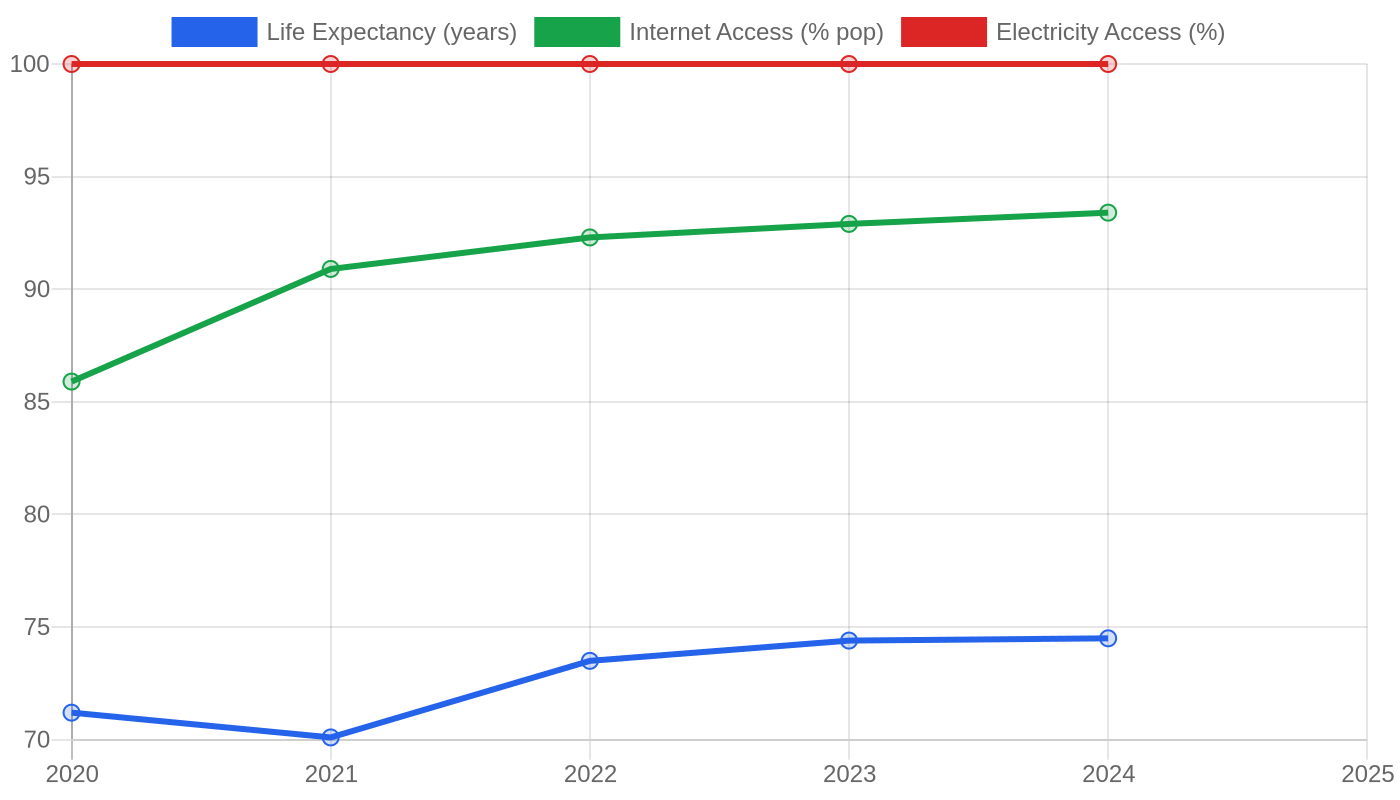
Data Transparency Gaps: While specific macroeconomic indicators like GDP growth and inflation rates are currently unreported in latest datasets, the structural composition of the economy points to a stable, albeit opaque, resource-based model.
The Pillars of a Resource-Based Economy
Kazakhstan’s economic identity is fundamentally tied to its vast natural resources, creating a landscape where industrial output often overshadows broader macroeconomic metrics in public discourse. Although specific figures for GDP growth, inflation, and unemployment are not currently available from the World Bank, the structure of the country’s main industries reveals a clear dependency on extractive and utility sectors.
Companies such as Bogatyr Access Komir and KazakhGold dominate the basic materials space, indicating that mining and metallurgy remain the primary engines of national wealth generation. This industrial focus is complemented by critical energy infrastructure, exemplified by the Ekibastuz GRES-2 Power Station, which underscores the state’s reliance on utilities to sustain both domestic consumption and export capabilities.
The absence of precise GDP per capita or population data makes it difficult to assess individual prosperity levels, yet the prominence of these heavy industries suggests an economy that is capital-intensive rather than labor-intensive. Consequently, economic stability is likely more correlated with global commodity prices than with domestic consumer spending trends.
Understanding this dynamic is crucial for investors, as the health of the Kazakh economy is inextricably linked to the performance of its mining and energy giants rather than a diversified service-led growth model.
Cost of Living and Housing Dynamics
Assessing the daily economic reality for residents and expatriates in Kazakhstan requires looking beyond headline inflation numbers, which are currently listed as unavailable. Without specific CPI data or cost-of-living indices, it is challenging to determine whether housing costs are rising or stabilizing relative to regional averages.
However, the presence of established financial institutions like Halyk Bank and Eurasian Bank suggests a developed banking sector that facilitates mortgage lending and consumer credit, implying a functional real estate market. For those considering relocation or investment, the lack of transparent safety indices and crime data adds a layer of uncertainty to quality-of-life assessments, making personal due diligence essential.
Generally, in economies driven by resource exports, urban centers tend to experience higher living costs due to the influx of capital and skilled labor, though exact rental versus buy ratios remain undefined in current reports. The absence of detailed income data, such as GNI per capita, further complicates the ability to gauge affordability, leaving potential residents to rely on anecdotal evidence or localized market surveys.
Therefore, while the financial infrastructure appears mature, the actual purchasing power of the average citizen remains a variable that cannot be precisely quantified without updated statistical releases.
Investment Climate and Corporate Landscape
The business environment in Kazakhstan is characterized by a mix of state-influenced strategic assets and competitive private enterprises, particularly within the financial and consumer services sectors. Major corporations such as Air Astana and Berkut Air highlight the importance of aviation and connectivity in the consumer services category, facilitating both tourism and trade across the region.
In the financial domain, the dominance of Halyk Bank and BTA Bank indicates a consolidated banking sector that plays a pivotal role in channeling capital to various industries. For foreign investors, the strength of companies like Kazakhmys in basic materials offers exposure to the global demand for metals, although regulatory changes following the political transition may impact operational frameworks.
The government’s structure, with a prime minister chairing the cabinet and sixteen ministers overseeing specific portfolios, suggests a bureaucratic system that can either streamline or hinder business operations depending on administrative efficiency. Deputy prime ministers play a crucial role in coordinating these efforts, potentially offering targeted support to priority sectors.
Ultimately, the investment landscape is one of established players and recognizable brands, providing a degree of predictability for long-term capital allocation despite the lack of granular economic growth statistics.
Safety, Politics, and Quality of Life
Navigating the socio-political fabric of Kazakhstan requires an understanding of its unique governance model and security context. Officially described as a democratic, secular, constitutional unitary republic, the country has undergone significant leadership changes, transitioning from the long-standing tenure of Nursultan Nazarbayev (1991–2019) to the current presidency of Kassym-Jomart Tokayev.
This shift marks a new chapter in the nation’s political history, with the president retaining substantial powers, including the ability to veto legislation passed by parliament and serve as the commander-in-chief of the armed forces. Regarding personal safety, current data does not provide specific Crime or Safety Indices, leaving a gap in quantitative assessments of security for residents and travelers.
The political stability inherited from the previous era continues under the new administration, but the concentration of power in the executive branch means that policy shifts can occur rapidly through presidential decree or cabinet decisions. The quality of life, therefore, is closely tied to the effectiveness of the sixteen ministers and three deputy prime ministers in delivering public services and maintaining social order.
While happiness data is not provided, the institutional framework suggests a top-down approach to governance that prioritizes stability and continuity over rapid democratic liberalization.
What’s Happening Now: Political Transition and Institutional Shifts
The most significant development shaping Kazakhstan’s current affairs is the ongoing political transition following the end of Nursultan Nazarbayev’s leadership in 2019. President Kassym-Jomart Tokayev has assumed the helm, marking a definitive era change after nearly three decades of Nazarbayev’s rule. This period is defined by efforts to consolidate power within the formal structures of the state, emphasizing the role of the president as both head of state and commander-in-chief.
The cabinet, chaired by the prime minister, includes sixteen ministers and three deputy prime ministers, suggesting a complex administrative apparatus tasked with managing the country’s diverse economic interests. Unlike daily news briefs that might focus on immediate market fluctuations, the current narrative is centered on institutional reform and the redefinition of executive authority.
The lack of recent GDP or inflation data implies that official statistical reporting may be undergoing revisions or pauses during this transitional phase. Furthermore, the emphasis on the president’s veto power highlights the centralization of decision-making, which could accelerate policy reforms but also reduce legislative checks and balances. Investors and observers must watch how Tokayev’s administration navigates the balance between maintaining stability and implementing necessary economic adjustments.
The Bottom Line
Kazakhstan presents a compelling case study for nations balancing resource wealth with political evolution. While specific economic metrics like GDP and inflation remain obscured, the strength of its corporate sector—led by mining giants and major banks—provides a solid foundation for long-term analysis. The political transition under President Tokayev introduces an element of uncertainty but also potential for modernized governance structures.
For stakeholders, the key takeaway is to monitor the interplay between executive power and industrial performance, rather than relying solely on traditional macroeconomic indicators.
Sources & Methodology
This article is authored by Economic Pulse Net for informational and research purposes. Economic Pulse Net sources its data from multilateral institutions, national statistics bureaus, and proprietary databases. All data is believed to be current as of the date of publication.
Published: October 26, 2026 | Category: Research — Kazakhstan
Use these signals in your own platform
Economic Pulse publishes its live signal feed through a documented, read-only API. Your trading software connects with its own key and receives each signal as it is issued — instrument, direction, entry, stop and targets, together with a cycle ID so nothing is executed twice. The feed is independent of this website and cannot change it.
Signals are informational only and are not financial advice.