Economic Pulse Net | Sources: World Bank World Development Indicators, Government Sources | 2026
Key Takeaways
– Tuvalu has undergone a historic legal transformation, with the Constitution of Tuvalu Act 2023 taking effect on 1 October 2023, marking the first major overhaul of the nation’s supreme law in decades.
– The new constitutional framework reaffirms the Bill of Rights and the Protection of Fundamental Rights and Freedoms, embedding human rights protections at the heart of Tuvaluan governance.
– As a small Pacific island nation, Tuvalu’s economic narrative is inseparable from its legal and political identity, with governance stability serving as the bedrock for any future development.
– While comprehensive macroeconomic datasets remain limited, the country’s focus on constitutional renewal signals a prioritisation of institutional strength over short-term economic metrics.
– Observers of small-state resilience should note that Tuvalu’s recent legal milestones represent a deliberate strategy of nation-building in the face of profound external pressures.
The Sovereignty Economy — Why a Constitution Matters as Much as a GDP Figure
In the world of economic reporting, we are trained to look at numbers first. Growth rates, inflation curves, unemployment lines — these are the vital signs we typically check. But for Tuvalu, the most significant economic indicator of recent years has not been a percentage or a price index; it has been a legal document.
The Constitution of Tuvalu, which declares itself “the supreme law of Tuvalu” and mandates that “all other laws shall be interpreted and applied subject to this Constitution,” underwent a landmark transformation in late 2023. The Constitution of Tuvalu Act 2023 was passed by parliament on 5 September 2023, with changes coming into effect on 1 October 2023.
Why should an economist care about constitutional law? Because for a nation of Tuvalu’s scale, legal clarity is economic infrastructure. The Principles of the Bill of Rights and the Protection of Fundamental Rights and Freedoms are not abstract ideals; they are the framework within which contracts are enforced, property is secured, and foreign investors calculate risk.
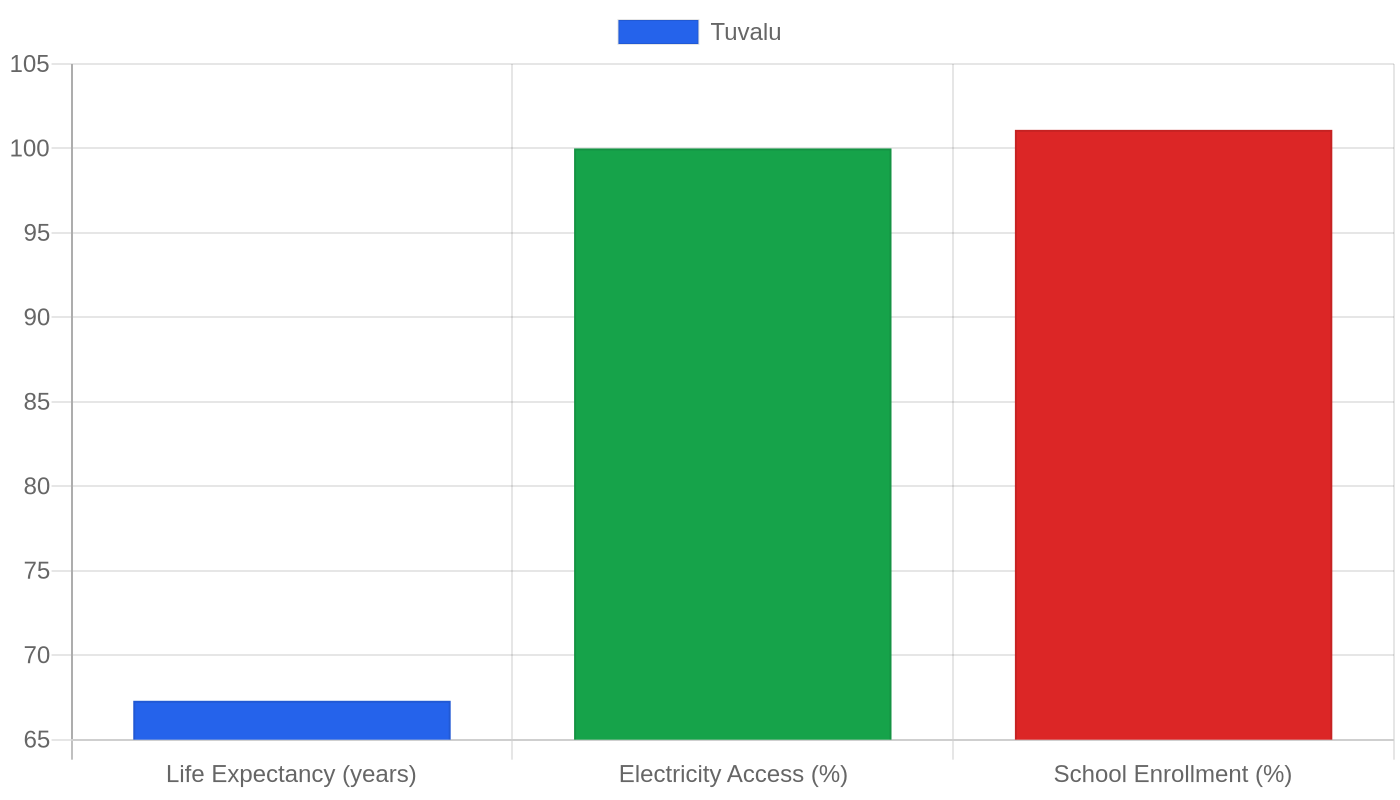
When the World Bank provides data on GDP, inflation, or unemployment — and in Tuvalu’s case, those datasets remain sparse — it is capturing a snapshot of activity that flows from deeper institutional foundations. The constitutional renewal sends a signal to regional partners, development banks, and potential investors that Tuvalu is serious about codifying its governance structures.
In the absence of robust economic data points, the constitutional reform stands as the most concrete evidence of a state actively shaping its own destiny.
Land, Lagoon, and Livelihood — The Cost of Living on a Pacific Atoll
Housing and daily expenses in Tuvalu are shaped by geography, import dependence, and the simple mathematics of supply and demand on a small landmass. There is no dense dataset from the World Bank on rental indices or consumer price breakdowns for Tuvalu, but the structural realities are well understood by regional economists. Nearly everything consumed — from building materials to fuel to processed food — must be imported, which places upward pressure on prices that domestic production cannot offset.
Land tenure on the atolls is largely customary, meaning that the concept of a freehold property market, as understood in larger economies, does not translate directly. Housing is typically family-oriented, with extended households sharing compounds, and the notion of “rent vs buy” is less a market decision and more a question of communal access and traditional rights.
For a visiting professional or a returning expatriate, accommodation options are extremely limited, often tied to government or aid-related postings. The cost of living, while not formally indexed in available data, is widely acknowledged by Pacific development organisations to be higher than many mainland assumptions, precisely because of the import premium. What data does not tell us, local knowledge does: resilience is the real currency here.
Families maintain subsistence practices — fishing, pulaka pits, coconut groves — that buffer against cash-based price shocks. In economic terms, Tuvalu operates a dual system: a formal, import-dependent cash economy and a robust customary economy that provides a safety net. Any serious analysis of affordability must account for both.
The Business of Smallness — Investment Climate in a Microstate
When we speak of “top companies” in Tuvalu, we are not talking about multinational headquarters or stock exchange listings. The economic landscape is dominated by state-owned enterprises, cooperatives, and small-scale private ventures serving a domestic market of a few thousand people. The National Bank of Tuvalu handles retail banking and financial services, while the Tuvalu National Provident Fund mobilises domestic savings.
Fisheries licensing fees — paid by foreign fleets operating in Tuvalu’s vast exclusive economic zone — represent one of the most significant revenue streams, a classic example of a small nation monetising its maritime sovereignty. The sale of the “.tv” internet domain has also provided a quirky but real source of national income, a reminder that in the digital age, a nation’s assets are not only physical.
The investment climate is defined by constraints: distance to markets, limited skilled labour, vulnerability to climate-related disruptions, and a narrow production base. Yet the constitutional reforms of 2023 may gradually improve the business environment by reinforcing the rule of law and clarifying the rights framework under which commercial disputes are resolved.
For development partners and impact investors, the sectors to watch are climate resilience infrastructure, telecommunications, renewable energy, and sustainable fisheries management. These are not sectors where one expects rapid private-sector scale; they are arenas where patient capital, multilateral cooperation, and sound governance can produce outsized long-term benefits for the population.
Safety, Sovereignty, and the Pacific Way — Politics and Quality of Life
Crime and safety indices for Tuvalu are not available in the provided data, but the qualitative picture from regional reporting is one of a generally low-crime, tightly-knit society where community norms and church life exert strong social control. The political landscape is a constitutional monarchy within the Commonwealth, with a Westminster-style parliamentary system adapted to island realities.
Politics is personal and local, often revolving around family and island affiliations rather than ideological platforms. The passage of the Constitution of Tuvalu Act 2023 through parliament on 5 September 2023, with effect from 1 October 2023, demonstrates a functioning legislative process capable of undertaking major legal reforms.
Quality of life in Tuvalu is not captured by happiness indices in the provided data, but it is reasonable to observe that the nation’s social fabric — its language, traditions, and community obligations — is a source of profound identity and continuity. The government’s willingness to update its supreme law suggests a forward-looking political class that understands the need to adapt governance to contemporary challenges, including the existential threat of sea-level rise.
For the people of Tuvalu, safety is not merely about crime statistics; it is about the security of their land, their culture, and their future as a sovereign nation.
A New Legal Era — What the 2023 Constitutional Changes Mean for the Nation’s Trajectory
This is the story that matters right now. On 5 September 2023, Tuvalu’s parliament passed the Constitution of Tuvalu Act 2023, and on 1 October 2023, the changes came into effect. This is not a routine administrative update; it is a re-founding of the nation’s legal order. The Constitution declares itself the supreme law, establishing that all other laws must be interpreted and applied subject to it.
The Principles of the Bill of Rights and the Protection of Fundamental Rights and Freedoms are enshrined, giving citizens a clear legal basis to challenge state action and demand accountability.
Why does this matter economically? Because legal certainty is the foundation of economic activity. A constitution that clearly protects fundamental rights creates a more predictable environment for both citizens and external partners. It signals that Tuvalu is not merely reacting to external pressures but is proactively shaping its own governance framework.
The timing is significant: as the nation navigates the complexities of international climate negotiations, digital economy opportunities, and regional geopolitics, it now does so with a modernised legal charter. For anyone tracking Pacific affairs, the constitutional transition is the single most important development in Tuvalu’s recent history. It is the lens through which future economic and social policies will be interpreted.
The Bottom Line
Tuvalu may not feature prominently in global economic databases, but its recent constitutional renewal makes it a nation to watch for students of sovereignty, resilience, and legal innovation. For development economists, diplomats, and investors interested in Pacific island states, the message is clear: Tuvalu is codifying its values and strengthening its institutions. The economic numbers may be sparse, but the political will is evident.
This is a country preparing for an uncertain future with the most durable tool available — a robust legal framework. Watch Tuvalu not for its GDP, but for its governance.
Sources & Methodology
This article is authored by Economic Pulse Net for informational and research purposes. Economic Pulse Net sources its data from multilateral institutions, national statistics bureaus, and proprietary databases. All data is believed to be current as of the date of publication.
Published: July 31, 2026 | Category: Research — Tuvalu
Use these signals in your own platform
Economic Pulse publishes its live signal feed through a documented, read-only API. Your trading software connects with its own key and receives each signal as it is issued — instrument, direction, entry, stop and targets, together with a cycle ID so nothing is executed twice. The feed is independent of this website and cannot change it.
Signals are informational only and are not financial advice.