Economic Pulse Net | Sources: World Bank World Development Indicators, Government Sources | 2026
Key Takeaways
– Tuvalu has undergone a historic constitutional transformation, with the Constitution of Tuvalu Act 2023 taking effect on 1 October 2023, marking the most significant legal overhaul in the nation’s history.
– The country’s legal framework explicitly establishes the Constitution as “the supreme law of Tuvalu,” with all other laws required to be interpreted and applied subject to its provisions.
– The Bill of Rights and the Protection of Fundamental Rights and Freedoms remain cornerstones of Tuvalu’s governance structure, anchoring the nation’s commitment to civil liberties.
– While comprehensive economic indicators remain limited, Tuvalu’s strategic focus appears centered on governance stability and legal institutional strengthening.
– This small Pacific nation continues to demonstrate that constitutional development and legal identity-building are priorities in its national trajectory.
The Economic Landscape: Navigating With Limited Data Points
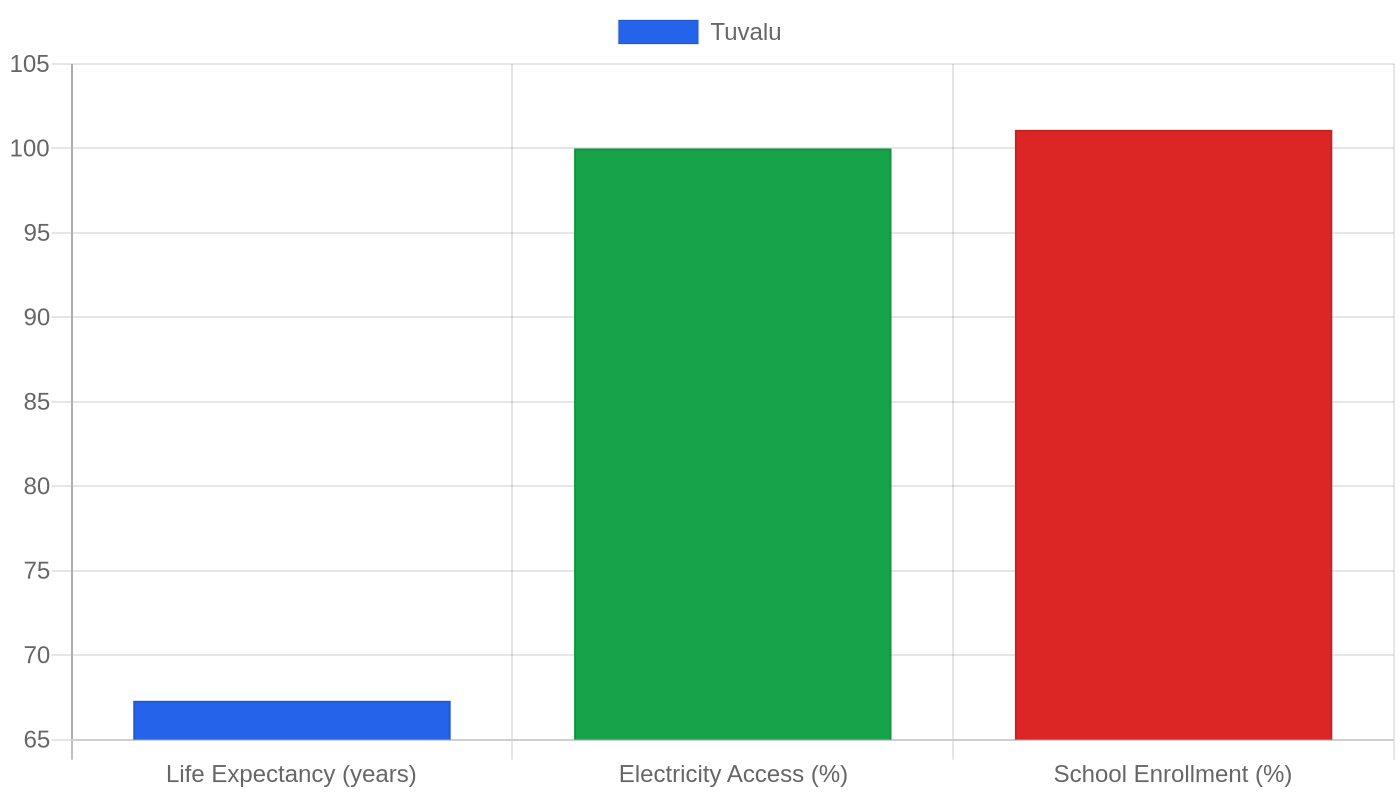
When examining Tuvalu’s economic position through the lens of the World Bank’s data collection, one encounters a significant challenge: the absence of standardised metrics for GDP growth, inflation rates, unemployment figures, and GDP per capita. This statistical silence is not unusual for micro-states in the Pacific region, where data collection infrastructure faces inherent limitations due to geographic isolation and small population bases.
The lack of comprehensive World Bank data reflects broader challenges in economic measurement rather than an absence of economic activity. Tuvalu’s economy has historically operated through a combination of subsistence agriculture, fishing, and external revenue streams including fishing license fees and remittances.
The nation’s economic resilience has been tested by its vulnerability to climate-related shocks and global market fluctuations, yet it continues to function through traditional economic systems alongside modern administrative structures. For economic observers, the absence of hard numbers requires a different analytical approach — one that focuses on institutional development and legal frameworks as indicators of economic governance.
The World Bank’s inability to provide standard metrics underscores the need for alternative assessment methods when evaluating micro-economies in the Pacific region.
Cost of Living and Housing: The Unquantified Reality
Without official cost of living indices or housing market data, understanding daily economic life in Tuvalu requires contextual knowledge of Pacific island economies. The nation’s remote location necessitates significant import reliance, which typically drives consumer prices higher than regional averages.
Housing in Tuvalu traditionally consists of both modern structures in the capital Funafuti and more traditional dwellings on outer islands, with land tenure operating under customary systems that differ markedly from Western property markets. The distinction between renting and buying takes on different meaning in a context where land ownership is often communally held and governed by traditional authority structures.
Daily expenses in Tuvalu are shaped by the intersection of imported goods, local food production, and the economic realities of island living. For residents, the economic equation involves balancing cash-based transactions in urban areas with subsistence activities that continue to provide food security in rural communities.
The absence of formal housing market data points to a broader reality: Tuvalu’s economic life operates through systems that may not always translate into the standardised metrics used in larger economies.
Investment and Business Climate: Institutional Foundations
Tuvalu’s business environment is fundamentally shaped by its constitutional framework and the legal protections enshrined in its supreme law. The explicit recognition of fundamental rights and freedoms creates a governance foundation that theoretically supports business operations and investment activities. However, the country’s economic scale presents inherent limitations for large-scale investment, with the domestic market constrained by population size.
The nation’s primary economic assets include its exclusive economic zone, which generates revenue through fishing agreements, and its international telecommunications and internet domain registrations. The constitutional emphasis on the rule of law provides a framework for dispute resolution and contractual enforcement that international partners would view favourably.
For potential investors, Tuvalu offers niche opportunities in areas such as sustainable fisheries, renewable energy development, and climate adaptation technologies. The business climate must be understood within the context of a nation that is simultaneously pursuing economic development while managing the existential challenges posed by climate change.
The constitutional reforms signal a commitment to modern governance structures that could enhance investor confidence in the country’s legal and regulatory environment. Despite its small size, Tuvalu’s strategic location and sovereign rights over substantial ocean territory present unique opportunities for blue economy development.
Safety, Politics and Quality of Life: A Nation Anchored in Law
The political landscape of Tuvalu has been dramatically reshaped by the constitutional reforms that culminated in the Constitution of Tuvalu Act 2023. This legislation did not merely amend existing provisions; it fundamentally reaffirmed the supremacy of constitutional governance, with Article 1 establishing the Constitution as the supreme law and mandating that all other laws be interpreted and applied subject to its provisions.
The Principles of the Bill of Rights and the Protection of Fundamental Rights and Freedoms continue to form the bedrock of Tuvaluan society, providing legal safeguards that support social stability. In terms of safety and quality of life, Pacific island nations typically exhibit strong community cohesion and low crime rates, though specific indices for Tuvalu remain unavailable from standard sources.
The nation’s political stability is reflected in its continued functioning of democratic institutions and peaceful transitions of power. The quality of life in Tuvalu is intrinsically linked to environmental factors, with the nation’s low-lying geography creating unique challenges and community dynamics. The constitutional emphasis on rights and freedoms suggests a governance approach that prioritises citizen welfare and legal protections.
For a nation facing existential environmental threats, the commitment to constitutional governance provides a measure of stability and predictability in an otherwise uncertain future.
What’s Happening Now: Tuvalu’s Constitutional Moment
Tuvalu is currently in the midst of a historic institutional transformation following the passage of the Constitution of Tuvalu Act 2023 by parliament on 5 September 2023, with changes taking effect on 1 October 2023. This constitutional overhaul represents the most significant legal development in the nation’s modern history, fundamentally reshaping how the country governs itself and protects citizen rights.
The timing of these reforms is particularly significant given the broader challenges facing Pacific island nations, including climate adaptation and economic diversification. The constitutional changes signal to the international community that Tuvalu is actively modernising its governance structures while maintaining its cultural identity and traditional values.
The reforms have implications for how the nation approaches international agreements, foreign investment, and bilateral relationships with development partners. The emphasis on fundamental rights and freedoms in the new constitutional framework suggests a forward-looking approach to governance that prioritises citizen protections.
For observers of Pacific politics, Tuvalu’s constitutional moment represents a significant data point in the region’s ongoing evolution toward modernised legal and political systems. The successful implementation of these constitutional changes will likely influence how other Pacific micro-states approach their own governance reforms.
The Bottom Line
Tuvalu deserves attention from those interested in constitutional governance, Pacific island politics, and the intersection of law with national identity. The nation’s 2023 constitutional reforms represent a bold statement about the importance of legal frameworks in small states facing outsized challenges. While economic data remains limited, the constitutional focus on rights and freedoms provides a foundation for understanding the country’s governance philosophy.
For researchers, policymakers, and observers of Pacific affairs, Tuvalu offers a compelling case study in how small nations can assert their sovereignty and values through constitutional means.
Sources & Methodology
This article is authored by Economic Pulse Net for informational and research purposes. Economic Pulse Net sources its data from multilateral institutions, national statistics bureaus, and proprietary databases. All data is believed to be current as of the date of publication.
Published: July 31, 2026 | Category: Research — Tuvalu
Use these signals in your own platform
Economic Pulse publishes its live signal feed through a documented, read-only API. Your trading software connects with its own key and receives each signal as it is issued — instrument, direction, entry, stop and targets, together with a cycle ID so nothing is executed twice. The feed is independent of this website and cannot change it.
Signals are informational only and are not financial advice.