Economic Pulse Net | Sources: World Bank World Development Indicators, Government Sources | 2026
Key Takeaways
– Australia’s legendary housing market is experiencing a brutal correction, with auction clearance rates now worse than during the pandemic, according to the *Australian Financial Review*
– A surprising inflation gauge suggests the Reserve Bank of Australia may still need to hike interest rates twice more, even as the economy shows signs of strain
– The country’s political stability remains a bedrock strength, with one of the world’s oldest continuous federal democracies and a constitutional monarchy that has provided institutional continuity since 1901
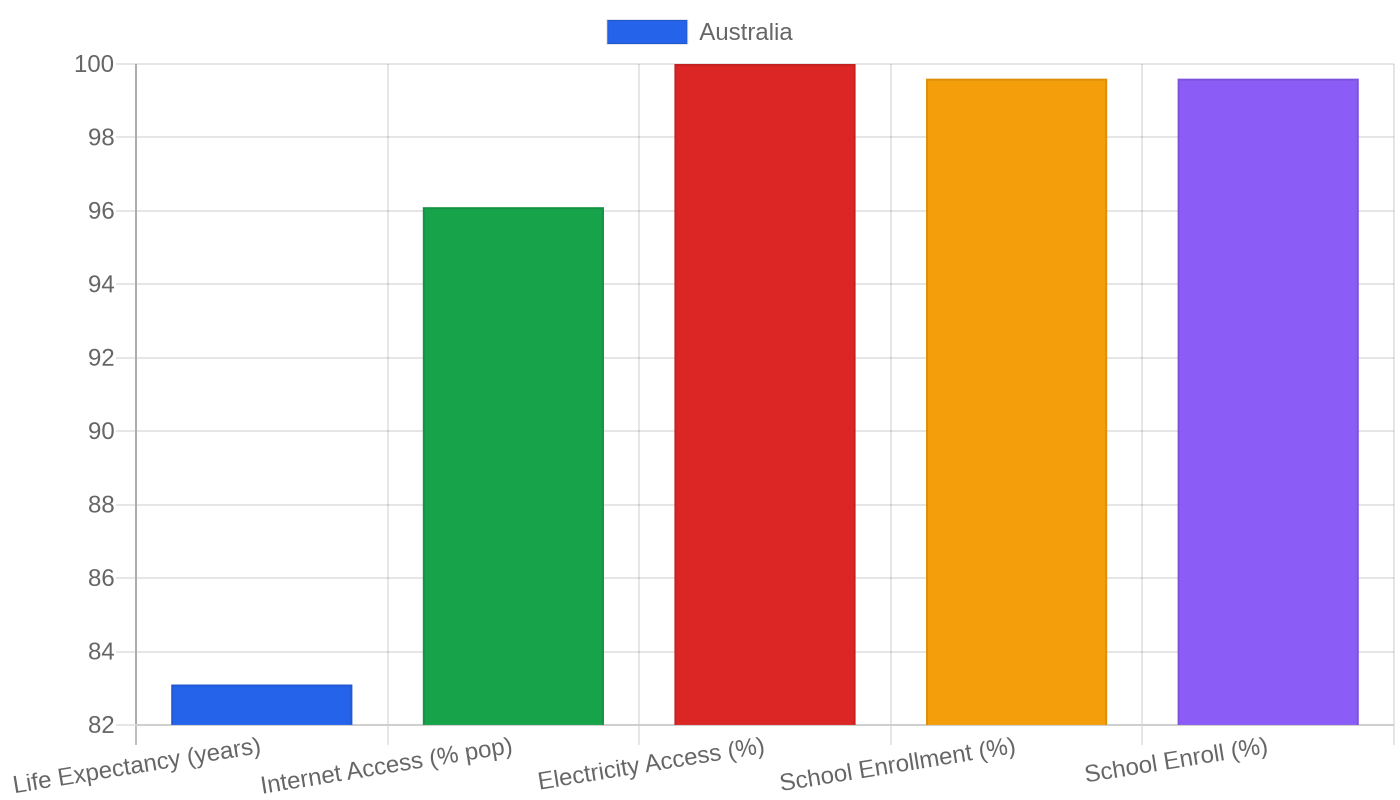
– Major structural economic data from the World Bank is currently unavailable, but the nation’s core industries and trade relationships continue to drive a complex economic narrative
– Australia is caught between persistent inflationary pressure and a cooling property market, creating a policy dilemma for the central bank
The Great Deceleration — GDP, Inflation, and the Jobs Puzzle
The Australian economy is navigating a period of profound uncertainty, though the precise contours remain obscured by gaps in official data. The World Bank has not published the latest figures for GDP growth, inflation, or unemployment, leaving analysts to piece together a picture from market signals and business reporting. What is clear is that the nation is grappling with a tension that has defined its post-pandemic trajectory: how to tame inflation without crushing the domestic economy.
The *Australian Financial Review* has flagged a troubling indicator — an inflation gauge that suggests the Reserve Bank of Australia may still need to hike rates twice. This is a significant signal in a country where households carry some of the highest levels of mortgage debt in the developed world. The RBA’s tightening cycle has already been aggressive, and the suggestion that two more hikes may be necessary points to underlying price pressures that refuse to subside.
Australia’s inflation story is not simply about global supply chains or energy prices; it is deeply embedded in a domestic economy where housing costs, construction bottlenecks, and labour shortages have created a stubborn inflationary core.
Employment data from the World Bank is unavailable, but the broader context suggests a labour market that remains unusually tight by historical standards. Australia’s post-pandemic recovery was characterised by a rapid rebound in employment, driven by massive fiscal stimulus and a reopening that saw pent-up demand unleashed. Yet the current environment — where the RBA may still need to tighten — suggests that the economy is running hot in ways that defy easy resolution.
The main industries that have traditionally underpinned Australian prosperity — mining, energy, agriculture, and services — continue to operate, but the question of whether they can sustain growth through a period of monetary tightening remains open.
The Property Paradox — When the Market Defies Logic
Australia’s relationship with housing is nothing short of pathological. For decades, rising property prices were treated as a national birthright, a reliable engine of wealth creation that papered over stagnant wages and growing inequality. That narrative is now under siege.
The *Australian Financial Review* reports that the ongoing slump in auction clearance rates is now worse than during the pandemic — a period when the market was widely expected to collapse before being rescued by record-low interest rates and government stimulus.
The current downturn is different. It is happening in an environment where interest rates are high and expected to go higher. Auction clearance rates are a leading indicator of market sentiment, and their deterioration to pandemic-era lows suggests that buyers are stepping back in a meaningful way. Yet this is not a simple story of collapse.
Australia’s housing market is characterised by chronic undersupply, particularly in the major cities of Sydney and Melbourne, where planning constraints, construction costs, and labour shortages have limited new builds. This supply-demand imbalance creates a floor beneath prices even as demand weakens.
The cost of living in Australia has become a central political and economic concern. While specific data from the World Bank is unavailable, the anecdotal evidence is overwhelming. Renters in capital cities are facing some of the most competitive and expensive markets in the country’s history.
The dream of home ownership, once a realistic aspiration for middle-income earners, has receded into the distance for a generation of Australians who now face a choice between crippling mortgage repayments or indefinite renting. The rental market itself is under extraordinary pressure, with vacancy rates at historic lows in most major cities.
Corporate Australia and the Investment Calculus
The top companies that dominate the Australian economy are a study in concentration and resilience. The major banks — Commonwealth Bank, Westpac, NAB, and ANZ — remain among the most profitable in the world, benefiting from an oligopolistic structure and a housing market that has historically been a reliable source of lending growth.
The mining giants — BHP, Rio Tinto, and Fortescue — continue to generate enormous revenues from iron ore, coal, and liquefied natural gas, commodities that remain in high demand from Asian markets, particularly China.
Yet the investment climate is shifting. The *ABC News* business coverage, including its latest business news, analysis, and programs, paints a picture of an economy in transition. The old certainties — that Australian resources would always find a buyer, that property would always rise, that the banks would always be safe — are being tested.
The RBA’s potential need for further rate hikes creates headwinds for corporate investment, particularly in interest-rate-sensitive sectors like construction, retail, and hospitality.
For international investors, Australia offers a combination of political stability, a well-regulated financial system, and proximity to Asia’s growth engines. The sectors to watch are those that align with global megatrends: critical minerals for the energy transition, renewable energy infrastructure, and technology services. Australia has the resources and the institutional framework to be a major player in these areas, but the transition is not automatic.
It requires policy certainty, which is currently in short supply given the monetary policy uncertainty.
Stability in an Unstable World — Politics, Safety, and Quality of Life
Australia’s political landscape is a study in continuity. As the World Bank data notes, the country is a constitutional monarchy, a parliamentary democracy, and a federation. The constitution has remained largely unchanged since Federation in 1901, making it one of the world’s oldest federations. Power is divided between the federal and state governments in a system that combines elements from the United Kingdom — a fused executive, constitutional monarchy, and strong party discipline.
This institutional stability is a significant asset. In a world of rising political volatility, Australia offers predictability. Elections are held regularly, transitions of power are orderly, and the rule of law is firmly entrenched. The strong party system ensures that governments can generally implement their agendas, even if the Senate often provides a check on the most ambitious proposals.
The current government, led by Prime Minister Anthony Albanese, has pursued a agenda focused on climate action, housing affordability, and strengthening the social safety net, though progress has been uneven.
Crime and safety data from the World Bank is unavailable, but Australia consistently ranks among the safest countries in the world in international surveys. Violent crime is relatively rare, and the major cities are generally safe by global standards. The quality of life remains high, supported by a robust healthcare system, a strong education sector, and a natural environment that is both beautiful and accessible.
These factors contribute to Australia’s reputation as a desirable destination for both migrants and investors, though the rising cost of living is beginning to erode some of this appeal.
The Rate Hike Dilemma — What’s Happening Right Now
This is the moment of maximum uncertainty for the Australian economy. The *Australian Financial Review* has been tracking two critical narratives simultaneously: the slump in auction clearance rates, now worse than during the pandemic, and the surprising inflation gauge that suggests the RBA may still need to hike twice. These two stories are in direct tension. If the RBA hikes again, it risks deepening the housing downturn and potentially triggering a broader economic slowdown.
If it holds, it risks allowing inflation to become entrenched, which would ultimately require even more painful adjustments later.
The *ABC News* business coverage provides a window into how these dynamics are playing out in real time. Businesses are reporting softer demand, consumers are pulling back on discretionary spending, and the housing market is sending clear warning signals. Yet the inflation data refuses to cooperate. The RBA’s preferred measures of underlying inflation remain above the target band, and the labour market — while showing some signs of softening — remains tight enough to keep upward pressure on wages and prices.
The central bank is in an unenviable position. It must navigate between the Scylla of recession and the Charybdis of entrenched inflation. The *Australian Financial Review*’s reporting suggests that the market is increasingly pricing in the possibility of further tightening, even as the real economy shows signs of strain. This is the classic central banker’s dilemma, and Australia’s RBA is not immune to it.
The decisions made in the coming months will shape the economic trajectory for years to come.
The Bottom Line
Australia remains a fundamentally wealthy and stable country, but it is confronting a period of adjustment that will test the resilience of its institutions and its people. Investors with a long-term horizon should watch Australia for its resource wealth, its political stability, and its potential in the energy transition. But the short-term picture is clouded by the RBA’s tightening cycle, a housing market in correction, and a cost-of-living crisis that is eroding the social fabric.
The lucky country has not lost its luck — but it is being forced to earn it.
Sources & Methodology
This article is authored by Economic Pulse Net for informational and research purposes. Economic Pulse Net sources its data from multilateral institutions, national statistics bureaus, and proprietary databases. All data is believed to be current as of the date of publication.
Published: July 19, 2026 | Category: Research — Australia
Use these signals in your own platform
Economic Pulse publishes its live signal feed through a documented, read-only API. Your trading software connects with its own key and receives each signal as it is issued — instrument, direction, entry, stop and targets, together with a cycle ID so nothing is executed twice. The feed is independent of this website and cannot change it.
Signals are informational only and are not financial advice.