Economic Pulse Net | Sources: World Bank World Development Indicators, Government Sources | 2026
Key Takeaways
– Australia’s property market is experiencing a deeper slump than during the pandemic, with auction clearance rates in sustained decline according to the *Australian Financial Review*.
– A surprising inflation gauge suggests the Reserve Bank of Australia may still need to raise interest rates twice more, defying hopes of an imminent pivot to easing.
– The country’s political system remains one of the world’s most stable liberal democracies, but economic pressures are testing the foundations of the “lucky country” model.
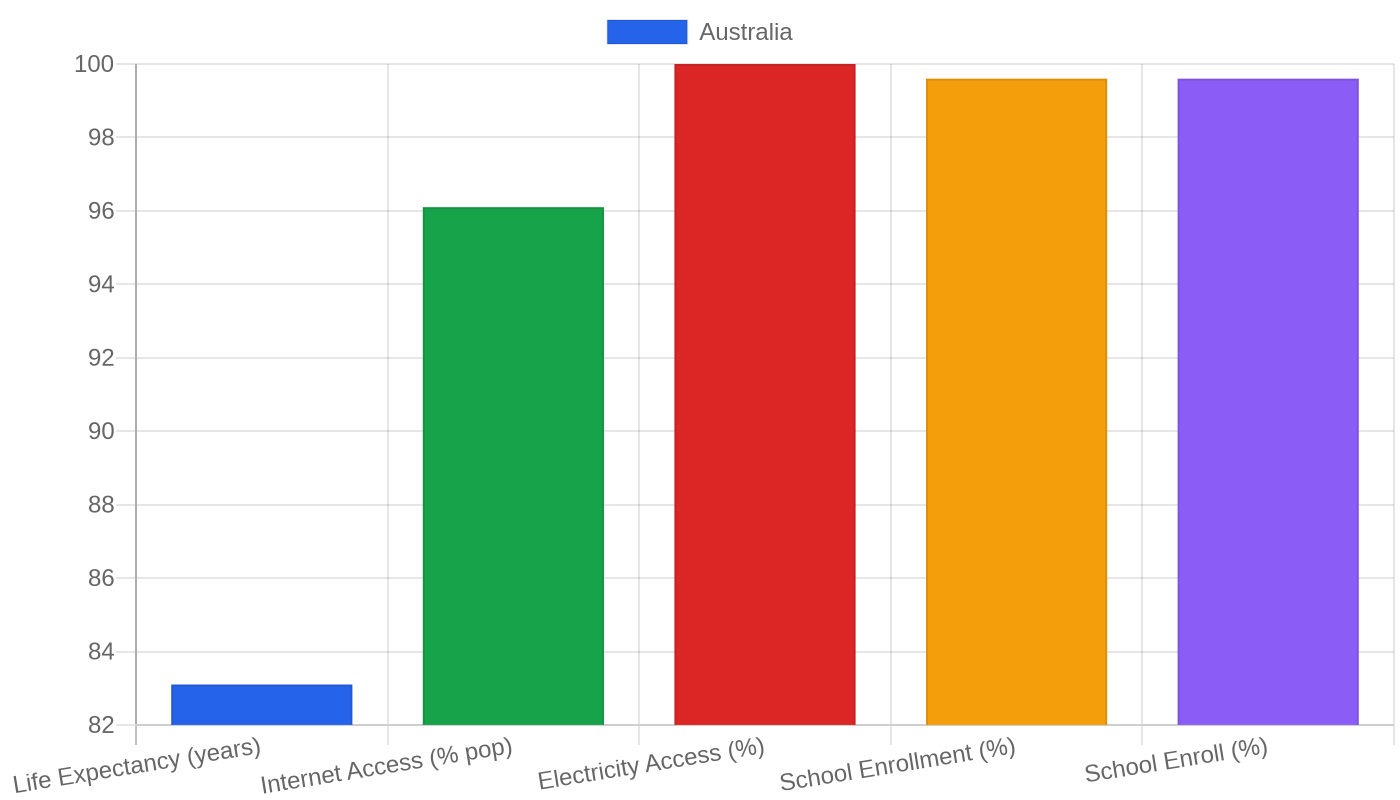
– Key economic indicators from the World Bank are currently unavailable, making it difficult to assess the full scale of Australia’s macroeconomic position through official channels.
– The nation’s reliance on commodity exports and housing wealth is being challenged by stubborn inflation and a cooling property sector.
The Paradox of Prosperity — Reading Australia’s Economic Tea Leaves
Australia has long been the envy of the developed world — a resource-rich, politically stable economy that weathered the global financial crisis better than almost any peer and emerged from the pandemic with remarkable resilience. Yet the latest data from the World Bank presents a curious void: GDP growth, inflation CPI, unemployment, GDP in USD, GDP per capita in PPP, GNI per capita, and population figures are all listed as unavailable. This absence of official baseline numbers is itself a story.
What we do know, however, paints a picture of an economy caught between two forces. On one hand, Australia’s main industries — mining, energy, agriculture, financial services, and education — continue to generate enormous wealth. The country remains one of the world’s largest exporters of iron ore, coal, and liquefied natural gas, and its service sector has proven remarkably adaptable. On the other hand, the domestic economy is showing clear signs of strain.
The *Australian Financial Review* reports that an ongoing slump in auction clearance rates is now worse than during the pandemic, a deeply concerning signal for a nation where housing wealth is the primary store of household value.
The inflation story is particularly telling. According to the *Australian Financial Review*, a surprising inflation gauge suggests the Reserve Bank of Australia may still need to hike interest rates twice. This runs counter to the narrative that has taken hold in many developed economies — that the inflation fight is largely won. For Australian households and businesses still adjusting to the highest borrowing costs in over a decade, the prospect of further tightening is a sobering one.
The RBA’s challenge is uniquely Australian: how to cool an overheating housing market and persistent services inflation without crushing the consumer spending that drives two-thirds of economic activity.
The Great Australian Dream on Life Support
Housing has always been Australia’s national obsession, and for good reason. The cost of living crisis gripping the country is, at its core, a housing crisis. While specific rental and purchase price data is not provided in the current dataset, the *Australian Financial Review*’s reporting on auction clearance rates tells a stark story.
Clearance rates — the percentage of properties sold at auction — are a leading indicator of market health, and the current slump surpassing pandemic-era lows suggests deep structural weakness.
The dynamic is brutally simple: higher interest rates have slashed borrowing capacity, but prices have not yet adjusted sufficiently to restore affordability. First-home buyers are locked out of markets that their parents’ generation entered with relative ease. Renters face vacancy rates near historic lows in major cities like Sydney and Melbourne. The Australian dream of owning a quarter-acre block with a backyard is increasingly a luxury reserved for the wealthy or those who bought years ago.
Daily expenses — groceries, fuel, electricity, insurance — have all risen sharply, squeezing household budgets that have little room left after mortgage or rent payments. This is not merely a cyclical downturn; it is a structural reckoning for a model of prosperity built on ever-rising land values.
Where the Money Moves — Investment Climate and Corporate Australia
Australia’s top companies — names like BHP, Rio Tinto, Commonwealth Bank, CSL, and Wesfarmers — represent a concentrated slice of the economy. Mining and banking dominate the ASX 200, and this narrow base creates both strength and vulnerability. The business environment remains one of the most transparent and well-regulated in the Asia-Pacific region, with strong property rights, a reliable legal system, and deep capital markets. Foreign investment flows freely into resources, infrastructure, and real estate.
Yet the current climate demands careful navigation. The *Australian Financial Review*’s markets coverage and the *ABC News* business analysis suggest investors are increasingly cautious. The prospect of further RBA rate hikes complicates the outlook for consumer-facing sectors like retail, hospitality, and housing construction. Meanwhile, the resources sector faces its own headwinds: China’s economic slowdown, the global energy transition, and rising operational costs in remote mining regions.
Sectors to watch include critical minerals (lithium, rare earths) as the world scrambles for battery supply chains, and renewable energy infrastructure, where Australia has natural advantages in solar and wind. But the immediate picture is one of uncertainty, with the RBA’s next moves likely to determine whether the economy achieves a soft landing or tips into a sharper downturn.
Stability Under Strain — Politics, Safety, and the Quality of Life Question
Politically, Australia remains a rock of stability. As the World Bank data notes, the country is a constitutional monarchy, a parliamentary democracy, and a federation. The constitution has remained largely unchanged since Federation in 1901, and the political system combines elements from the United Kingdom — a fused executive, constitutional monarchy, and strong party discipline. This institutional continuity is one of Australia’s greatest assets.
Governments change, policies shift, but the system itself rarely wobbles.
Crime and safety indices are not available in the current dataset, but Australia consistently ranks among the safest countries in the world by international measures. Violent crime is low, police are generally trusted, and the rule of law is robust. The quality of life, however, is under pressure. The housing crisis, cost-of-living squeeze, and the creeping sense that younger generations will be worse off than their parents are eroding the social fabric.
Australia’s famed egalitarianism — the belief that a fair go is available to all — is being tested. The country’s beaches, sunshine, and natural beauty remain, but the economic foundation that once made the “lucky country” a global benchmark for prosperity is showing cracks.
The RBA Tightrope — What’s Happening Right Now
This is the moment that will define Australia’s economic trajectory for the next decade. The *Australian Financial Review* is reporting two critical developments simultaneously: an ongoing slump in auction clearance rates that is now worse than during the pandemic, and a surprising inflation gauge that suggests the RBA may still need to hike twice. These are not contradictory — they are two sides of the same coin.
The housing market is cooling because of past rate hikes, but inflation is proving stickier than expected, meaning the RBA cannot declare victory yet.
The *ABC News* business coverage, including its latest business news, analysis, and programs, provides the broader context. Businesses are reporting softening demand as households tighten belts. Consumer confidence is fragile. The labor market, which has been remarkably tight, may be starting to loosen. The RBA’s challenge is to calibrate policy precisely: too much tightening and the economy tips into recession; too little and inflation becomes entrenched.
The *Australian Financial Review* markets coverage reflects this uncertainty, with bond yields and the Australian dollar fluctuating on every data release and central bank comment. For Australian households, business owners, and investors, the next few months will be decisive.
The Bottom Line
Australia is not in crisis, but it is at a crossroads. The country’s institutional strength, resource wealth, and skilled workforce provide a powerful buffer against the worst outcomes. But the housing market, inflation dynamics, and the RBA’s policy response will determine whether the next few years bring a soft landing or a harder reckoning. Investors should watch Australia for its commodity exposure and stable governance, but with eyes wide open to the domestic headwinds.
This is a country that has been lucky for a long time — and it is about to find out how much of that luck was earned.
Sources & Methodology
This article is authored by Economic Pulse Net for informational and research purposes. Economic Pulse Net sources its data from multilateral institutions, national statistics bureaus, and proprietary databases. All data is believed to be current as of the date of publication.
Published: July 19, 2026 | Category: Research — Australia
Use these signals in your own platform
Economic Pulse publishes its live signal feed through a documented, read-only API. Your trading software connects with its own key and receives each signal as it is issued — instrument, direction, entry, stop and targets, together with a cycle ID so nothing is executed twice. The feed is independent of this website and cannot change it.
Signals are informational only and are not financial advice.