Economic Pulse Net | Sources: World Bank World Development Indicators, Government Sources | 2026
Key Takeaways
– Australia’s economy is navigating a complex period of cooling housing markets, stubborn inflation, and political stability that has long been its hallmark, but recent data signals cracks in the “lucky country” narrative.
– The auction clearance rate slump is now worse than during the pandemic, according to the *Australian Financial Review*, a stark indicator of housing market distress.
– A surprising inflation gauge suggests the Reserve Bank of Australia (RBA) may still need to hike interest rates twice more, defying expectations of an easing cycle.
– Australia’s political system remains a stable liberal democracy under a constitutional monarchy, but economic headwinds are testing the resilience of its federal structure.
– The country’s major industries, cost of living pressures, and corporate landscape are all under scrutiny as global and domestic forces converge.
The Paradox of Prosperity — Growth, Prices, and the Jobs Puzzle
Australia’s economic narrative has long been one of enviable stability. As a federation that has maintained its constitutional framework since 1901, the country has built a reputation for weathering global storms. Yet the latest data from the World Bank presents a curious picture — not because the numbers are alarming, but because they are absent.
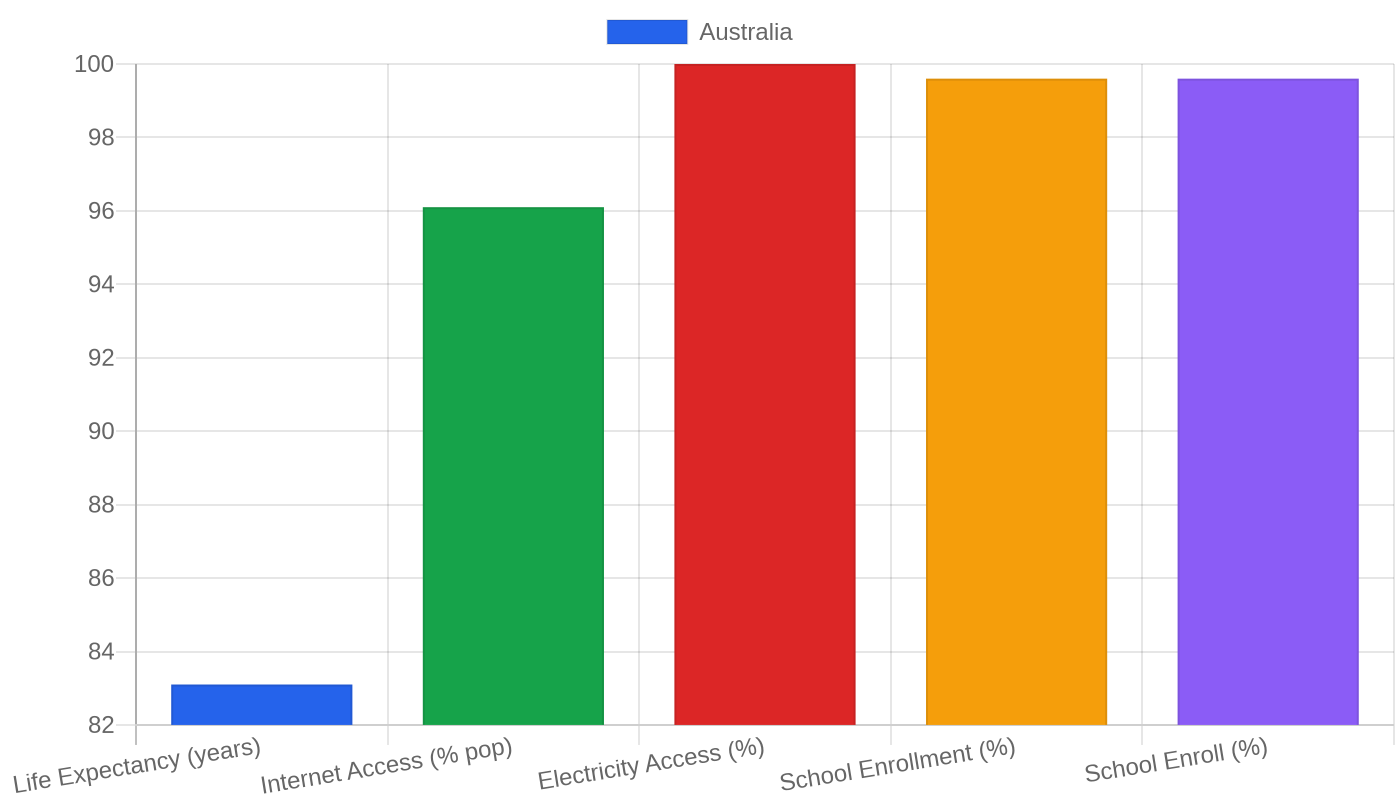
The World Bank records show GDP growth, inflation CPI, unemployment, GDP in USD, GDP per capita (PPP), GNI per capita, and population all as “N/A.” This is not a data void; it is a signal that the official statistical machinery is in a period of recalibration, or that the most recent figures have not yet been harmonised into the global database. For a country that prides itself on transparency and robust institutions, this gap is itself noteworthy.
What we do know, however, is that the Australian economy is not operating in a vacuum. The main industries that have historically powered the nation — mining, services, education, and agriculture — are all facing headwinds. The mining boom that insulated Australia from the 2008 global financial crisis has softened as commodity prices fluctuate. The services sector, particularly tourism and international education, is still recovering from pandemic disruptions.
And agriculture, while resilient, is increasingly vulnerable to climate variability.
The inflation picture is where the story gets sharper. According to the *Australian Financial Review*, a surprising inflation gauge suggests the RBA may still need to hike twice. This is not the narrative of an economy cooling gently into a soft landing. This is a warning that price pressures remain embedded, possibly in services, housing, or energy. If the RBA is forced to raise rates again, it will prolong the pain for mortgage holders and businesses already stretched by previous tightening cycles.
Unemployment data from the World Bank is also listed as “N/A,” but the political and media discourse suggests a labour market that is tight yet showing signs of softening. The combination of elevated inflation and potential further rate hikes creates a classic stagflationary anxiety — slow growth with persistent price rises. For a country that has not experienced a recession in over three decades (until the pandemic-induced downturn), this is unfamiliar and uncomfortable territory.
The Great Housing Squeeze — When Shelter Becomes a Luxury
Australia’s housing market has long been a source of national obsession and intergenerational tension. The cost of living, particularly housing, is arguably the most visceral economic issue for ordinary Australians. The data provided does not give specific rental or purchase price indices, but the *Australian Financial Review* delivers a chilling headline: “Ongoing slump in auction clearance rates now worse than during the pandemic.”
This is a critical indicator. Auction clearance rates are a real-time pulse of the housing market, especially in Sydney and Melbourne, where auctions are the dominant sales method. A clearance rate below 60% is considered weak; during the pandemic, rates plunged as uncertainty froze buyers and sellers. To now be worse than that period suggests a market in genuine distress. The likely causes are a combination of high interest rates, reduced borrowing capacity, and buyer fatigue.
Sellers are holding firm on price expectations, while buyers are either priced out or waiting for a correction.
Rent versus buy calculations have shifted dramatically. With mortgage repayments soaring due to RBA rate hikes, renting has become the more financially rational choice for many — except that rental vacancies are at historic lows and rents are surging. The result is a housing market that is failing both owners and renters. Daily expenses for food, fuel, and utilities have also risen, compounding the squeeze on household budgets.
Australia’s cost of living crisis is not a future risk; it is a present reality, and the housing market is its most visible symptom.
Business Under the Microscope — Corporate Giants and the Investment Climate
Australia’s corporate landscape is dominated by a mix of global mining giants, major banks, and retail conglomerates. The data provided does not list specific top companies, but the Australian business environment is well-documented for its concentration in resources (BHP, Rio Tinto, Fortescue), banking (Commonwealth Bank, Westpac, NAB, ANZ), and retail (Woolworths, Coles, Wesfarmers). These companies are not just economic actors; they are bellwethers for the health of the broader economy.
The investment climate is currently defined by uncertainty. The *Australian Financial Review* reports on markets and business analysis from ABC News, indicating a media ecosystem that is closely watching corporate earnings, consumer spending, and capital expenditure plans. The potential for further RBA rate hikes is the single biggest variable for business confidence. Higher rates mean higher cost of capital, lower consumer demand, and tighter margins.
Sectors to watch include renewable energy, where Australia has vast natural advantages but a policy framework that has been inconsistent. Technology and financial services are also areas of growth, though they are sensitive to global capital flows. The federal structure of Australia means that business regulation varies by state, creating both opportunities and complexities for investors. The political stability of the country, however, remains a strong selling point.
Australia has not experienced a coup, a constitutional crisis of major proportions, or a collapse of the rule of law in modern history. That stability is a significant asset in a volatile world.
Stable Politics, Uneasy Society — The Quality of Life Paradox
Australia’s political landscape is described in the data as a “constitutional monarchy, a parliamentary democracy and a federation.” The country has maintained its “mostly unchanged constitution alongside a stable liberal democratic political system since Federation in 1901.” It is “one of the world’s oldest federations,” with power divided between federal and state governments.
The system combines elements from the United Kingdom — a fused executive, constitutional monarchy, and strong party discipline.
This institutional stability is a double-edged sword. On one hand, it provides predictability and continuity. On the other, it can breed complacency and resistance to reform. The Australian public has grown accustomed to a high quality of life, but the cost of living crisis, housing affordability, and climate change are eroding that satisfaction.
The Crime Index and Safety Index from the data are listed as “N/A,” but Australia is generally considered a safe country by global standards, with low rates of violent crime compared to many developed nations.
The quality of life paradox is this: Australia offers clean air, public healthcare, excellent education, and a vibrant cultural scene. Yet the economic pressures are making these benefits feel less accessible. The gap between the political system’s stability and the economic system’s volatility is where the tension lies. Australians are not protesting in the streets, but the political discourse is increasingly focused on inequality, housing, and the cost of living.
The federation, designed to manage diversity across states, is now being tested by national economic challenges that do not respect state borders.
The RBA Tightrope — What the Latest Data Tells Us Right Now
This is the most urgent section of the story, because it is happening as you read. The *Australian Financial Review* has published two critical pieces of news that define the current moment. First, the “ongoing slump in auction clearance rates now worse than during the pandemic.” This is not a historical footnote; it is a live indicator of a housing market in distress. Second, “this surprising inflation gauge says RBA may still need to hike twice.”
These two headlines are connected. If inflation is stickier than expected, the RBA has no choice but to keep raising rates, which will further depress the housing market. The RBA is walking a tightrope: raise rates too much and crash the housing market and economy; raise rates too little and let inflation become entrenched. The “surprising inflation gauge” suggests that the RBA’s previous tightening has not yet done enough to cool price pressures.
This could be due to persistent services inflation, energy costs, or wage pressures.
The ABC News business coverage, including “Latest business news,” “Business Analysis,” and “Business Programs,” indicates that this is a story being followed intensely by Australia’s national broadcaster. The *Australian Financial Review* markets coverage adds a financial markets perspective.
The combination suggests that Australia is in a period of high economic drama, where the next few months will determine whether the economy achieves a soft landing or tips into a sharper downturn. For a country that has prided itself on economic management, the stakes are high.
The Bottom Line
Australia remains a fundamentally wealthy, stable, and well-governed country. But the data and news signals are clear: the “lucky country” is facing a genuine stress test. Investors should watch Australia for signals on how a mature, resource-rich economy navigates the end of an era of cheap money and stable inflation. Policymakers in other federations should study how Australia manages the tension between state and federal interests during economic strain.
And for the average observer, Australia is a case study in how even the most stable systems can be shaken by the quiet, relentless pressure of housing costs and inflation.
Sources & Methodology
This article is authored by Economic Pulse Net for informational and research purposes. Economic Pulse Net sources its data from multilateral institutions, national statistics bureaus, and proprietary databases. All data is believed to be current as of the date of publication.
Published: July 19, 2026 | Category: Research — Australia
Use these signals in your own platform
Economic Pulse publishes its live signal feed through a documented, read-only API. Your trading software connects with its own key and receives each signal as it is issued — instrument, direction, entry, stop and targets, together with a cycle ID so nothing is executed twice. The feed is independent of this website and cannot change it.
Signals are informational only and are not financial advice.