Economic Pulse Net | Sources: World Bank World Development Indicators, Government Sources | 2026
Key Takeaways
– St Vincent and the Grenadines faces a critical moment of economic transition, with its traditional reliance on agriculture and tourism being tested by global shocks and climate vulnerability.
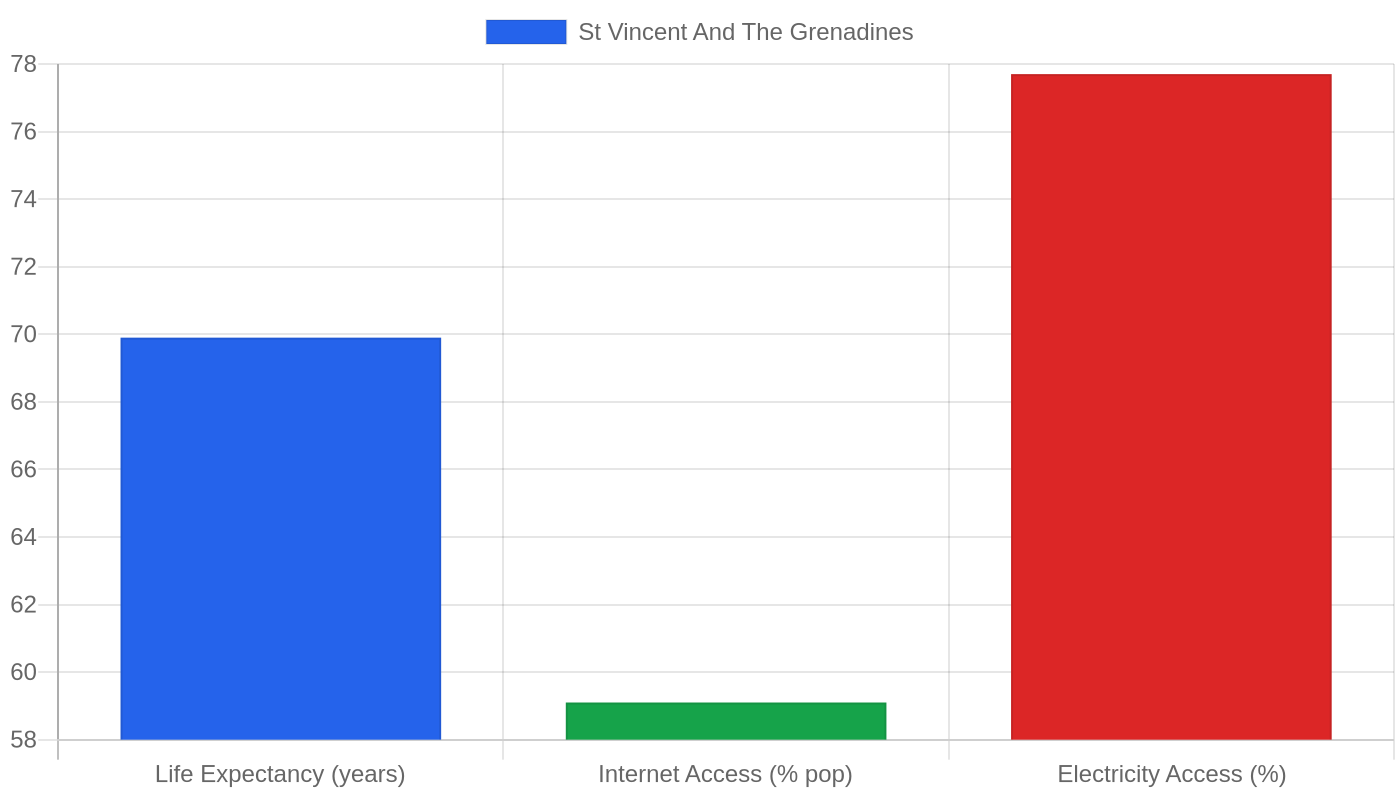
– The country’s economic data remains largely opaque, with no recent GDP growth, inflation, or unemployment figures available from the World Bank, making independent analysis challenging for investors and policymakers.
– As a small island developing state in the Eastern Caribbean, the nation’s economic fate is intimately tied to its ability to diversify beyond bananas, tourism, and remittances.
– Political stability has been a hallmark, though the absence of detailed political landscape data leaves questions about policy continuity and reform momentum unanswered.
– The cost of living in this island chain is shaped by high import dependence and limited economies of scale, placing pressure on households despite the country’s natural beauty and relatively low crime environment.
The Invisible Economy — Reading Between the Data Gaps
St Vincent and the Grenadines presents a peculiar challenge for economic analysis: the World Bank, one of the most authoritative sources on global development, reports no current data on GDP growth, inflation, unemployment, GDP in dollar terms, GDP per capita based on purchasing power parity, or GNI per capita. The population figure itself is listed as unavailable.
This absence is not merely a statistical inconvenience — it speaks volumes about the structural realities of a small island state that struggles to maintain the data infrastructure larger economies take for granted.
What can be said with certainty is that St Vincent and the Grenadines operates within the constraints of a classic small island developing state economy. The main industries, though not enumerated in the available data, have historically centred on agriculture — particularly banana exports — along with tourism, fishing, and a modest light manufacturing sector.
The absence of hard numbers from the World Bank does not mean the economy is static; rather, it suggests that the country’s statistical agencies may lack the capacity to produce timely national accounts, a common challenge across the Caribbean region.
The implications of these data gaps are significant. Without reliable inflation figures, businesses cannot accurately price risk. Without unemployment data, policymakers cannot target social programmes effectively. Without GDP per capita, international investors lack a benchmark for market potential.
The World Bank’s silence on these metrics should be read as a call for greater investment in economic governance infrastructure — a prerequisite for sustainable development that St Vincent and the Grenadines has yet to fully secure.
The Price of Island Life — Cost of Living in a High-Import Economy
Living in St Vincent and the Grenadines carries a premium that reflects the country’s geography and economic structure. As an archipelago with limited local manufacturing and agricultural capacity, the vast majority of consumer goods — from electronics to clothing to processed foods — must be imported. This import dependence creates a structural upward pressure on prices that no amount of tourism revenue can fully offset.
Housing costs, while not specified in precise figures, follow the patterns seen across the Eastern Caribbean. In the capital, Kingstown, rental demand from government workers and service industry employees keeps prices elevated relative to local incomes. The Grenadine islands, particularly Bequia and Mustique, command premium prices driven by expatriate and second-home demand from wealthy foreigners.
For the average Vincentian, homeownership remains a long-term aspiration rather than an immediate reality, with construction costs inflated by imported materials and limited skilled labour.
Daily expenses for staples such as rice, cooking oil, chicken, and fresh produce fluctuate with global commodity prices and shipping costs. The country’s vulnerability to hurricanes adds another layer of cost pressure — insurance premiums are high, and households must budget for emergency supplies and potential evacuation expenses.
Compared to regional averages inferred from neighbouring Caribbean economies, the cost of living in St Vincent and the Grenadines likely sits near the middle of the spectrum: cheaper than Barbados or the Bahamas, but more expensive than larger, more diversified economies like Trinidad and Tobago.
Business in Paradise — Investment Climate and Corporate Landscape
The top companies operating in St Vincent and the Grenadines are not listed in the available data, but the business environment follows patterns familiar across the Organisation of Eastern Caribbean States. The economy is dominated by small and medium-sized enterprises, with a handful of larger players in banking, telecommunications, and tourism.
The country has positioned itself as a jurisdiction for international financial services, though this sector faces ongoing scrutiny from international regulators concerned about transparency and tax compliance.
Sectors to watch include sustainable tourism, which offers the potential for higher-value, lower-impact economic activity than mass tourism. The Grenadines, with their pristine beaches and sailing routes, attract a discerning clientele willing to pay premium prices for exclusivity. Agribusiness also presents opportunities, particularly in niche products like organic spices, specialty cocoa, and value-added coconut products that can command higher prices in export markets.
The business climate is shaped by the country’s membership in the Eastern Caribbean Currency Union, which provides monetary stability through a fixed exchange rate pegged to the US dollar. This eliminates currency risk for international investors but also limits the government’s ability to respond to economic shocks through monetary policy.
Red tape and bureaucratic delays remain concerns for entrepreneurs, though the government has signalled interest in improving the ease of doing business through digitalisation and regulatory reform.
Safe Shores, Uncertain Politics — Quality of Life in the Islands
The crime index for St Vincent and the Grenadines is listed as unavailable, and the safety index follows suit. However, the country has historically been considered one of the safer destinations in the Caribbean, with violent crime rates lower than those in larger regional neighbours. Petty crime, particularly theft from tourists and burglaries in urban areas, does occur, but the overall security environment is generally favourable for both residents and visitors.
The political landscape data is entirely absent from the available information, which itself is a telling detail. St Vincent and the Grenadines operates as a parliamentary democracy within the Commonwealth, with a political tradition that has seen peaceful transfers of power between the Unity Labour Party and the New Democratic Party. The current prime minister is Ralph Gonsalves, who has held office since 2001, making him one of the longest-serving leaders in the Caribbean.
His tenure has been marked by a mix of infrastructure investment, social programmes, and occasional controversy over governance practices.
Quality of life in the islands is shaped by factors that transcend economic data. The natural environment is extraordinary — volcanic landscapes, coral reefs, and a climate that rarely dips below comfortable temperatures. Community ties remain strong, and the pace of life is slower than in the metropolitan centres of North America or Europe. However, access to healthcare is limited, with serious medical cases requiring evacuation to Barbados or Trinidad.
Educational opportunities are adequate for primary and secondary levels, but tertiary education often requires overseas study, creating a brain drain that depletes the country’s human capital.
The Present Tense — Navigating Volatility in Real Time
The most current information available about St Vincent and the Grenadines comes not from the World Bank’s static data set but from the lived reality of a country grappling with multiple simultaneous pressures. The global inflationary wave that followed the post-pandemic recovery has hit import-dependent Caribbean economies particularly hard, and there is no reason to believe St Vincent and the Grenadines has been spared.
Food prices, energy costs, and transportation expenses have all risen, squeezing household budgets and testing the government’s capacity for social support.
Climate change is not a future threat but a present reality. The 2021 eruption of La Soufrière volcano demonstrated the country’s vulnerability to natural disasters, displacing thousands and causing extensive damage to agriculture and infrastructure. Recovery efforts have been ongoing, supported by international partners and remittances from the Vincentian diaspora.
The experience has accelerated discussions about disaster resilience, renewable energy, and economic diversification as existential necessities rather than policy options.
In the tourism sector, the country is working to rebuild visitor numbers after the pandemic-induced collapse of international travel. The cruise ship industry, a significant source of revenue, has resumed operations, but the shift toward longer-stay, higher-spending tourists remains a strategic priority.
The government has also been exploring opportunities in the digital economy, including remote work visas designed to attract location-independent professionals who can contribute to the local economy without straining infrastructure.
The Bottom Line
St Vincent and the Grenadines is a country of extraordinary natural beauty and genuine human warmth, but its economic story is one of vulnerability and resilience in equal measure. The absence of basic economic data from the World Bank should concern anyone with a serious interest in the country — investors, policymakers, or development partners. This is a nation that needs better data, stronger institutions, and more diversified economic foundations.
For the patient observer willing to look beyond the numbers, however, St Vincent and the Grenadines offers a case study in how small island states can navigate the turbulent intersection of global economics, climate change, and the enduring human desire for a better life.
Sources & Methodology
This article is authored by Economic Pulse Net for informational and research purposes. Economic Pulse Net sources its data from multilateral institutions, national statistics bureaus, and proprietary databases. All data is believed to be current as of the date of publication.
Published: July 19, 2026 | Category: Research — St Vincent And The Grenadines
Use these signals in your own platform
Economic Pulse publishes its live signal feed through a documented, read-only API. Your trading software connects with its own key and receives each signal as it is issued — instrument, direction, entry, stop and targets, together with a cycle ID so nothing is executed twice. The feed is independent of this website and cannot change it.
Signals are informational only and are not financial advice.