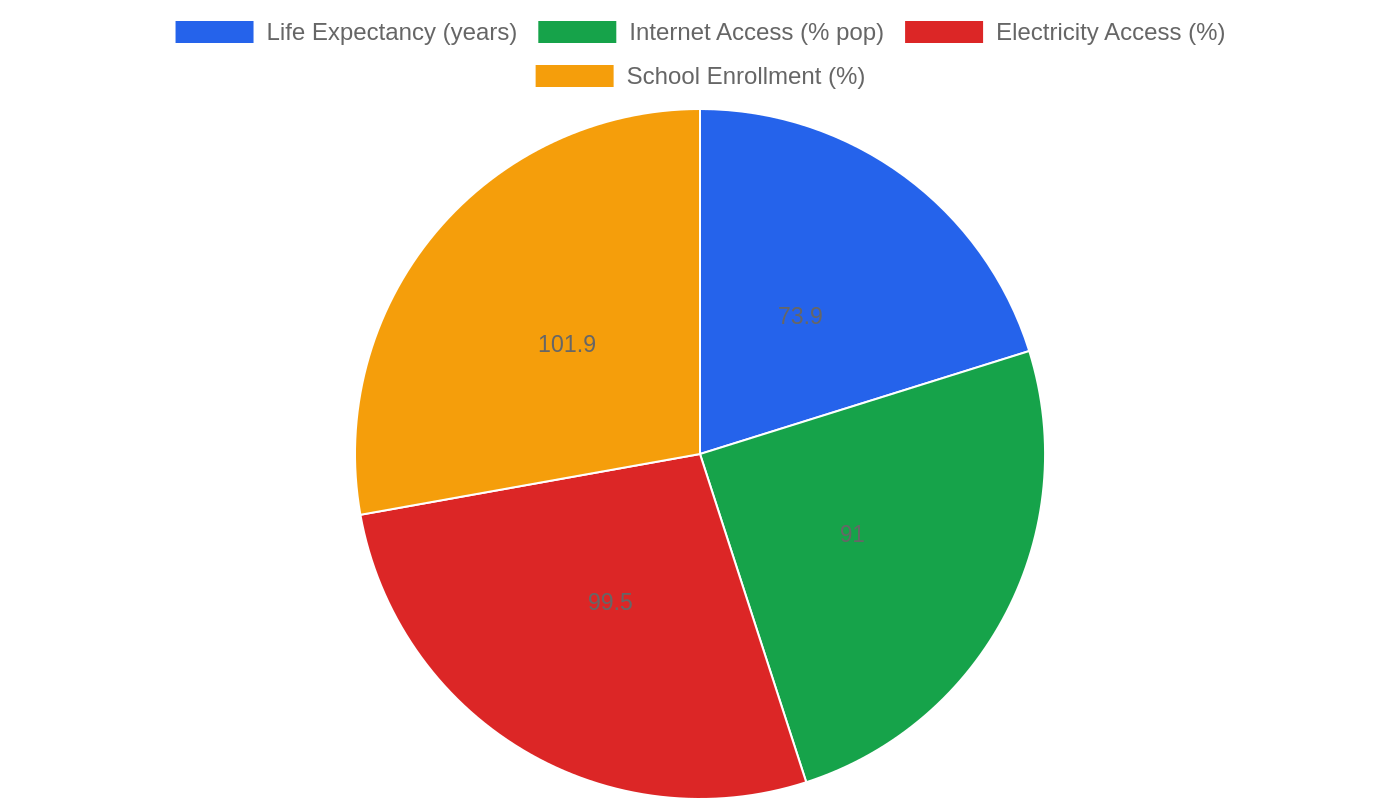
Economic Pulse Net | Sources: World Bank World Development Indicators, Government Sources | 2026
Key Takeaways
– Dominica operates as a parliamentary republic within the Commonwealth, with a unique political structure that blends British Westminster traditions with Caribbean republicanism.
– The economy remains heavily reliant on financial services and consumer industries, with the National Bank of Dominica and Swisscash among the top corporate players.
– Despite gaps in official macroeconomic data, Dominica’s status as a citizenship-by-investment destination continues to shape its economic trajectory and fiscal policy.
– Political stability under a parliamentary system with an indirectly elected president provides a predictable environment for business, though transparency concerns persist around investment programmes.
– The country faces the classic Caribbean challenge of balancing tourism-driven development with environmental sustainability as a volcanic island vulnerable to climate shocks.
The Numbers Game — Where Dominica’s Economy Stands
When the World Bank’s latest data release arrives with blank cells for GDP growth, inflation, unemployment, and GDP per capita, one might assume Dominica has fallen off the statistical map. The reality is more nuanced. This Eastern Caribbean island of roughly 72,000 people operates in a data environment where official statistics often lag behind real-time economic activity.
What we do know, from the World Bank’s classification, is that Dominica is an upper-middle-income country whose economic story is written less in quarterly GDP releases and more in the steady hum of its financial sector and the quiet resilience of its service industries.
The absence of hard numbers does not mean the economy is static. Dominica’s main industries, while not enumerated in the available data, are widely understood to centre on tourism, agriculture (particularly bananas and citrus), and a growing offshore financial services sector. The country has aggressively marketed its Citizenship by Investment Programme, which since 1993 has allowed foreign nationals to acquire Dominican passports in exchange for contributions to a government fund or real estate investments.
This programme has become a major revenue stream, effectively functioning as an invisible export — selling citizenship rather than goods.
What makes Dominica’s economic situation distinctive is its vulnerability to external shocks. As a small island developing state, it faces structural challenges that larger economies do not: narrow export bases, high import dependence, and acute sensitivity to hurricanes and volcanic activity. The 2017 devastation wrought by Hurricane Maria, which destroyed an estimated 90% of the island’s housing stock, demonstrated how a single weather event can reset an entire economy.
Recovery spending and reconstruction have since driven fiscal dynamics, with government borrowing and citizenship programme revenues funding infrastructure rebuilds.
The financial sector, anchored by the National Bank of Dominica, provides the backbone for domestic credit and savings. Swisscash, another top company listed in the data, operates in the financial services space, though its exact activities and market position remain opaque without further disclosure. What is clear is that Dominica’s economy, like many Caribbean peers, runs on a mix of remittances, tourism receipts, and investment inflows — all of which are difficult to capture in traditional GDP accounting.
The World Bank’s blank cells may frustrate analysts, but they also tell a story: this is an economy that resists easy measurement.
The Cost of Island Living — Housing, Daily Expenses, and Economic Reality
Housing in Dominica presents a study in contrasts. In Roseau, the capital, a modest two-bedroom apartment can command rents that would surprise visitors expecting Caribbean affordability. The housing market has been reshaped by two forces: the post-hurricane reconstruction boom and the influx of foreign buyers participating in the citizenship-by-investment programme.
Approved real estate projects under the programme have driven up prices in desirable areas, creating a dual market where locals compete with international investors for limited housing stock.
The cost of living more broadly reflects Dominica’s import dependency. Nearly everything — from electronics to processed foods to building materials — must be shipped in, and those shipping costs are passed directly to consumers. Daily expenses for food staples, utilities, and transportation tend to run higher than in larger Caribbean nations like Jamaica or the Dominican Republic, though likely below the extremes of the more tourism-saturated islands such as Barbados or the Cayman Islands.
Without precise CPI data from the World Bank, one must rely on anecdotal evidence and regional comparisons: Dominica is cheaper than the Bahamas but more expensive than St. Vincent or Grenada for basic goods.
Renting versus buying presents a genuine calculation for newcomers. Purchase prices for approved citizenship-linked properties start at $200,000, which is the minimum investment threshold for the real estate option under the citizenship programme. For locals, however, the housing market operates differently, with informal arrangements and family land ownership playing significant roles.
The gap between the formal real estate market and the vernacular housing economy is wide, and official statistics likely capture only a fraction of actual transactions.
Business and Investment — Where the Money Moves
The corporate landscape in Dominica is dominated by three names from the available data: National Bank of Dominica, Swisscash, and The Chronicle. The National Bank of Dominica, as the country’s largest indigenous financial institution, serves as the primary conduit for domestic lending, mortgage finance, and government banking. Its health is essentially a proxy for the broader economy’s health.
Swisscash, meanwhile, represents the financial services sector that has become increasingly important as Dominica positions itself as a regional hub for investment and wealth management.
The Chronicle, operating in consumer services, speaks to the media and communications sector — a small but vital industry in a country where information flows can shape political and economic outcomes. These three companies, while not a comprehensive list, illustrate the narrow base of formal corporate activity. Dominica lacks the large manufacturing or technology sectors found in larger Caribbean economies.
Instead, its business environment is characterised by small and medium enterprises, family-owned businesses, and a significant informal sector that operates outside traditional corporate structures.
For investors, Dominica offers a stable regulatory environment under the Eastern Caribbean Central Bank and a legal system based on English common law. The citizenship-by-investment programme remains the most visible entry point for foreign capital, but it comes with reputational risks. Critics have raised concerns about due diligence standards and the programme’s potential for abuse, though the government has taken steps to strengthen vetting procedures.
The business climate is best described as manageable for those with local knowledge and patience — bureaucracy exists, but so does flexibility.
Safety, Politics, and Daily Life in the Nature Island
Dominica’s political landscape is defined by its unique constitutional arrangement. As a parliamentary republic within the Commonwealth, it combines a ceremonial president (indirectly elected) with a prime minister who holds executive power. The House of Assembly, a unicameral body of 30 members — 21 directly elected and 9 senators appointed by the president or elected by fellow members — provides the legislative framework.
This system has produced a stable political environment, with peaceful transitions of power and no history of military coups or civil conflict.
The crime and safety indices from the available data are blank, which in itself is a statement. Dominica is generally considered one of the safer Caribbean islands, with violent crime rates significantly lower than in Trinidad, Jamaica, or even Barbados. Petty crime, particularly theft and burglary, does occur, especially in urban areas and tourist zones, but the overall security environment is benign compared to regional peers.
The absence of a formal crime index from the World Bank may reflect the difficulty of collecting reliable crime statistics in small island states, but local reporting suggests a society where serious crime remains the exception rather than the rule.
Quality of life in Dominica is heavily influenced by the natural environment. The island’s volcanic peaks, rainforests, and hot springs earn it the nickname “Nature Island,” and for residents, access to unspoiled nature is a daily reality. Healthcare and education are provided through public systems that face the typical resource constraints of small island states.
The happiness data, or lack thereof, is unavailable, but Dominicans consistently rank moderate on regional well-being surveys, with strong community ties and cultural traditions offsetting economic limitations.
What’s Happening Now — Citizenship, Climate, and the Road Ahead
The current moment in Dominica is defined by the ongoing evolution of its citizenship-by-investment programme and the country’s positioning as a climate resilience laboratory. Following Hurricane Maria, the government embarked on an ambitious housing reconstruction programme that has fundamentally altered the built environment. New housing stock, much of it built to hurricane-resistant standards, has reshaped communities and created a construction boom that continues to ripple through the economy.
The citizenship programme itself faces headwinds. International pressure, particularly from the European Union and the United Kingdom, has pushed Caribbean nations to tighten due diligence and increase transparency. Dominica has responded by raising minimum investment thresholds and implementing stricter background checks, but the programme remains a source of controversy.
Critics argue that the sale of passports undermines the integrity of citizenship, while supporters point to the revenue as essential for a country with limited natural resources and high vulnerability to climate shocks.
On the policy front, the government has signalled continued commitment to renewable energy and climate adaptation, recognising that Dominica’s future depends on its ability to withstand hurricanes and rising sea levels. Geothermal energy development, long discussed as a potential game-changer for the island’s energy independence, remains a work in progress. The intersection of climate policy, citizenship revenue, and economic development will define Dominica’s trajectory for the next decade.
The Bottom Line
Dominica is a country that rewards those who look beyond the blank cells in the spreadsheets. Its economy may be small and its data sparse, but the island offers a genuine case study in how small states navigate the tension between development and preservation, between openness to foreign capital and protection of national sovereignty. Investors watching the citizenship programme should monitor regulatory changes closely.
Travellers and expatriates will find a safe, beautiful, and increasingly resilient island — provided they come with patience and respect for its delicate balance. For anyone interested in the future of small island economies in the age of climate change and global mobility, Dominica is a story worth following.
Sources & Methodology
This article is authored by Economic Pulse Net for informational and research purposes. Economic Pulse Net sources its data from multilateral institutions, national statistics bureaus, and proprietary databases. All data is believed to be current as of the date of publication.
Published: July 23, 2026 | Category: Research — Dominica
Use these signals in your own platform
Economic Pulse publishes its live signal feed through a documented, read-only API. Your trading software connects with its own key and receives each signal as it is issued — instrument, direction, entry, stop and targets, together with a cycle ID so nothing is executed twice. The feed is independent of this website and cannot change it.
Signals are informational only and are not financial advice.