Economic Pulse Net | Sources: World Bank World Development Indicators, Government Sources | 2026
Key Takeaways
– China’s GDP growth has cooled to 4.96% in 2025, a measured pace that reflects the country’s deliberate shift from breakneck expansion to “high-quality development.”
– Unemployment stands at 4.6%, remarkably low by global standards, suggesting the world’s second-largest economy is still generating jobs despite structural headwinds.
– The economy is now valued at nearly $19.5 trillion, with GDP per capita on a purchasing power parity basis exceeding $29,000 — placing China firmly in upper-middle-income territory.
– A wave of state-backed corporate champions — from Alibaba in technology to Agricultural Bank of China in finance — dominates the landscape, while consumer brands like Anta Sports and 361 Degrees signal rising domestic consumption power.
– Beijing is betting big on artificial intelligence and the digital economy, according to *China Daily*, as the Communist Party seeks to engineer the next phase of growth through technological self-sufficiency.
The Great Moderation — Why 4.96% Growth Is China’s New Normal
The headline figure from the World Bank — 4.95994886240992% GDP growth in 2025 — is a number that would have been considered a disappointment a decade ago, when double-digit expansion was routine. Today, it is a carefully managed achievement. China’s economy has entered what economists call the “great moderation”: a deliberate deceleration engineered by Beijing to pivot from quantity to quality.
Consider the scale. At nearly $19.5 trillion, China’s economy is so vast that even a 4.96% expansion adds roughly $965 billion in new output — the equivalent of adding an entire Sweden every year. The World Bank data shows GDP per capita on a purchasing power parity basis at $29,333. This is not yet wealthy by Western European standards, but it represents a tripling of living standards over the past two decades.
The GNI per capita of $14,230 tells a similar story: China has successfully lifted hundreds of millions from poverty into a burgeoning middle class.
Inflation data is not available from the World Bank for this period, but the unemployment rate of 4.615% is worth dwelling on. In an economy undergoing a painful property sector correction and a manufacturing transition toward higher-value production, keeping joblessness below 5% is a significant policy achievement.
The Chinese Communist Party treats employment as a “red line” — a non-negotiable priority — and the data suggests its interventions, including state-directed hiring and infrastructure spending, are working.
The main industries driving this growth are not explicitly listed in the data, but the composition of China’s top companies tells the story. The list includes technology (Alibaba Group), financials (Agricultural Bank of China), industrials (Amoi), consumer goods (Anta Sports, 361 Degrees), and basic materials (Aluminum Corporation of China). This is a diversified economy, but one where the state retains a heavy hand through state-owned enterprises and strategic planning.
The Cost of Living Puzzle — Affluence Amid Austerity
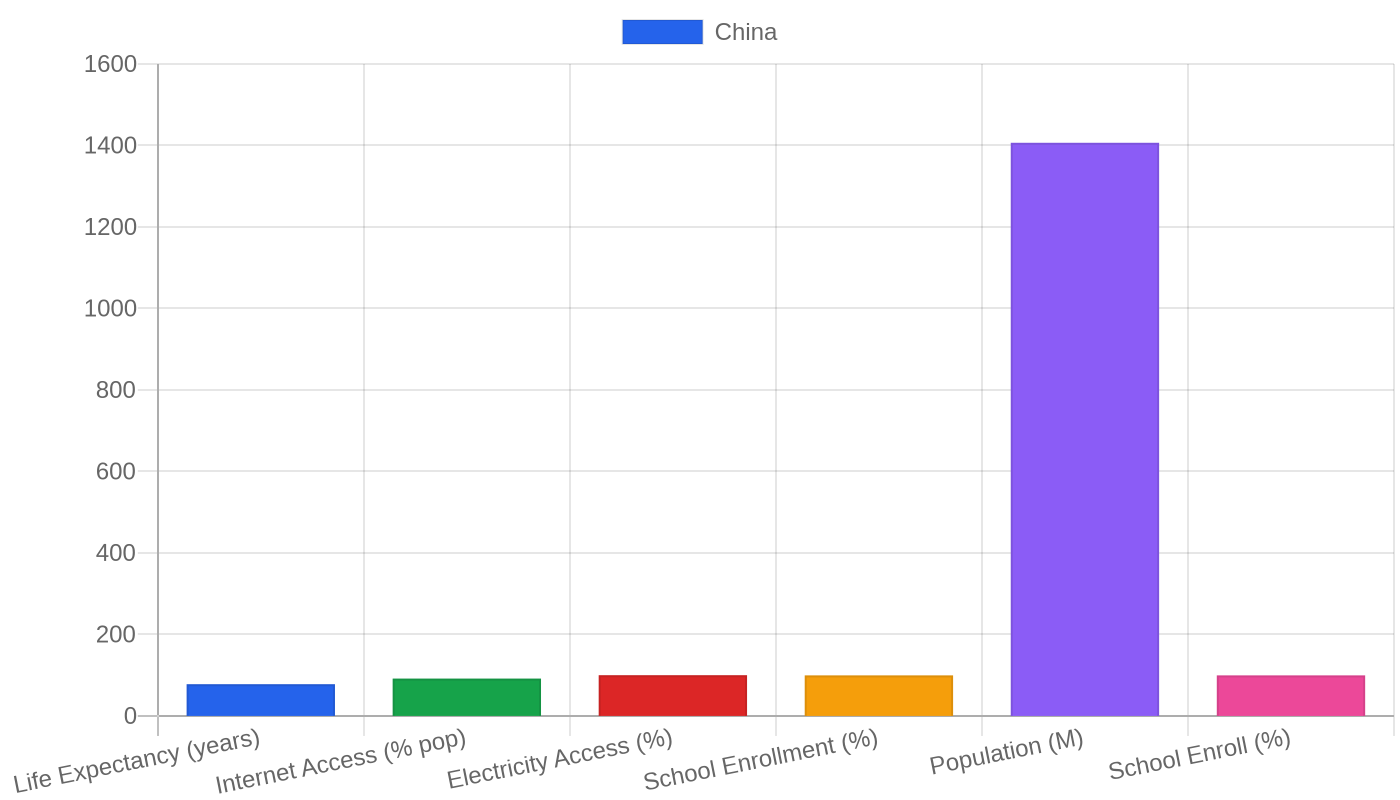
Housing data is not provided in the available information, but the broader picture of Chinese living costs can be inferred from the economic structure. With a GNI per capita of $14,230 and a population of 1.406 billion, China is a country of stark contrasts. In megacities like Shanghai, Beijing, and Shenzhen, the cost of living — particularly housing — has soared to levels that rival Tokyo or Singapore. A middle-class apartment in central Beijing can easily cost 20 to 30 times the average annual household income.
Yet China is also a nation where millions still live in smaller cities and rural areas where costs are dramatically lower. The government’s “common prosperity” campaign, championed by the Communist Party leadership, aims to narrow these gaps through redistribution, wage growth, and social welfare expansion.
Rent-to-buy dynamics vary enormously by region; in tier-one cities, renting is often the only realistic option for young professionals, while in smaller cities, homeownership rates remain high thanks to lower prices and family support.
Daily expenses for food, transportation, and utilities are generally affordable by developed-world standards, particularly for locally produced goods. The rise of domestic consumer brands like Anta Sports and 361 Degrees — both listed among China’s top companies — reflects a growing preference for Chinese-made products that offer quality at competitive prices. This “guochao” or national trend phenomenon is reshaping consumer behavior and reducing reliance on foreign imports.

Titans of Industry — Where the Smart Money Flows
The list of China’s top companies reads like a roll call of the country’s strategic priorities. Alibaba Group leads the technology charge, though it now operates under tighter regulatory supervision following Beijing’s crackdown on tech monopolies. The Agricultural Bank of China, one of the “Big Four” state-owned lenders, represents the financial backbone that channels credit to state-directed projects.
Air China connects the country’s vast geography, while Aluminum Corporation of China Limited feeds the industrial machine.
What is striking is the consumer goods presence. Anta Sports, 361 Degrees, Aigo, and Anker are all Chinese brands that have grown from domestic players into global competitors. This is not accidental. The Communist Party’s 14th Five-Year Plan explicitly calls for strengthening domestic consumption and building world-class Chinese brands. For investors, the sectors to watch are technology (particularly AI and semiconductors), green energy (solar, wind, and electric vehicles), and consumer goods.
The business environment, however, is not for the faint-hearted. Foreign companies face increasing regulatory complexity, data localization requirements, and a political landscape that prioritizes “national security” over market access. Yet the sheer size of the Chinese market — 1.4 billion consumers — means that multinationals continue to invest, albeit with greater caution. Domestic entrepreneurs, meanwhile, operate within a system that rewards alignment with state priorities and punishes deviation.
Stability Above All — Politics, Safety, and Daily Life
The World Bank provides no crime or safety index data for China, but the country’s reputation for public safety is well-established. Street crime is low in major cities, and violent crime is rare compared to many other nations of similar size. The government’s extensive surveillance infrastructure, including ubiquitous cameras and facial recognition technology, contributes to this security — though at a cost to privacy that many citizens accept in exchange for order.
Politically, China is defined by the absolute leadership of the Chinese Communist Party. The available data describes the PRC as a “unitary state” under the party’s control, governing through a framework the CCP calls “socialism with Chinese characteristics.” Academic sources cited in the data characterize the system as authoritarian, though the government itself emphasizes its socialist and democratic credentials.
For the average citizen, the trade-off is clear: political freedoms are limited, but the state delivers stability, economic growth, and gradually improving social services.
Quality of life in China has improved dramatically over the past generation. Life expectancy has risen, extreme poverty has been eliminated, and access to education and healthcare has expanded. Yet challenges remain: air pollution, though improved, still plagues northern cities; the healthcare system is overburdened; and the aging population — a consequence of the now-reversed one-child policy — will strain public finances in the decades ahead.
The AI Revolution — China’s Digital Leap Forward
According to *China Daily*, the country is making significant strides in artificial intelligence and the digital economy. A report from the state-affiliated newspaper, headlined “In numbers: China’s AI and digital economy achievements,” highlights Beijing’s push to make technology the primary engine of future growth. This is not merely a corporate trend; it is a national strategy backed by billions in state funding, preferential policies, and the mobilization of research institutions.
The timing is critical. As China’s traditional growth drivers — real estate, infrastructure, and low-cost manufacturing — lose momentum, the Communist Party is betting that AI, big data, and automation can fill the gap. The “Business+” section of *China Daily* has been tracking these developments closely, reporting on everything from smart manufacturing to fintech innovation. For a country that once competed on labor costs, the goal now is to compete on algorithms.
This digital transformation has real-world implications. It means more efficient supply chains, personalized consumer services, and potentially a leapfrogging of traditional industrial stages. It also raises questions about employment — will AI create more jobs than it destroys? — and about surveillance, as the same technologies used for economic development are also deployed for social control.
For now, the government’s message is relentlessly optimistic: China is not just participating in the Fourth Industrial Revolution; it aims to lead it.
The Bottom Line
China in 2025 is an economy in transition — slower but more sophisticated, more regulated but more technologically advanced. For investors, the opportunities lie in sectors aligned with state priorities: AI, green energy, and domestic consumption. For businesses, the market remains irresistible but increasingly complex. For the Chinese people, the bargain of stability and rising living standards in exchange for political conformity continues to hold.
This is a country that has mastered the art of managed change — and the world is watching to see where it leads.
Sources & Methodology
This article is authored by Economic Pulse Net for informational and research purposes. Economic Pulse Net sources its data from multilateral institutions, national statistics bureaus, and proprietary databases. All data is believed to be current as of the date of publication.
Published: July 23, 2026 | Category: Research — China
Use these signals in your own platform
Economic Pulse publishes its live signal feed through a documented, read-only API. Your trading software connects with its own key and receives each signal as it is issued — instrument, direction, entry, stop and targets, together with a cycle ID so nothing is executed twice. The feed is independent of this website and cannot change it.
Signals are informational only and are not financial advice.