Economic Pulse Net | Sources: World Bank World Development Indicators, Government Sources | 2026
Key Takeaways
* Political Structure: Haiti operates as a semi-presidential republic with a multiparty system, where the president serves as head of state and the prime minister acts as head of government.
Corporate Landscape: The business environment is dominated by financial institutions like Bank of the Republic of Haiti and Banque de l’Union Haïtienne, alongside consumer goods giants such as Brasserie Nationale d’Haïti.
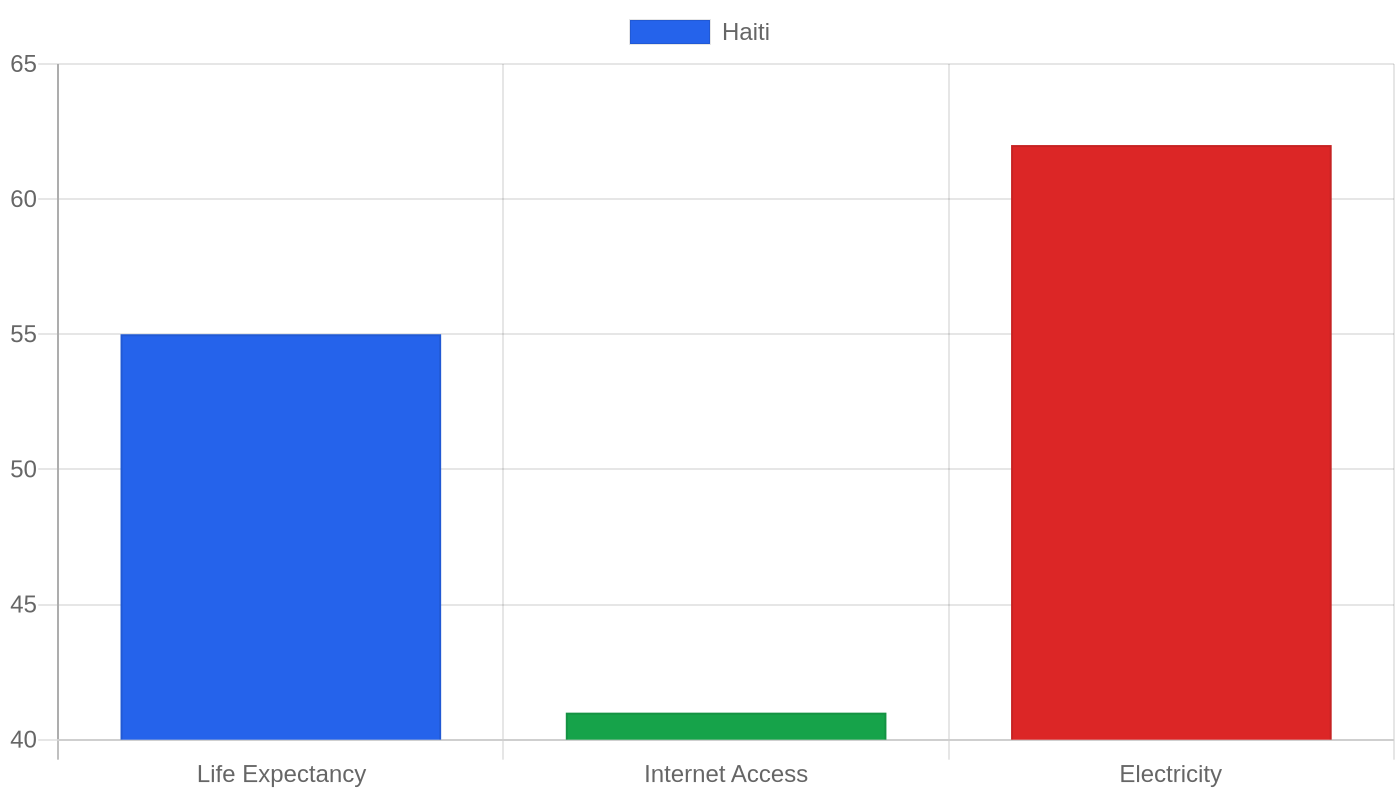
Data Gaps: Comprehensive macroeconomic indicators, including GDP growth, inflation rates, and unemployment figures, are currently unavailable from the World Bank, reflecting broader statistical challenges.
Security Concerns: Specific crime and safety indices are not currently reported, necessitating caution for any foreign entities or individuals assessing operational risks.
Economic Foundations and Structural Challenges
The economic narrative of Haiti is currently defined by significant data voids that obscure traditional metrics of health and growth. According to the World Bank, key indicators such as GDP growth, inflation CPI, and unemployment rates are listed as N/A%, signaling either a lack of recent reporting or systemic difficulties in capturing real-time economic activity.
Similarly, total GDP in USD, GDP per capita (PPP), and GNI per capita remain unreported, making it difficult to benchmark Haiti’s performance against regional peers using standard international standards. This absence of hard data suggests an economy that may be operating largely outside formal statistical frameworks, potentially relying heavily on informal sectors that escape traditional measurement.
Without clear figures on population size or income levels, analysts must look to industrial output and corporate stability as proxy indicators for economic resilience. The inability to quantify these fundamental variables complicates policy-making and discourages large-scale foreign direct investment, as investors require predictable baselines for risk assessment.
Consequently, the economic story here is one of opacity, where the true scale of production and consumption remains hidden beneath the surface of official records.
Cost of Living and Daily Realities
For residents and expatriates alike, the cost of living in Haiti presents unique challenges that are difficult to quantify without robust consumer price index data. With inflation figures marked as N/A% by the World Bank, there is no official metric to track how rapidly the prices of essential goods and services are rising over time.
This lack of transparency extends to housing markets, where rent versus buy dynamics and daily expense fluctuations cannot be compared to regional averages due to missing baseline data. Individuals navigating this environment likely face unpredictable pricing structures, influenced by supply chain disruptions and currency volatility rather than stable market forces.
The absence of a Safety Index and Crime Index further complicates lifestyle planning, as security concerns often dictate neighborhood choices and insurance costs in ways that are not captured in standard economic surveys. Therefore, the day-to-day financial reality for those in Haiti is shaped more by immediate availability and local bargaining power than by broader macroeconomic trends.
Investment & Business Climate
Despite the macroeconomic uncertainties, Haiti maintains a distinct corporate landscape driven by a handful of major players across financial and consumer sectors. The banking sector is anchored by institutions such as Bank of the Republic of Haiti, Banque de l’Union Haïtienne, Capital Bank, and Fonkoze, which provide critical liquidity and microfinance services to the population.
In the consumer goods space, companies like Brasserie de la Couronne, Brasserie Nationale d’Haïti, and Comme Il Faut dominate local production, indicating a strong domestic manufacturing base for everyday necessities. The presence of conglomerates like GB Group and consumer service providers such as Caribintair and Balistrad suggests diversification beyond basic commodities into telecommunications and specialized services.
These top companies operate within a framework that requires adaptability, given the lack of comprehensive economic data to guide long-term strategic planning. For investors, the focus remains on identifying resilient businesses that can withstand external shocks while serving core domestic needs. The concentration of power among these specific firms highlights both the opportunities for partnership and the risks associated with limited market competition.
Safety, Politics & Quality of Life
The political architecture of Haiti is formally structured as a semi-presidential republic featuring a multiparty system, yet this framework operates under significant strain. The president, elected directly by popular vote every five years, serves as head of state but is restricted from serving two consecutive terms or more than two terms in total. Executive power is shared with the prime minister, who acts as head of government and is appointed by the president from the majority party in the National Assembly.
This division of authority aims to balance democratic representation with administrative efficiency, though historical precedents suggest frequent tensions between these branches. Regarding personal security, current Crime and Safety Indices are listed as N/A, leaving little objective guidance for travelers or residents assessing daily risks.
The combination of complex political rules and unclear safety metrics creates an environment where quality of life is heavily dependent on individual circumstances and localized conditions. Understanding the legal constraints on presidential tenure provides insight into potential future leadership transitions, but does not guarantee political stability.
What’s Happening Now / Current Affairs
The current affairs landscape in Haiti is characterized by institutional continuity amidst underlying uncertainty, as detailed in recent governmental descriptions. The ongoing political structure relies on the established protocol of presidential elections held quinquennially, ensuring a regular cycle of leadership renewal within constitutional limits.
While specific recent news events are not detailed in the provided data, the emphasis on the appointment process for the prime minister underscores the importance of coalition-building within the National Assembly. The operational status of major banks and consumer goods companies indicates that essential economic functions continue despite the lack of updated macroeconomic statistics.
Stakeholders are likely monitoring the interplay between executive appointments and legislative support to gauge short-term policy directions. The absence of new data points suggests that the immediate focus remains on maintaining basic governance structures rather than implementing sweeping reforms. Observers should watch for any shifts in the balance of power between the presidency and the parliament, as these changes could alter the business climate significantly.
The Bottom Line
Haiti presents a complex case for observers, where formal economic data is insufficient to guide traditional investment analysis. The country’s strength lies in its established corporate entities and functional political framework, even as statistical gaps hinder precise evaluation. Investors and policymakers must rely on qualitative assessments of major companies and political stability rather than quantitative growth metrics.
This environment favors those who can navigate ambiguity and engage with local market leaders directly.
Sources & Methodology
This article is authored by Economic Pulse Net for informational and research purposes. Economic Pulse Net sources its data from multilateral institutions, national statistics bureaus, and proprietary databases. All data is believed to be current as of the date of publication.
Published: October 22, 2026 | Category: Research — Haiti
Use these signals in your own platform
Economic Pulse publishes its live signal feed through a documented, read-only API. Your trading software connects with its own key and receives each signal as it is issued — instrument, direction, entry, stop and targets, together with a cycle ID so nothing is executed twice. The feed is independent of this website and cannot change it.
Signals are informational only and are not financial advice.