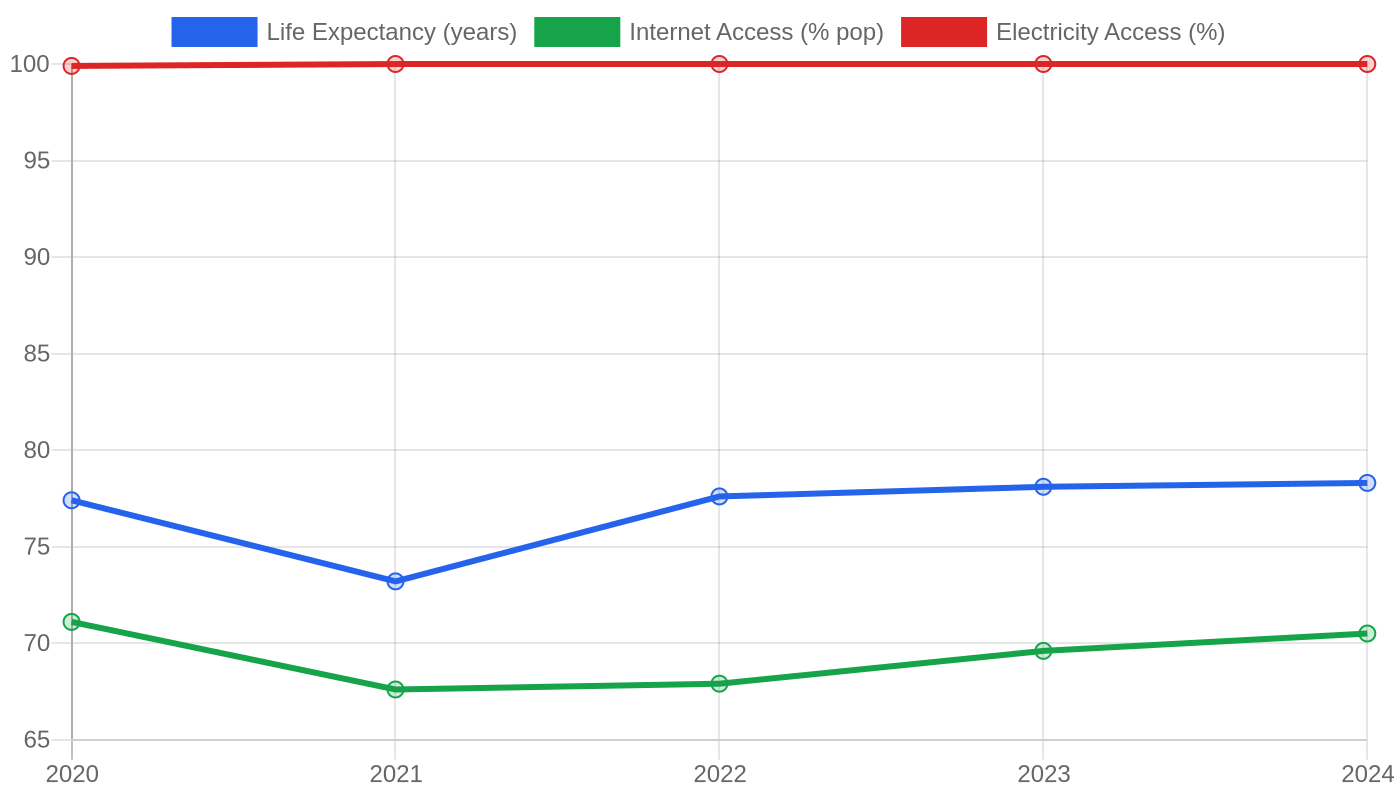
Economic Pulse Net | Sources: World Bank World Development Indicators, Government Sources | 2026
Key Takeaways
* State-Dominated Structure: Cuba operates as a unitary one-party socialist state where the Communist Party serves as the “leading force of society and of the state,” fundamentally shaping all economic activity.
Data Scarcity: Official macroeconomic indicators, including GDP growth, inflation, and unemployment figures from the World Bank, are currently listed as N/A, reflecting the opacity of the national accounts.
Monopolistic Industries: The economy is anchored by state-controlled giants in aviation, tobacco, energy, and telecommunications, with no private multinational competitors dominating the landscape.
Political Stability via Ideology: The political system remains rigidly guided by Marxism-Leninism and the ideas of José Martí, ensuring policy continuity over market liberalization.
Investment Constraints: While major entities like Habanos S.A.
and ETECSA operate globally or nationally, the business environment is defined by strict state oversight rather than open market dynamics.
The Architecture of a Command Economy
The Cuban economic landscape is defined less by fluid market forces and more by the rigid architecture of a centrally planned system. According to the World Bank, specific macroeconomic metrics such as GDP growth, inflation CPI, and unemployment rates are currently recorded as N/A, indicating a significant gap in transparent, real-time data reporting that complicates external analysis.
This lack of visible data is not merely a statistical omission but a reflection of an economic model where production targets and resource allocation are determined by state planning rather than consumer demand signals. Without clear GDP per capita (PPP) or GNI per capita figures, international investors and economists must rely on qualitative assessments of industrial output rather than quantitative benchmarks.
The absence of these standard indicators suggests that the Cuban economy functions in a parallel universe of accounting, where value is measured in strategic autonomy and social stability rather than traditional financial returns. Consequently, any assessment of economic health requires looking past the missing numbers to examine the operational capacity of key state enterprises.
This opacity creates a high barrier to entry for foreign capital, as the true cost of doing business and the actual liquidity within the system remain obscured behind closed doors. The economy’s resilience, therefore, is tested not by its ability to grow its GDP in percentage terms, but by its capacity to maintain essential services and industrial output under external pressure.
The High Cost of Isolation and Scarcity
While specific cost-of-living indices and housing market data are unavailable, the general economic reality in Cuba is shaped by scarcity and state pricing mechanisms. In a system where the majority of goods and services are distributed through state channels, the true cost of living is often reflected in long queues, limited availability, and a dual-currency legacy that has recently undergone complex reforms.
Daily expenses for basic necessities are heavily subsidized or rationed, yet the black market premium for imported goods can be exorbitant, creating a stark divide between those with access to hard currency and those reliant on the peso. Housing markets do not operate on conventional supply-and-demand principles; instead, property transactions are subject to strict legal frameworks and bureaucratic approval, limiting liquidity and speculative investment.
Compared to regional averages in Latin America, the purchasing power of the average Cuban is significantly constrained by low wages and limited import options. This environment means that while nominal costs may appear low, the effective cost of accessing quality goods and services is high due to inefficiencies and shortages. Residents must navigate a complex web of informal networks to secure essentials, making social capital as valuable as financial capital in daily life.
State Giants and Strategic Sectors
The business climate in Cuba is dominated by large, state-owned enterprises that control critical sectors of the economy. Top companies such as Cubatabaco and Habanos S.A. are global leaders in the premium cigar industry, leveraging brand heritage to generate vital foreign exchange earnings. In the energy sector, Cuba Petróleo Unión manages oil and gas resources, a strategic asset given the country’s reliance on imported fuels.
The telecommunications landscape is controlled by ETECSA, which holds a monopoly on internet and mobile services, a sector that is increasingly crucial for both business and social connectivity. Aviation services are provided by state carriers like Aero Caribbean, Aerotaxi, and Cubana de Aviación, which facilitate tourism and transport despite the challenges of maintaining aging fleets.
The Central Bank of Cuba oversees financial regulations, ensuring that monetary policy aligns with the broader goals of the socialist state. These entities operate with minimal competition, allowing them to set prices and allocate resources according to state directives rather than market pressures. For foreign investors, engaging with these companies often requires navigating complex joint-venture structures and adhering to strict regulatory compliance.
The dominance of these firms highlights an economy where scale and state backing are the primary drivers of success, rather than innovation or efficiency alone.
Political Rigidity and Social Stability
Cuba’s political landscape is characterized by its adherence to Marxism-Leninism and the guiding ideas of José Martí, creating a stable but inflexible governance structure. The Constitution, amended in 1992 and 2002, explicitly defines the Communist Party of Cuba as the “leading force of society and of the state,” ensuring that political decisions are aligned with ideological consistency.
This democratic centralist approach minimizes political volatility but also limits pluralism and dissent, which can impact social cohesion and individual freedoms. Crime and safety indices are not publicly reported by major international bodies, leaving the actual security situation in the hands of local authorities and state media narratives.
The government maintains order through a robust security apparatus, which contributes to low levels of violent crime but also enforces strict controls on movement and assembly. Quality of life metrics, such as happiness or well-being scores, are difficult to assess independently due to the lack of free civil society organizations and independent polling. However, the state emphasizes achievements in healthcare and education as pillars of social stability, which provide a baseline of public service coverage.
This political framework ensures that economic policies are subordinate to national sovereignty and ideological purity, creating a predictable but restrictive environment for citizens and businesses alike.
Current Affairs and Economic Shifts
In the current period, Cuba continues to navigate the tensions between maintaining its socialist identity and addressing pressing economic needs. Recent developments suggest a gradual, albeit cautious, opening in certain sectors to attract foreign investment and technology. The government has been focusing on modernizing key industries such as tourism and biotechnology to generate hard currency without compromising state control.
There are ongoing discussions about digital transformation, driven by the need to improve efficiency in state enterprises and connect with the global economy. Meanwhile, the impact of external sanctions and supply chain disruptions remains a significant factor influencing domestic production and import capabilities. The state is also grappling with internal debates on how to best utilize remittances and private enterprise initiatives to supplement the official economy.
These shifts indicate a pragmatic approach to survival, where ideological commitments are balanced against the practical realities of resource constraints. Observers note that while large-scale reforms are unlikely, micro-level adjustments in agriculture, retail, and services are becoming more common. The future trajectory will likely depend on Cuba’s ability to leverage its human capital and strategic assets to foster sustainable growth within its unique political framework.
The Bottom Line
Cuba presents a unique case study for economists and policymakers interested in non-market economies and the resilience of state-led development models. Investors should view this country not as a traditional emerging market, but as a niche opportunity within highly regulated, state-partnered ventures. The lack of transparent data and the dominant role of the Communist Party require a high tolerance for political risk and bureaucratic complexity.
Ultimately, Cuba’s economic story is one of adaptation within constraints, offering insights into how socialist systems manage globalization and scarcity.
Sources & Methodology
This article is authored by Economic Pulse Net for informational and research purposes. Economic Pulse Net sources its data from multilateral institutions, national statistics bureaus, and proprietary databases. All data is believed to be current as of the date of publication.
Published: October 10, 2026 | Category: Research — Cuba
Use these signals in your own platform
Economic Pulse publishes its live signal feed through a documented, read-only API. Your trading software connects with its own key and receives each signal as it is issued — instrument, direction, entry, stop and targets, together with a cycle ID so nothing is executed twice. The feed is independent of this website and cannot change it.
Signals are informational only and are not financial advice.