Economic Pulse Net | Sources: World Bank World Development Indicators, Government Sources | 2026
Key Takeaways
* Growth Slowdown: Canada’s GDP growth is projected at just 1.74% for 2025, reflecting significant headwinds from global trade disputes and domestic economic constraints.
Price Stability Achieved: Inflation has cooled to a manageable 2.07%, suggesting that monetary policy efforts are stabilizing consumer prices despite broader geopolitical friction.
Labor Market Strain: With unemployment hovering near 6.9%, the labor market is showing signs of softening, impacting household spending power and economic velocity.
Trade War Impact: Recent analysis indicates that aggressive tariff policies from major trading partners are forcing a downward revision in growth forecasts, highlighting Canada’s vulnerability to external shocks.
Economic Headwinds and Structural Shifts
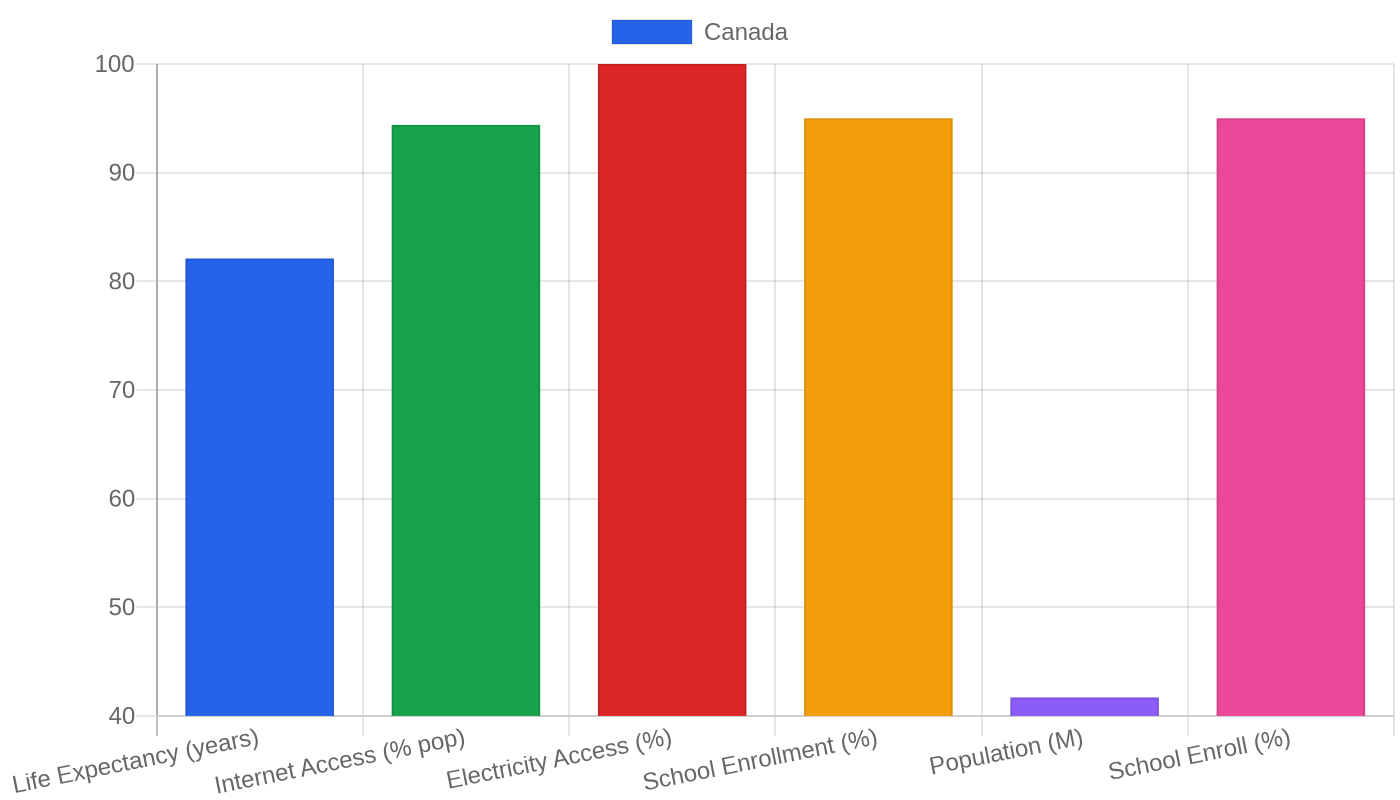
Canada’s economic landscape in 2025 is defined by a delicate balance between inherent stability and emerging external pressures. According to World Bank data, the nation’s Gross Domestic Product (GDP) stands at approximately $2.32 trillion USD, supporting a population of roughly 41.6 million people. This results in a substantial GDP per capita based on purchasing power parity (PPP) of $66,745.82, indicating a high standard of living relative to many global peers.
However, the trajectory of this growth is concerning; the economy is expected to expand by only 1.74268536175708% in 2025. This modest growth figure is not merely a reflection of slow internal momentum but is heavily influenced by international trade dynamics. Concurrently, inflation as measured by the Consumer Price Index (CPI) has settled at 2.07232411149103%.
While this rate is close to central bank targets and suggests price stability, it exists within an environment where unemployment remains elevated at 6.907%. The combination of slowing growth and persistent joblessness suggests that the Canadian economy is entering a period of consolidation rather than expansion. For policymakers, these numbers signal that traditional stimulus may have limited efficacy when faced with structural trade barriers.
The high GNI per capita of $56,420 underscores the wealth generated per individual, yet the aggregate growth metrics reveal a system under stress. Understanding these figures requires looking beyond the headline GDP to see how income distribution and employment levels are interacting with slower national output.
Cost of Living and Housing Dynamics
For residents and investors alike, the cost of living in Canada presents a complex picture shaped by high income levels and regional disparities. With a GNI per capita of $56,420, average earners possess significant purchasing power compared to global standards, allowing for a robust consumer services sector. However, the affordability of housing and daily necessities remains a critical topic, particularly in major urban centers where demand outpaces supply.
While specific rental indices are not detailed in the current dataset, the high GDP per capita implies that housing costs are likely significant, potentially consuming a larger portion of median incomes than in lower-income nations. The stability of inflation at roughly 2.07% provides some relief, preventing runaway price increases in essential goods and services.
Nevertheless, the interplay between high wages and high costs creates a unique economic ecosystem where disposable income can vary wildly depending on location. Consumers must navigate a market where premium services and real estate commands a high price tag, even as general goods remain relatively stable in price. This dynamic encourages a lifestyle that balances high-end consumption with careful budgeting, particularly as employment rates fluctuate.
Investment Climate and Corporate Landscape
The business environment in Canada is characterized by a diverse array of industries ranging from heavy manufacturing to digital logistics. Major corporations operating within this space include Norda Stelo, 3Way International Logistics, and Advanced Cyclotron Systems, each playing pivotal roles in their respective sectors such as industrials, logistics, and health care.
The presence of well-known consumer service brands like A&W, Addition Elle, and A Buck or Two highlights a vibrant domestic retail market that relies heavily on consumer confidence. Additionally, companies like ABS Friction in manufacturing and Access Communications in telecommunications demonstrate the breadth of Canada’s industrial base. These entities contribute to an economy that is increasingly focused on specialized services and technology-driven solutions.
Investors looking at the Canadian market should note the strength of the industrial sector, which includes firms like 1-800-GOT-JUNK? and Ache Records, indicating a mix of traditional and niche service offerings. The diversity of top companies suggests resilience, as no single sector dominates the entire economy to the point of systemic risk. However, the overall investment climate is currently being scrutinized due to potential disruptions in supply chains and cross-border trade flows.
Safety, Politics, and Social Stability
Canada continues to be recognized as a “full democracy” with a deep-rooted tradition of liberalism and egalitarian political ideology. Since the 1960s, social justice has become a distinguishing element of the nation’s political culture, influencing policy decisions and public discourse. Founding principles such as “peace, order, and good government,” alongside an Implied Bill of Rights, underpin the federal structure and provide a framework for moderate political engagement.
While specific crime and safety indices are listed as N/A in the current data, the political narrative emphasizes stability and social cohesion over punitive measures. This moderate ideological stance fosters an environment where civil liberties and community welfare are prioritized, contributing to a generally safe and predictable society. The emphasis on peace and order supports long-term planning for businesses and residents who value regulatory consistency.
Furthermore, the country’s commitment to social justice often translates into strong public services and safety nets, which help mitigate economic shocks for vulnerable populations. This political stability is a key asset, providing a secure backdrop against which economic volatility can be managed.
What’s Happening Now: The Tariff Shock
The most pressing issue facing Canada right now is the impact of international trade wars, specifically those initiated by the United States under the Trump administration. Deloitte Canada has recently cut its GDP growth forecast by 20%, citing the grip of tariffs on the domestic economy. This significant downward revision, reported by CBC News Business, signals that the anticipated benefits of free trade are being eroded by protectionist policies.
The business community is responding with caution, as outlined in recent briefs from The Globe and Mail and CBC, which highlight growing uncertainty among corporate leaders. These tariffs threaten to disrupt established supply chains, particularly affecting industries reliant on cross-border commerce. As a result, businesses are reassessing their strategies, potentially leading to reduced investment and hiring in the short term.
The speed of this forecast adjustment underscores the suddenness of the economic shock and the lack of preparedness for such aggressive trade measures. Stakeholders are now closely monitoring policy responses and potential retaliatory measures that could further complicate the economic outlook.
The Bottom Line
Canada remains a wealthy, stable democracy with a high standard of living, but it faces immediate headwinds from global trade tensions. Investors and analysts should watch how the 20% growth forecast revision plays out in subsequent quarters, as it may indicate deeper structural challenges. While the low inflation rate is positive, the rising unemployment and trade barriers require careful navigation.
Ultimately, Canada’s resilience lies in its diversified economy and political stability, but its near-term performance will depend heavily on resolving international trade disputes.
Sources & Methodology
This article is authored by Economic Pulse Net for informational and research purposes. Economic Pulse Net sources its data from multilateral institutions, national statistics bureaus, and proprietary databases. All data is believed to be current as of the date of publication.
Published: October 02, 2026 | Category: Research — Canada
Use these signals in your own platform
Economic Pulse publishes its live signal feed through a documented, read-only API. Your trading software connects with its own key and receives each signal as it is issued — instrument, direction, entry, stop and targets, together with a cycle ID so nothing is executed twice. The feed is independent of this website and cannot change it.
Signals are informational only and are not financial advice.