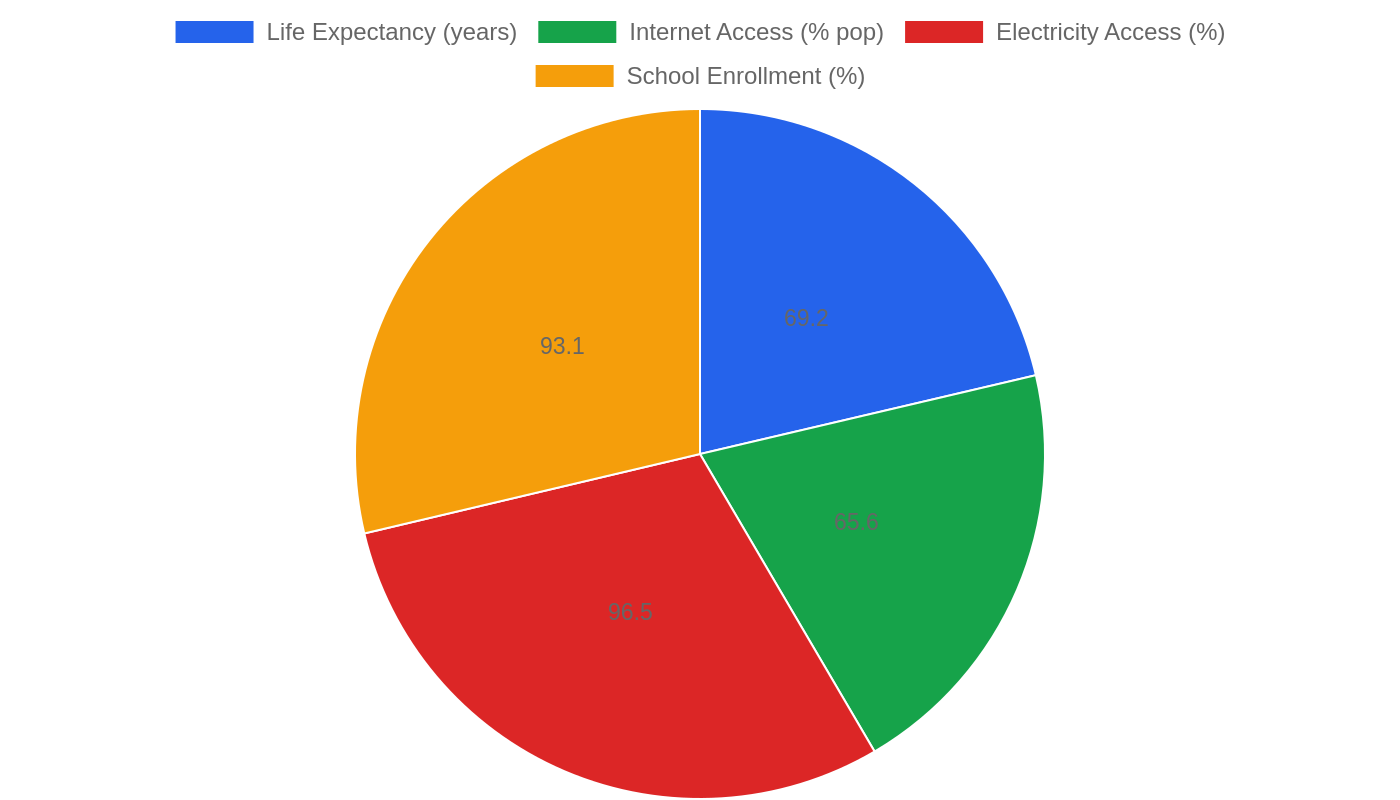
Economic Pulse Net | Sources: World Bank World Development Indicators, Government Sources | 2026
Key Takeaways
* Authoritarian Stability: The Lao People’s Democratic Republic (LPDR) operates as a unitary communist state, ranking as the lowest among ASEAN nations in democratic indices, which provides political continuity but limits political pluralism.
State-Dominated Economy: Major economic activities are controlled by state-owned enterprises and utilities, with the Lao Holding State Enterprise playing a pivotal role in the utilities sector alongside private or semi-private entities like Lao Airlines.
Infrastructure-Driven Growth: The economy is heavily reliant on energy exports and consumer services, with key players such as Nam Theun 2 Power Company driving utility revenues and aviation firms supporting connectivity.
Data Transparency Gaps: Standard macroeconomic indicators such as GDP growth, inflation rates, and unemployment figures are currently reported as unavailable, suggesting limited statistical transparency for international investors.
Regime Classification: Despite self-designating as a “people’s democratic state” pursuing a transition to socialism, external observers classify the regime as authoritarian, highlighting a disconnect between domestic rhetoric and international perception.
The Engine of State: Industries and Macro Realities
The economic landscape of Laos is defined less by vibrant market competition and more by strategic state control over critical infrastructure and resources. According to World Bank data, specific metrics regarding GDP growth, inflation, and unemployment remain unreported, creating a veil of opacity around the country’s immediate economic health. However, the structural composition of the economy reveals a heavy reliance on utilities and consumer services.
The presence of major entities like Electricite du Laos and Nam Theun 2 Power Company indicates that hydropower generation is a cornerstone of national revenue, likely serving both domestic needs and export markets. This focus on utilities suggests that Laos is positioning itself as an energy hub within the region, leveraging its natural resources to drive industrial output.
Simultaneously, the consumer services sector is robustly represented by Boun Oum Airways, Lao Airlines, Lao Central Airlines, and Lao Skyway, pointing to a growing emphasis on connectivity and tourism. These aviation companies facilitate the movement of goods and people, essential for a landlocked nation seeking to integrate into regional trade networks.
While precise GDP per capita figures are missing, the dominance of these sectors implies an economy transitioning from pure agrarian roots toward service and energy-based value creation. The lack of available data on population and GNI per capita makes it difficult to assess individual prosperity, but the industry list paints a picture of a state-guided development model where large-scale projects dictate economic momentum.
Living Costs and Daily Expenses
For residents and expatriates alike, understanding the cost of living in Laos requires navigating a market shaped by state influence and limited data transparency. Detailed housing costs, rent-to-buy ratios, and daily expense breakdowns are not explicitly quantified in the provided datasets, forcing observers to infer trends from the broader business environment.
Typically, in economies dominated by state utilities like Electricite du Laos, energy costs may be subsidized or regulated differently than in free-market economies, potentially impacting household budgets. The availability of local consumer goods, exemplified by the Lao Brewery Company, suggests a functioning domestic manufacturing sector that can help stabilize prices for everyday items. However, without concrete inflation CPI figures, predicting the erosion of purchasing power remains speculative.
In the absence of hard numbers, one must assume that costs are influenced by import dependencies and currency stability, factors often correlated with the performance of the utility and aviation sectors. Compared to regional averages, the cost structure likely reflects a developing economy where basic necessities are accessible, but luxury goods and imported services may carry premium price tags due to logistical challenges inherent in a landlocked geography.
The interplay between state-controlled utilities and private consumer brands creates a unique pricing dynamic that defies simple comparison with neighboring nations lacking similar data constraints.
Investment Climate and Corporate Landscape
Investing in Laos offers a distinct profile characterized by state hegemony and emerging private enterprise in niche sectors. The corporate landscape is anchored by the Lao Holding State Enterprise, which oversees utilities, signaling that significant capital flows are directed through state channels rather than open markets. For foreign investors, this means that partnerships with state-owned entities are often prerequisites for accessing lucrative opportunities in energy and infrastructure.
Meanwhile, the aviation sector presents a more diversified investment theme, with multiple airlines including Lao Airlines, Boun Oum Airways, Lao Central Airlines, and Lao Skyway competing or cooperating to serve regional routes. This multiplicity of carriers suggests a competitive yet regulated environment within consumer services, offering potential avenues for joint ventures or operational improvements.
The Lao Brewery Company stands out as a key player in the consumer goods sector, indicating stable demand for branded products and a mature distribution network. Investors must navigate a political system classified as an authoritarian regime, which ensures policy continuity but may limit regulatory flexibility and transparency. The absence of standard economic indicators complicates risk assessment, requiring due diligence that goes beyond traditional financial modeling.
Ultimately, the business climate rewards those who can effectively engage with state structures while identifying gaps in the consumer services and utilities markets where efficiency gains are possible.
Safety, Politics, and Quality of Life
Life in Laos unfolds within a rigid political framework that significantly influences social stability and quality of life. The LPDR is constitutionally a unitary communist state that claims to be a “people’s democratic state,” yet this self-description contrasts sharply with international assessments.
The Economist’s Democracy Index 2016 categorized Laos as an “authoritarian regime,” placing it at the bottom of the nine ASEAN nations studied, which underscores the limited political freedoms and centralized power structure. This political reality contributes to a form of stability; however, it comes at the cost of political dissent and open debate.
Regarding personal safety, crime and safety indices are not currently available, leaving residents and visitors to rely on general perceptions of security in Southeast Asian capitals. The lack of data on happiness indices further obscures the subjective well-being of the population, making it difficult to gauge social satisfaction levels. Nevertheless, the structured nature of the government likely imposes order and reduces certain types of civil unrest common in more volatile regimes.
For expatriates, the combination of authoritarian governance and limited data transparency creates an environment where predictability is high, but autonomy is low. Understanding this political nuance is essential for anyone considering long-term residence or business operations in the country.
Current Affairs and Policy Shifts
The current affairs in Laos are dominated by the ongoing implementation of its socialist transition policies within a tightly controlled political environment. As a state that officially pursues the transition from capitalism to socialism before moving toward communism, recent developments likely focus on strengthening state control over strategic industries.
With no new election data or specific reform announcements provided in the latest indicators, the narrative remains centered on the consolidation of power by the Lao People’s Revolutionary Party. The continued operation and expansion of state-linked utilities like Nam Theun 2 Power Company suggest that energy infrastructure remains a primary vehicle for national development and revenue generation.
Aviation companies continue to operate, reflecting efforts to maintain regional connectivity despite global economic headwinds. Without visible shifts in democratic indicators or significant changes in the authoritarian classification, the status quo appears entrenched. Any recent news would likely revolve around administrative adjustments within the state enterprise sector rather than broad market liberalization.
The absence of live indicators on inflation or unemployment means that economic policy discussions are largely internal, focusing on maintaining growth through state-directed investment rather than responding to transparent public pressure.
The Bottom Line
Laos presents a unique case study for economists and investors interested in state-led development models within Southeast Asia. While the lack of transparent economic data poses challenges for precise valuation, the dominance of state utilities and a growing consumer services sector offer clear insights into the country’s economic priorities. Investors should approach the market with caution, recognizing the authoritarian political framework that ensures stability but limits openness.
This country is best suited for stakeholders comfortable with long-term engagement, state partnerships, and opaque regulatory environments.
Sources & Methodology
This article is authored by Economic Pulse Net for informational and research purposes. Economic Pulse Net sources its data from multilateral institutions, national statistics bureaus, and proprietary databases. All data is believed to be current as of the date of publication.
Published: October 02, 2026 | Category: Research — Laos
Use these signals in your own platform
Economic Pulse publishes its live signal feed through a documented, read-only API. Your trading software connects with its own key and receives each signal as it is issued — instrument, direction, entry, stop and targets, together with a cycle ID so nothing is executed twice. The feed is independent of this website and cannot change it.
Signals are informational only and are not financial advice.