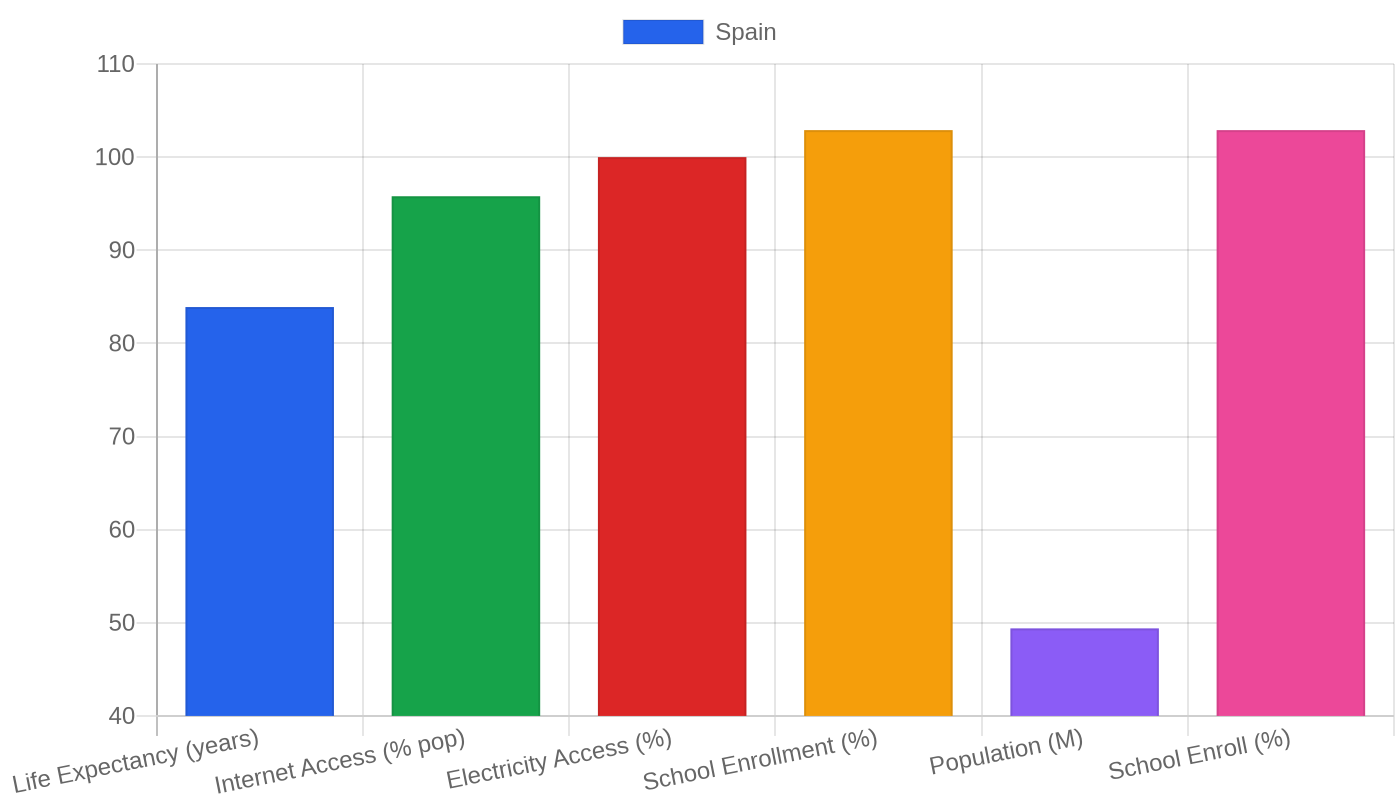
Economic Pulse Net | Sources: World Bank World Development Indicators, Government Sources | 2026
🇪🇸 Spain 2026 — Europe’s Quiet Growth Engine Faces Its Next Test
Spain has long been the eurozone’s perennial underachiever — a sun-soaked economy that boomed, busted, and spent the better part of a decade clawing its way back. But the latest World Bank figures tell a different story. With GDP growth of 2.82% in 2025, Spain is expanding at a pace that would make many of its northern neighbours envious, even as inflation cools and unemployment — though still stubbornly high — continues its slow retreat.
This is a country of nearly 50 million people, a $1.9 trillion economy, and a business landscape that stretches from renewable energy giants to global travel-technology platforms. The question now is whether Spain can convert this cyclical upswing into something more durable — or whether the old structural fault lines will reassert themselves.
Key Takeaways
– Spain’s economy grew 2.82% in 2025, according to the World Bank — a solid performance that outpaces much of the eurozone.
– Inflation has cooled to 2.70%, bringing price growth close to the European Central Bank’s target and easing pressure on household budgets.
– Unemployment remains the headline problem at 10.38% — more than double the eurozone average, though the direction of travel is downward.
– GDP per capita (PPP) stands at $59,868, placing Spain in the upper-middle tier of advanced economies.
– A diversified corporate base — from Acciona and ACS Group to Amadeus IT Group — underpins Spain’s export and services strength.
Growth With a Catch: The Numbers Behind Spain’s Expansion
Spain’s 2.82% GDP growth rate for 2025, as reported by the World Bank, is the kind of figure that turns heads in Brussels and Frankfurt. In a eurozone where several major economies have been flirting with stagnation, Spain’s expansion is a genuine bright spot. The country’s total output now stands at $1.906 trillion, making it one of the largest economies in the European Union.
On a per-capita basis, adjusting for purchasing power, Spaniards enjoy an average income of $59,868 — a figure that reflects a high-income economy with deep consumer markets.
But the headline growth number masks a persistent structural weakness: unemployment. At 10.38%, Spain’s jobless rate remains the highest among major European economies, a legacy of a labour market that relies heavily on temporary contracts and a services sector prone to seasonal swings. The good news is that inflation, at 2.70%, is no longer the household-budget menace it was during the post-pandemic surge.
That combination — steady growth, moderate inflation, falling but still elevated unemployment — is the central tension of Spain’s economic story in 2026. Growth is real, but its benefits are not yet evenly spread.
The Cost of Living Squeeze: Sun, Sangria, and Stretched Budgets
For ordinary Spaniards, the lived experience of this recovery is more complicated than the GDP figures suggest. Inflation at 2.70% may sound benign, but it comes on top of several years of accumulated price increases that have permanently reset the cost of everyday life. Housing — particularly in Madrid, Barcelona, and the coastal tourism hubs — remains the single biggest pressure point, with rents and purchase prices having outpaced wage growth for much of the past decade.
The gap between what a median household earns and what it costs to rent a modest apartment in a major city has become a defining political issue.
Compared with northern European peers, Spain still offers relatively affordable daily living — groceries, transport, and dining out remain cheaper than in France or Germany. But the regional divergence within Spain is stark: a euro stretches far further in Extremadura or Castilla-La Mancha than in Catalonia or the Balearic Islands.
For young Spaniards in particular, the combination of high unemployment and expensive urban housing has delayed independence and family formation, feeding a demographic challenge that no growth figure can solve on its own.
Corporate Spain: Where the Money Is Made
Spain’s corporate landscape is more diverse and internationally competitive than its tourism-heavy image suggests. The World Bank’s snapshot of leading firms reveals an economy anchored in industrials, infrastructure, and technology. ACS Group and **Acciona** are global players in construction, engineering, and renewable energy — sectors where Spanish firms have built genuine world-class expertise, particularly in wind and solar.
**Amadeus IT Group** is a quiet powerhouse of the global travel industry, processing reservations for airlines and travel agencies worldwide from its Madrid base.
Acerinox gives Spain a foothold in basic materials, as one of the world’s leading stainless steel producers. **Almirall** represents the country’s pharmaceutical ambitions, while **Atresmedia** and **Afinsa** reflect the strength of Spain’s media and consumer-services sectors. The presence of **Abengoa**, a conglomerate with deep roots in energy and engineering, underscores how much of Spain’s corporate identity is tied to infrastructure and the energy transition.
For investors, the through-line is clear: Spain’s competitive advantage lies in renewables, engineering, and services exports — sectors that are well-positioned for the decades ahead.
Stability, Sunlight, and the Democratic Dividend
Spain’s political story is one of the most remarkable in modern Europe. The constitutional history stretches back to the Constitution of 1812, but the modern democratic settlement was forged in the late 1970s. In June 1976, King Juan Carlos dismissed Carlos Arias Navarro and appointed the reformer Adolfo Suárez as Prime Minister — a pivotal decision that set the stage for the 1977 general election, which convened the Constituent Cortes to draft a new constitution.
After a national referendum on 6 December 1978, 88% of voters approved the document, cementing a democratic transition that became a model for the world.
That legacy matters in 2026. Spain today is a stable, functioning democracy within the European Union and NATO, with a quality of life that consistently ranks among the highest in Europe — long life expectancy, strong public healthcare, and a culture that prizes social connection. The country’s crime and safety indices were not available in the dataset provided, but Spain is widely regarded as one of the safer large economies in Western Europe, with low rates of violent crime relative to its size.
The political landscape is fragmented — no single party commands an outright majority — but the constitutional framework has proven resilient through decades of regional tensions and coalition politics.
What’s Happening Now: The Reform Agenda Meets the Ballot Box
The coming months will test whether Spain’s growth spurt can survive contact with politics. The government is under pressure to tackle the housing crisis, with proposals ranging from rent controls to public housing construction — measures that divide economists and voters alike.
At the same time, the labour market remains the subject of intense debate, as policymakers search for ways to bring the 10.38% unemployment rate down without undermining the flexibility that has made Spain an attractive destination for investment.
Inflation at 2.70% gives the European Central Bank room to manoeuvre on interest rates, which in turn affects Spanish mortgages — a large share of which are variable-rate, making Spanish households unusually sensitive to ECB decisions. Business groups are watching the renewable energy pipeline closely, with Acciona and ACS Group positioned to benefit from EU green-transition funding.
Meanwhile, the political calendar — including regional elections and ongoing negotiations over the national budget — will determine how much of the reform agenda actually becomes law. For now, the macro numbers are cooperating. The test is whether the politics can keep up.
The Bottom Line
Spain in 2026 is a country that has quietly become one of Europe’s better economic stories — solid growth, cooling inflation, and a corporate sector with genuine global reach. But the 10.38% unemployment rate is a reminder that the recovery is not yet broad enough, and the housing squeeze is a live political risk.
Investors should watch Spain for its renewable-energy and infrastructure champions; policymakers should watch it as a test case for whether southern European economies can convert cyclical growth into lasting prosperity. The sun is shining on Spain’s economy — but the hard work of reform is only beginning.
Sources & Methodology
This article is authored by Economic Pulse Net for informational and research purposes. Economic Pulse Net sources its data from multilateral institutions, national statistics bureaus, and proprietary databases. All data is believed to be current as of the date of publication.
Published: September 24, 2026 | Category: Research — Spain
Use these signals in your own platform
Economic Pulse publishes its live signal feed through a documented, read-only API. Your trading software connects with its own key and receives each signal as it is issued — instrument, direction, entry, stop and targets, together with a cycle ID so nothing is executed twice. The feed is independent of this website and cannot change it.
Signals are informational only and are not financial advice.