Economic Pulse Net | Sources: World Bank World Development Indicators, Government Sources | 2026
🇩🇿 Algeria 2026 — The Quiet Giant of North Africa Waits for Its Moment
Key Takeaways
– Algeria is a nation of immense strategic importance — Africa’s largest country by landmass, a major energy producer, and home to a young, growing population — yet it remains one of the most politically opaque economies in the region.
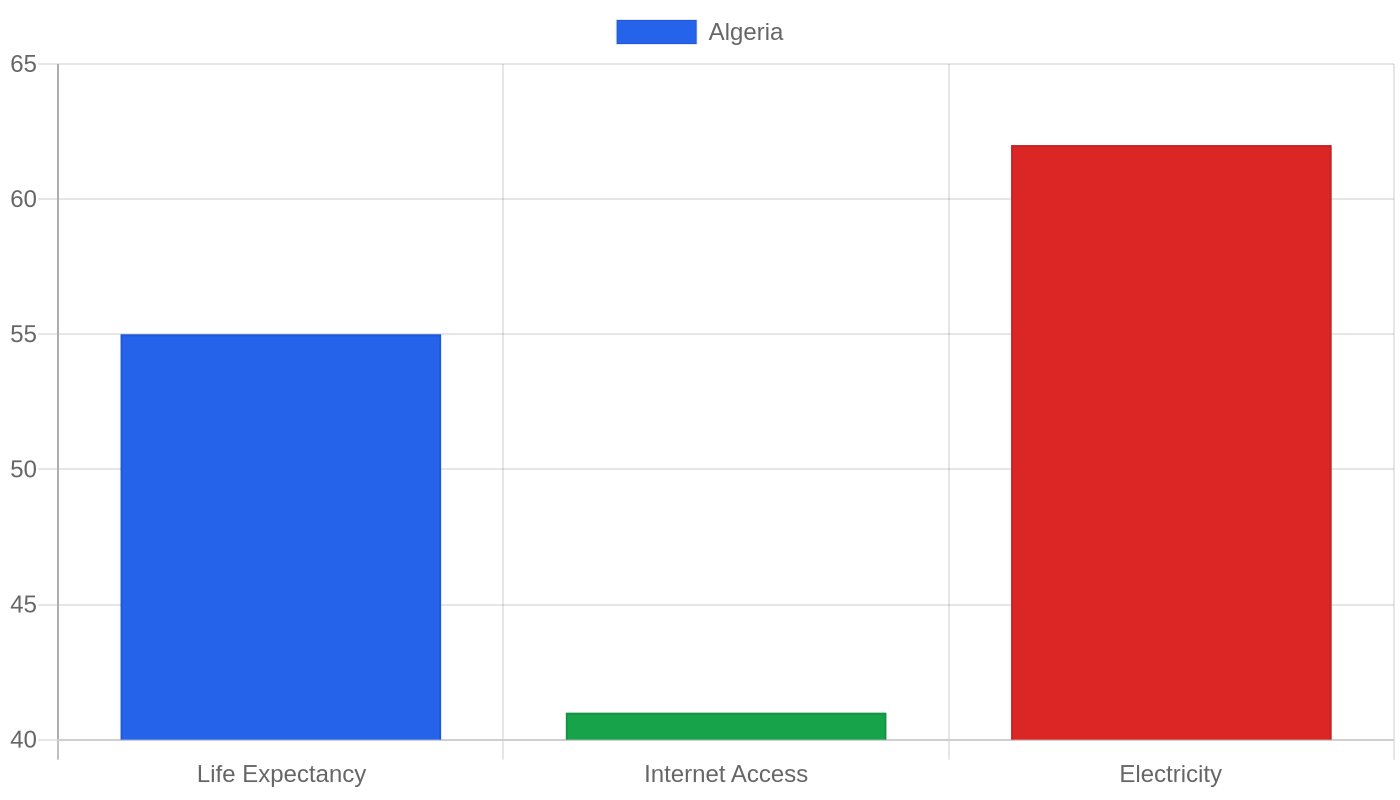
– The country’s economic data landscape is remarkably sparse: the World Bank lists GDP growth, inflation, unemployment, GDP per capita, and GNI per capita as unavailable, making independent assessment of living standards unusually difficult.
– A handful of powerful state-linked and private conglomerates — from Algérie Télécom and Djezzy to Cevital and Asmidal — dominate key sectors, signaling an economy where access and scale are tightly held.
– Political power does not flow from the ballot box. An unelected network of civilian and military “décideurs” — collectively known as “le pouvoir” — exercises de facto rule, even determining who becomes president.
– For investors and analysts, Algeria is a high-information-risk market: the opportunity is real, but the visibility is poor.
An Economy Shrouded in Silence
Algeria presents a paradox that should unsettle any serious economic observer. It is a vast nation — the largest in Africa — with substantial hydrocarbon reserves, a strategic Mediterranean coastline, and a population that, by regional standards, is relatively well educated. And yet, the most basic macroeconomic indicators are simply missing from the World Bank’s public data.
GDP growth, inflation, unemployment, total GDP, GDP per capita on a purchasing-power-parity basis, GNI per capita, and even the country’s population figure are all listed as unavailable. That absence is itself a data point: it tells us that Algeria’s statistical apparatus either cannot or will not produce timely, transparent numbers, and that international institutions lack the access they enjoy in most peer economies. For a country of Algeria’s size and geopolitical weight, this is extraordinary.
It means that anyone trying to understand the Algerian economy — whether a fund manager, a journalist, or a policymaker — is working largely in the dark, relying on inference, anecdote, and the occasional official statement. The practical consequence is a persistent “risk premium” baked into how the world treats Algeria: investors demand higher returns to compensate for what they cannot see, and multilateral lenders tread carefully.
In an era when even fragile states publish quarterly inflation prints, Algeria’s statistical quiet is a loud signal about how its economy is governed.
What Algerians Actually Pay — and Why We Can’t Fully Know
The cost of living in Algeria is, by most regional comparisons, moderate — but the absence of published inflation and housing data makes precise assessment impossible from the World Bank’s figures. What we can say is structural: Algeria operates a heavily subsidized economy, with the state historically cushioning citizens against food and fuel price shocks through transfers and price controls. That model is expensive, and it is financed overwhelmingly by hydrocarbon revenue.
When oil and gas prices are strong, Algerian households feel relatively protected; when they weaken, the subsidy bill becomes a fiscal flashpoint. Housing remains a chronic pressure point in Algerian cities, particularly Algiers, where demand from a young population outpaces formal supply — a dynamic familiar across North Africa, but intensified in Algeria by the state’s central role in land allocation and construction.
Without reliable rent, mortgage, or consumer-price data, Algerians themselves often rely on informal networks and word of mouth to gauge what things “should” cost. For a journalist, this is a frustrating but revealing situation: the cost-of-living conversation in Algeria is conducted in whispers and anecdote, not in published indices.
The Corporate Map: State Champions and Private Empires
Algeria’s corporate landscape is dominated by a small cast of large players, and the roster reads like a map of the country’s strategic priorities. On the state side, Algérie Télécom and Djezzy anchor telecommunications — a sector the government treats as a matter of national sovereignty. Algérie Poste provides financial and postal services to a wide swath of the population, functioning in many places as a de facto banking network.
In transport, Air Algérie, Air Express Algeria, Algérie Ferries, and Antinea Airlines reflect the country’s geography: a vast landmass and a diaspora-heavy population that needs to move by air and sea. In industry and resources, Asmidal (basic materials, tied to fertilizers and chemicals) and Cevital (consumer goods, one of the largest private conglomerates in the region) stand out. Echorouk TV rounds out the list as a major private media voice.
What this mix reveals is an economy where the commanding heights are held by the state or by a handful of well-connected private groups — a structure that concentrates opportunity and makes market entry for outsiders unusually difficult. Sectors to watch, if reform ever accelerates, are telecoms liberalization, agribusiness, and logistics — all areas where demand clearly exists but competition is thin.
Power Without Ballots: Politics, Safety, and Daily Life
Algeria’s political system is best understood as a managed equilibrium. The government has been described as authoritarian, and elected politicians hold relatively little sway over real affairs. Instead, a group of unelected civilian and military figures — the “décideurs,” collectively known as “le pouvoir” — exercise de facto rule, even deciding who should become president.
At one point, the most powerful figure in the country was reportedly Mohamed Mediène, the head of military intelligence, before his downfall amid the upheaval of 2019. This arrangement has profound implications for quality of life: policy continuity is high, but accountability is low, and citizens have limited formal channels to challenge decisions. Crime and safety indices for Algeria are not available in the provided data, which again limits an evidence-based assessment of public security.
What is clear is that the country’s stability is maintained through a combination of security-force presence, subsidy-driven social peace, and the careful management of elite rivalries. For ordinary Algerians, the trade-off is familiar across the region: order and predictability, purchased at the cost of political voice.
The 2019 Aftershock and Its Long Shadow
The single most consequential recent development shaping Algeria today is the 2019 protest movement and the elite rupture it triggered — the episode that brought down Mohamed Mediène, the long-serving head of military intelligence, and shook the foundations of “le pouvoir.” That moment exposed something the outside world had long suspected: Algeria’s stability rests on a delicate internal balance among security, military, and civilian power centers, and when that balance shifts, the entire system rattles.
Since then, the regime has worked to reassert control, but the underlying pressures — a young population demanding opportunity, an economy overly reliant on hydrocarbons, and a political class with limited popular legitimacy — have not gone away. The absence of current World Bank data on growth, inflation, and unemployment makes it impossible to say precisely how the post-2019 economy has performed, but the structural vulnerabilities are unmistakable.
Algeria today is a country managing its transition quietly, without the transparency that would allow outsiders — or its own citizens — to fully judge the results. Watch for any signs of statistical reopening or reform announcements; those will be the tell that the system is ready to be seen.
The Bottom Line
Algeria is a country that matters — for energy, for North African stability, and for the roughly 45 million people who live there — but it is also one of the least legible major economies in the world. The World Bank’s missing data is not a clerical oversight; it is a symptom of a system that prefers opacity to scrutiny. For investors, the message is caution and patience: the opportunities in telecoms, agribusiness, and logistics are real, but the information risk is unusually high.
For policymakers and analysts, Algeria deserves sustained attention precisely because so much about it remains unseen — and in economics, what you cannot measure, you cannot manage.
Sources & Methodology
This article is authored by Economic Pulse Net for informational and research purposes. Economic Pulse Net sources its data from multilateral institutions, national statistics bureaus, and proprietary databases. All data is believed to be current as of the date of publication.
Published: September 24, 2026 | Category: Research — Algeria
Use these signals in your own platform
Economic Pulse publishes its live signal feed through a documented, read-only API. Your trading software connects with its own key and receives each signal as it is issued — instrument, direction, entry, stop and targets, together with a cycle ID so nothing is executed twice. The feed is independent of this website and cannot change it.
Signals are informational only and are not financial advice.