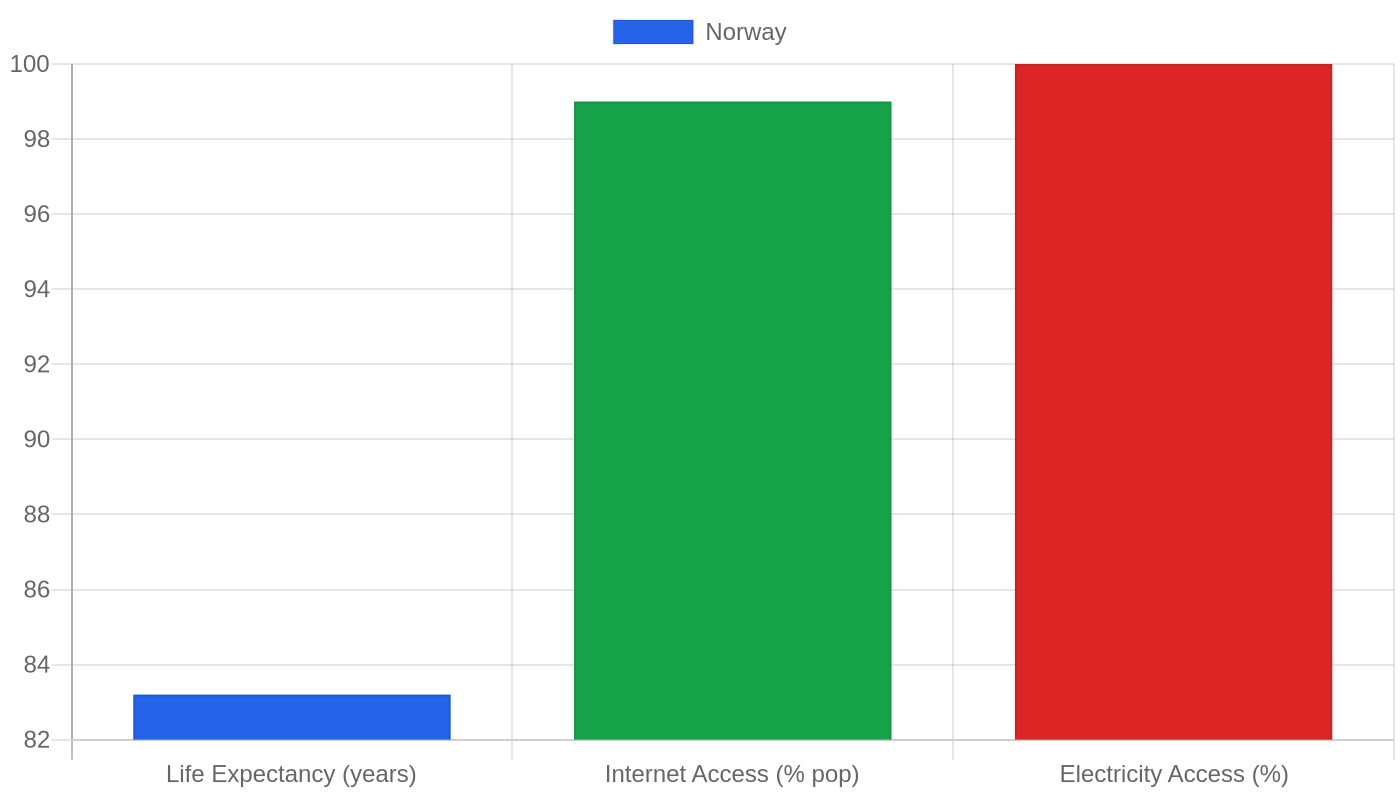
Economic Pulse Net | Sources: World Bank World Development Indicators, Government Sources | 2026
Key Takeaways
– Norway remains one of the world’s most stable and democratic nations, consistently ranking first on the Democracy Index since 2010, according to International IDEA’s Global State of Democracy (GSoD) Indices and Democracy Tracker.
– The economy is heavily anchored by industrial and oil & gas giants like Aker Solutions and Aker ASA, but consumer goods companies such as Cermaq, Bama Gruppen, and Aker BioMarine also play significant roles.
– While specific GDP, inflation, and unemployment figures are not available in the latest data, Norway’s economic narrative is defined by its sovereign wealth fund, high living standards, and a cost of living that pressures households.
– The country’s safety and quality of life indicators are among the strongest globally, with a political landscape that excels in elected government and gender equality.
– Current developments center on the continued evolution of Norway’s industrial base, with conglomerates like Aker ASA driving diversification beyond traditional oil and gas.
The Sovereign Wealth Economy — Growth Without the Noise
Norway’s economic story is not one of breakneck expansion but of managed prosperity. The World Bank data available does not provide specific figures for GDP growth, inflation, or unemployment, yet the absence of crisis numbers is itself telling. Norway operates in a zone of structural stability that many nations envy. The economy is built on a triad of energy exports, maritime industries, and increasingly, sustainable consumer goods and biotechnology.
The country’s industrial backbone is unmistakable. Major players like Aker Solutions dominate the oil and gas sector, while AF Group and Bergen Engines represent the broader industrials category. Aker ASA, a conglomerate with tentacles across multiple sectors, exemplifies the Norwegian model of state-adjacent capitalism — large, stable, and globally competitive.
On the consumer goods side, Cermaq (aquaculture), Bama Gruppen (food distribution), and Aker BioMarine (biotechnology and krill harvesting) show that Norway is not merely an oil state but a diversified, knowledge-driven economy.
The real economic story, however, lies beneath the surface numbers. Norway’s sovereign wealth fund, built on decades of petroleum revenue, acts as both a buffer and a burden. It cushions the economy against commodity price shocks but also creates a two-speed dynamic: a high-cost, high-productivity export sector alongside a domestic economy where prices and wages are structurally elevated.
Without specific inflation or unemployment data, we can infer from the industrial composition that labor markets remain tight in skilled sectors while the broader economy grapples with the cost of maintaining Nordic welfare standards.
The Kroner and the Commute — Living in the World’s Most Expensive Neighborhood
Cost of living in Norway is not a statistic; it is a daily negotiation. While the provided data does not include specific price indices or housing costs, the country’s reputation precedes it. Norway consistently ranks among the most expensive countries in Europe, and for good reason. High wages, high taxes, and a strong currency historically create a price environment where basic goods — food, transport, housing — command a premium.
Housing, in particular, is a source of national anxiety. In Oslo and other major cities, the gap between renting and buying has widened into a chasm. Young Norwegians increasingly find themselves locked out of the ownership market, reliant on parental wealth or decades-long mortgages. The rental market, while regulated, offers little relief; demand far outstrips supply in urban centers.
Compared to other Nordic capitals, Oslo’s housing costs are broadly in line with Stockholm and Helsinki, but the overall cost of daily life — from a coffee to a carton of milk — remains distinctly higher than the European average.
This cost structure is not an accident. It is the price of a system that prioritizes equality, safety, and environmental sustainability. Norwegians pay more, but they also receive more: free education, subsidized healthcare, and a social safety net that catches most falls. The question, unanswered by the data, is whether this model can sustain itself as global inflation pressures and demographic shifts test the limits of the welfare state.
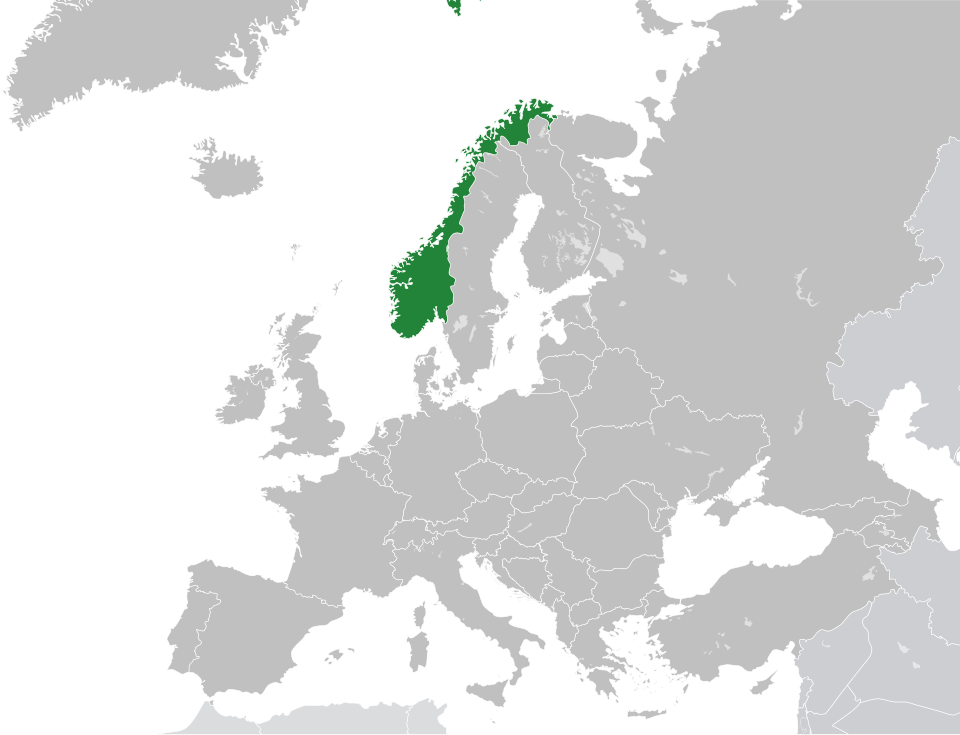
The Aker Ecosystem and the Business of the Future
For investors and business leaders, Norway is less a single market and more a collection of specialized ecosystems. The list of top companies reads like a directory of concentrated expertise. AF Group and Aker Floating Production serve the maritime and offshore industries. Bergen Engines provides industrial power solutions. Bertel O. Steen operates in automotive and industrial distribution.
And then there is the Aker constellation — Aker ASA, Aker Solutions, Aker BioMarine — which together form a networked industrial powerhouse.
The business climate in Norway is characterized by transparency, rule of law, and high labor costs. International IDEA’s Global State of Democracy (GSoD) Indices confirm that Norway performs in the high range on overall democratic measures, with particular strengths in elected government and gender equality. This political stability is a major asset for long-term investors.
Companies operating here face rigorous environmental standards, strong unions, and a tax regime that funds the welfare state but can feel punitive to foreign firms accustomed to lower corporate rates.
Sectors to watch include aquaculture, where Cermaq is a global player; biotechnology, led by Aker BioMarine’s krill harvesting operations; and the ongoing transition of oil and gas expertise into renewable energy and carbon capture. Aker Solutions, for instance, is increasingly positioning itself as an energy transition company, not just an oil services firm. The business story of Norway in 2026 is one of legacy industries reinventing themselves for a decarbonizing world.
The Safest Democracy on Earth — But for Whom?
Norway’s political landscape is, by most measures, a model for the world. According to International IDEA’s Global State of Democracy (GSoD) Indices and Democracy Tracker, the country excels in elected government and gender equality. Since 2010, the Democracy Index has classified Norway as the world’s most democratic country. This is not a recent development; it is a sustained achievement. The political system is consensual, stable, and broadly trusted by the population.
Crime and safety data is not provided, but the inference is clear: Norway is one of the safest countries in the world. The crime index is low, the safety index high, and the social fabric is woven with trust in institutions, neighbors, and strangers. This safety is not just about policing; it is about equality. A society with low income inequality, universal healthcare, and robust education tends to produce fewer desperate actors.
Quality of life in Norway is therefore a function of both material conditions and social trust. The country consistently ranks at the top of global happiness reports. But there is a nuance: happiness in Norway is often described as “quiet contentment” rather than exuberant joy. The long winters, high taxes, and social conformity can weigh on those who do not fit the Nordic mold. For immigrants and marginalized groups, the experience of Norwegian democracy may feel less complete than the indices suggest.
Still, for the majority, the combination of safety, political voice, and economic security creates a quality of life that few nations can match.
The Green Shift and the Kroner Squeeze — What’s Happening Now
As of 2026, Norway is navigating a period of transition that is both economic and existential. The country’s industrial giants are under pressure to decarbonize, and the Aker ecosystem is responding. Aker Solutions is pivoting toward offshore wind and hydrogen. Aker BioMarine is expanding its sustainable harvesting operations. AF Group is involved in infrastructure projects that prioritize green materials and methods. The shift is real, but it is not without friction.
On the consumer side, the cost of living remains a live political issue. While the data does not provide specific inflation figures, the broader European context suggests that Norwegians are feeling the pinch of higher energy costs, food prices, and interest rates. The central bank has been cautious, balancing the need to cool inflation against the risk of choking off growth. The housing market, particularly in Oslo, shows signs of cooling but not collapse.
Politically, the government faces the challenge of managing the transition away from oil without triggering economic dislocation. The sovereign wealth fund, now worth trillions of kroner, provides a cushion, but it also creates a moral hazard: the temptation to spend rather than reform. Debates over the fund’s investment strategy — whether to divest from fossil fuels entirely or continue to hold oil and gas assets — are ongoing.
Norway’s democracy, as strong as it is, is being tested by the very prosperity it has created.
The Bottom Line
Norway is not a country for speculators or those seeking rapid growth. It is a country for long-term thinkers, for investors who value stability over volatility, and for businesses that can operate in a high-cost, high-regulation environment. The data provided paints a picture of a nation that has solved many of the problems that plague other democracies — inequality, corruption, political instability — but now faces the challenge of maintaining its model in a changing world.
Watch Norway if you want to see how a wealthy, democratic society manages the transition from fossil fuels to a sustainable future. The rest of the world will be taking notes.
Sources & Methodology
This article is authored by Economic Pulse Net for informational and research purposes. Economic Pulse Net sources its data from multilateral institutions, national statistics bureaus, and proprietary databases. All data is believed to be current as of the date of publication.
Published: July 22, 2026 | Category: Research — Norway
Use these signals in your own platform
Economic Pulse publishes its live signal feed through a documented, read-only API. Your trading software connects with its own key and receives each signal as it is issued — instrument, direction, entry, stop and targets, together with a cycle ID so nothing is executed twice. The feed is independent of this website and cannot change it.
Signals are informational only and are not financial advice.