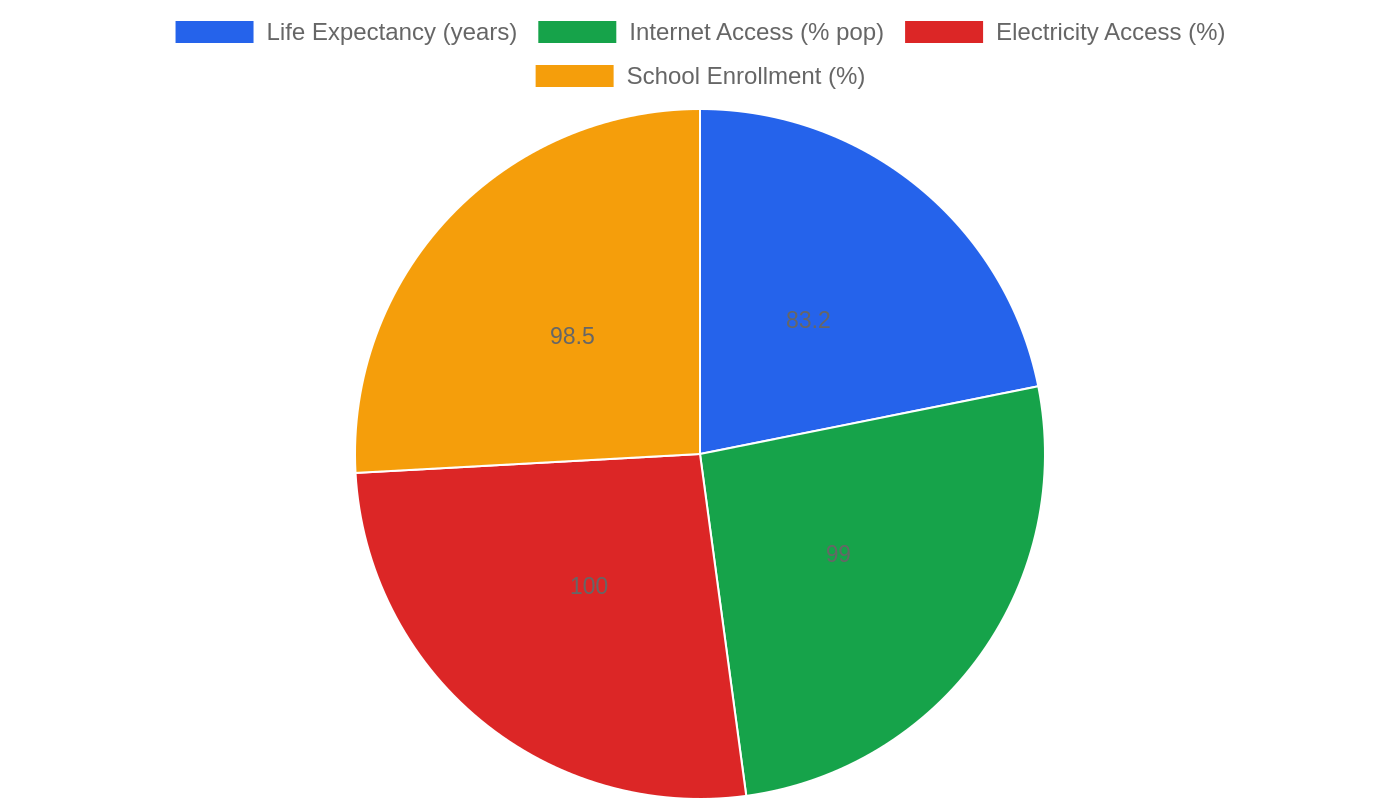
Economic Pulse Net | Sources: World Bank World Development Indicators, Government Sources | 2026
Key Takeaways
– Norway remains one of the world’s most advanced democracies, consistently ranking first in the Democracy Index since 2010, according to International IDEA’s Global State of Democracy (GSoD) Indices and Democracy Tracker.
– The economy is dominated by a mix of industrial giants, oil and gas specialists, and consumer goods conglomerates, with companies like Aker Solutions and Cermaq shaping both domestic and global markets.
– While specific GDP, inflation, and unemployment figures are unavailable from the World Bank at this time, Norway’s structural strengths in governance and gender equality provide a resilient foundation for economic stability.
– The country’s political landscape is characterized by high performance in elected government and gender equality, making it a benchmark for democratic governance worldwide.
– Investors and businesses should watch Norway for its stable institutions, strong rule of law, and a business environment anchored by major industrial and consumer goods players.
The Sovereign Wealth Economy — Understanding Norway’s Quiet Strength
To write about Norway’s economy is to write about a paradox. The World Bank data provides no current figures for GDP growth, inflation, or unemployment — a statistical silence that might alarm analysts covering other nations. But in Norway, the absence of crisis data is itself a kind of data. This is an economy that does not lurch from quarter to quarter with the volatility seen elsewhere. It hums. It endures.
The backbone of Norwegian economic life is not a single industry but a constellation of interlocking sectors, each anchored by major domestic firms. The World Bank’s list of top companies reveals a striking pattern: industrials dominate. AF Group, Aker Floating Production, Bergen Engines, and Bertel O. Steen all operate in manufacturing, engineering, and infrastructure. These are not flashy tech startups; they are the kind of companies that build bridges, maintain engines, and keep supply chains moving.
They reflect a national economic philosophy that prizes durability over disruption.
Alongside the industrials sit the oil and gas specialists. Aker Solutions is a global name in energy services, and its presence on the list underscores Norway’s continued relevance in hydrocarbon markets. But the consumer goods sector is equally telling. Aker BioMarine, Bama Gruppen, and Cermaq are major players in food, aquaculture, and marine resources. Norway is not just an oil nation; it is a seafood superpower, a furniture maker, and a conglomerate economy through entities like Aker ASA.
The diversity of these industries — from Arthur Soltvedt Møbelfabrikk’s furniture to Bergen Engines’ industrial machinery — suggests a resilience that no single commodity price shock can easily break.
Without specific GDP or inflation figures from the World Bank, the narrative must focus on what is measurable: the structure of production. Norway’s economic strength lies not in a single number but in the breadth of its industrial base, the quality of its institutions, and the stability of its political environment. This is an economy built to last, not to spike.
The Price of Nordic Comfort — Housing, Daily Life, and the Cost of Living
Housing in Norway is a conversation that every expatriate, every young professional, and every policymaker eventually has. While the World Bank data does not provide specific cost-of-living indices, the reality on the ground is shaped by the same forces that define the broader economy: high wages, strong social protections, and a housing market that reflects both scarcity in urban centers and abundance of space in rural areas.
In Oslo, the capital, the rental market is competitive. A one-bedroom apartment in the city center commands a premium that would be familiar to residents of other wealthy European capitals. Outside the major cities, however, the landscape changes. Norway’s geography — fjords, mountains, and a long coastline — means that housing costs vary dramatically by location.
The daily expenses of food, transport, and utilities are generally high by international standards, but they are offset by a social welfare system that provides universal healthcare, subsidized education, and generous parental leave.
The rent-versus-buy calculation in Norway is heavily influenced by interest rates and mortgage regulations. Norwegian banks are conservative lenders, and the central bank has historically prioritized stability over speculation. For those who can enter the market, homeownership is a path to long-term wealth. For others, the rental market offers security, if not affordability.
The cost of living in Norway is not a barrier to a good life; it is a feature of a society that values quality over quantity, and that charges accordingly.
Where the Giants Play — Investment Climate and Corporate Norway
For investors, Norway presents a landscape of established players rather than a frontier of startups. The World Bank’s list of top companies reads like a directory of industrial and consumer goods stalwarts. Aker ASA is a conglomerate with interests spanning oil, marine biotechnology, and floating production. Aker Solutions is a heavyweight in oil and gas services. Cermaq is a global leader in salmon farming. These are not companies that need to be discovered; they are companies that need to be understood.
The business climate in Norway is defined by transparency, rule of law, and a high level of trust between the private sector and the state. According to International IDEA’s Global State of Democracy (GSoD) Indices and Democracy Tracker, Norway performs in the high range on overall democratic measures, with particular strengths in elected government and gender equality. This political stability is a direct asset for business.
Companies operating in Norway face predictable regulations, a skilled workforce, and a government that, while interventionist in some sectors, respects market mechanisms.
Sectors to watch include aquaculture, renewable energy, and industrial engineering. The companies on the World Bank’s list — from Bergen Engines to Bama Gruppen — are well-positioned to benefit from global trends in food security, energy transition, and infrastructure modernization. Norway is not a market for speculators; it is a market for patient capital, for investors who value governance as much as growth.
The Safest Democracy on Earth — Politics, Safety, and the Quality of Life
Norway is not just a country; it is a benchmark. According to International IDEA’s Global State of Democracy (GSoD) Indices and Democracy Tracker, Norway performs in the high range on overall democratic measures, with particular strengths in elected government and gender equality. Since 2010, the country has been classified as the world’s most democratic nation by the Democracy Index. This is not a casual distinction; it is a fundamental characteristic of how the country operates.
The political landscape is one of stability, consensus, and high citizen engagement. Norway is considered to be one of the most developed democracies and states of justice in the world. This has direct implications for safety and quality of life. While the World Bank data does not provide a specific Crime Index or Safety Index, the correlation between democratic strength and public safety is well established.
High trust in institutions, low levels of corruption, and a robust welfare state create an environment where crime is low and social cohesion is high.
Gender equality is not just a policy goal in Norway; it is a lived reality. The country’s strengths in this area, as measured by the GSoD Indices, translate into higher workforce participation, better health outcomes, and a more inclusive society. For residents and visitors alike, Norway offers a quality of life that is difficult to match: clean air, safe streets, functional public services, and a political system that listens.
The Democracy Dividend — What’s Happening Now in Norway
The story of Norway in 2026 is not one of crisis or transformation. It is the story of a country that is quietly, steadily, reaping the benefits of its institutional choices. The Democracy Index rankings, which have placed Norway at the top since 2010, are not static accolades. They reflect ongoing processes: elections that are free and fair, a civil service that is meritocratic, and a society that values equality as a cornerstone of economic policy.
What is happening now in Norway is a continuation of this trajectory. The country is navigating the global energy transition with a pragmatic approach, balancing its role as a major oil and gas producer with investments in renewable energy and marine biotechnology. Companies like Aker BioMarine are exploring new frontiers in sustainable nutrition, while Aker Solutions is adapting its engineering expertise to cleaner energy systems.
The political debate is not about whether to change, but how to manage change without sacrificing the social contract that has made Norway successful.
The current affairs landscape is shaped by the same forces that have defined Norway for decades: a commitment to democratic governance, a diversified industrial base, and a population that expects its government to deliver. There are no dramatic reforms underway, no populist upheavals, no fiscal crises. That is precisely the point. Norway’s strength is its stability, and its stability is its story.
The Bottom Line
Norway is a country for those who value consistency over volatility, governance over gambling, and quality of life over rapid growth. Investors should watch it for its industrial giants, its stable political environment, and its ability to navigate global challenges without losing its social fabric. Policy makers should study it as a model of democratic resilience.
And anyone seeking to understand how a modern economy can balance wealth, welfare, and democracy should look to Norway — not for a blueprint, but for proof that it can be done.
Sources & Methodology
This article is authored by Economic Pulse Net for informational and research purposes. Economic Pulse Net sources its data from multilateral institutions, national statistics bureaus, and proprietary databases. All data is believed to be current as of the date of publication.
Published: July 22, 2026 | Category: Research — Norway
Use these signals in your own platform
Economic Pulse publishes its live signal feed through a documented, read-only API. Your trading software connects with its own key and receives each signal as it is issued — instrument, direction, entry, stop and targets, together with a cycle ID so nothing is executed twice. The feed is independent of this website and cannot change it.
Signals are informational only and are not financial advice.