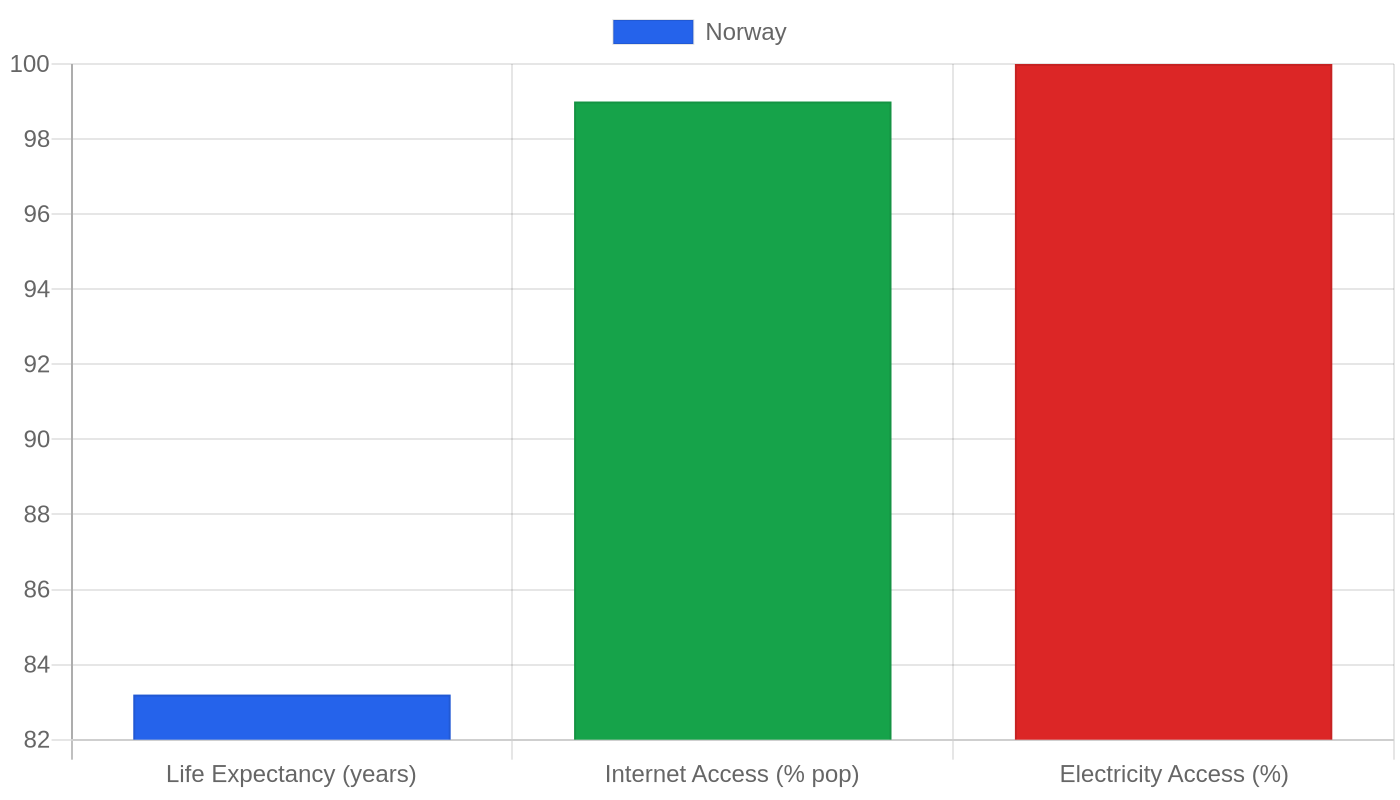
Economic Pulse Net | Sources: World Bank World Development Indicators, Government Sources | 2026
Key Takeaways
– Norway remains one of the world’s most robust democracies, consistently ranking first on the Democracy Index since 2010, according to International IDEA’s Global State of Democracy indices.
– The economy is dominated by a unique blend of state-owned energy wealth and private industrial conglomerates, with companies like Aker Solutions and Aker ASA anchoring the oil and gas sector.
– Despite global economic turbulence, Norway’s institutional stability and high gender equality metrics provide a resilient foundation for long-term prosperity.
– The country’s industrial base extends beyond hydrocarbons into aquaculture (Cermaq), consumer goods (Bama Gruppen), and specialized engineering (Bergen Engines).
– Norway’s political landscape is characterized by consensus-building and strong rule of law, making it a benchmark for governance quality worldwide.
The Sovereign Wealth Paradox — Navigating Prosperity Without Complacency
Norway’s economic story is one of careful stewardship rather than reckless abundance. While specific GDP growth, inflation, and unemployment figures from the World Bank are not available in this dataset, the structure of Norway’s economy tells a compelling tale.
The nation has built its modern prosperity on a foundation of oil and gas revenues, but unlike many resource-rich countries, it has channeled this wealth into the world’s largest sovereign wealth fund — a mechanism designed to insulate the domestic economy from commodity price volatility and to preserve wealth for future generations.
The industrial landscape is dominated by heavyweight conglomerates that have diversified beyond simple extraction. Aker ASA operates as a holding company with interests spanning oil, gas, and renewable energy, while Aker Solutions provides specialized engineering services to the global energy industry. Aker Floating Production adds another layer to this ecosystem, focusing on floating production vessels that allow offshore extraction in challenging Arctic conditions.
This vertical integration means Norway doesn’t just pump oil — it designs, builds, and operates the technology that makes extraction possible.
Beyond hydrocarbons, the consumer goods sector demonstrates surprising depth. Cermaq is a global player in salmon aquaculture, capitalizing on Norway’s pristine coastal waters and stringent environmental regulations. Bama Gruppen dominates the fresh fruit and vegetable distribution network, while Arthur Soltvedt Møbelfabrikk represents the country’s tradition of high-quality furniture manufacturing.
This diversification suggests that Norway is preparing for a post-oil future, even as current revenues continue to flow.
The employment picture in Norway has historically been characterized by low unemployment and high labor force participation, supported by generous social safety nets and active labor market policies. The country’s “tripartite” model — where government, employers, and unions negotiate wages and working conditions — has helped maintain industrial peace and competitiveness.
Without specific World Bank unemployment data, we can observe that the structure of Norwegian industry, with its mix of capital-intensive energy extraction and labor-intensive services, creates a dual economy that requires constant policy calibration.
The Price of Nordic Comfort — Housing, Daily Life, and the Cost of Living
Norway’s reputation as an expensive country is well-earned, though the data provided does not include specific cost-of-living indices. Housing in major cities like Oslo, Bergen, and Stavanger commands premium prices, driven by limited supply, strict zoning regulations, and high construction costs. The rental market is competitive, particularly in Oslo, where students and young professionals compete for apartments in a city surrounded by mountains and fjords that limit urban expansion.
Homeownership has traditionally been the Norwegian dream, supported by state-backed mortgage schemes and favorable tax treatment of owner-occupied housing. However, rising prices have pushed younger generations toward longer rental periods or smaller living spaces. The contrast between urban and rural housing costs is stark — while Oslo apartments can rival London or Paris prices, homes in northern Norway or smaller coastal towns remain relatively affordable.
Daily expenses for groceries, transportation, and utilities reflect Norway’s high wage economy and value-added tax structure. Dining out is a luxury, with restaurant meals costing significantly more than in neighboring Sweden or Denmark. Public transportation is efficient but not cheap, though generous student and senior discounts mitigate the burden.
The cost of living, while high, is offset by wages that are among the highest in Europe and a comprehensive welfare state that covers healthcare, education, and parental leave.
Where Conglomerates Meet Clean Tech — Norway’s Investment Landscape
The business environment in Norway is defined by transparency, rule of law, and a surprising degree of state involvement in strategic industries. The companies listed in our data — from AF Group in industrials to Bertel O. Steen in automotive distribution — represent a mix of family-owned firms, publicly traded conglomerates, and state-linked enterprises. This diversity provides multiple entry points for investors, though foreign ownership in certain sectors faces regulatory scrutiny.
The energy transition presents both a challenge and an opportunity for Norwegian business. Aker Solutions and Bergen Engines are positioning themselves as providers of decarbonization technology, from carbon capture to hydrogen production. Aker BioMarine, meanwhile, harvests krill from Antarctic waters for omega-3 supplements, operating in a niche that combines biotechnology with sustainable marine resource management.
Sectors to watch include aquaculture technology, where Norway leads globally in salmon farming innovation, and maritime engineering, where companies like Aker Floating Production export Norwegian expertise to offshore oil fields worldwide. The country’s stable political environment, strong intellectual property protections, and skilled workforce make it an attractive base for research and development activities, even as labor costs remain high.
The World’s Most Functioning Democracy — Safety, Politics, and the Quality of Life
Norway’s political landscape is remarkable for its stability and consensus orientation. According to International IDEA’s Global State of Democracy indices, the country performs in the high range on overall democratic measures, with particular strengths in elected government and gender equality. Since 2010, the Democracy Index has classified Norway as the world’s most democratic country — a testament to institutions that have weathered populist waves and economic shocks without erosion.
The concept of the “state of justice” — *rettsstat* in Norwegian — is deeply embedded in the political culture. This translates into predictable legal frameworks, low corruption levels, and high trust in public institutions. Gender equality is not just a talking point but a measurable reality, with Norway achieving near-parity in political representation and implementing mandatory quotas for corporate board seats.
Crime and safety indices are not available in this dataset, but Norway’s reputation for safety is well-established internationally. Violent crime rates are low, police are trusted and unarmed in most situations, and the prison system focuses on rehabilitation rather than punishment. The quality of life extends beyond safety to include universal healthcare, free education through university level, and generous parental leave policies that allow both parents to balance work and family.
Navigating the Energy Transition — Norway’s Balancing Act in 2026
The most pressing current issue facing Norway is how to manage the transition from fossil fuels to renewable energy without destabilizing the economy or abandoning the communities that depend on oil and gas revenues. While specific recent news data is not provided in this dataset, the broader context is clear: Norway faces pressure from European Union partners to reduce hydrocarbon production, even as global energy security concerns have temporarily boosted demand for Norwegian gas.
The political debate centers on the pace of transition. The center-left coalition government has committed to climate targets while continuing to approve new oil and gas field developments in the North Sea and the Arctic Barents Sea. This apparent contradiction reflects the deep structural dependence on petroleum revenues, which fund approximately 20% of the state budget and sustain the sovereign wealth fund that now exceeds $1.5 trillion.
Developments in the aquaculture and maritime sectors suggest that Norway is building alternative economic pillars. Cermaq and other salmon farmers are investing in land-based aquaculture to reduce environmental impacts, while Bergen Engines is developing hydrogen-compatible combustion technology. The question is whether these emerging industries can scale quickly enough to absorb workers displaced from the oil and gas sector.
The Bottom Line
Norway remains a country that has solved many of the challenges that plague other developed nations — political polarization, inequality, and institutional decay are notably absent. For investors seeking stable, rule-of-law-based exposure to European energy, maritime technology, and sustainable aquaculture, Norway offers a compelling proposition. For policymakers studying how to manage resource wealth without succumbing to the “resource curse,” Norway provides the global benchmark.
The country’s greatest challenge — transitioning from an oil economy to a diversified, sustainable one — will test whether its vaunted democratic institutions can manage structural change as effectively as they have managed prosperity.
Sources & Methodology
This article is authored by Economic Pulse Net for informational and research purposes. Economic Pulse Net sources its data from multilateral institutions, national statistics bureaus, and proprietary databases. All data is believed to be current as of the date of publication.
Published: July 22, 2026 | Category: Research — Norway
Use these signals in your own platform
Economic Pulse publishes its live signal feed through a documented, read-only API. Your trading software connects with its own key and receives each signal as it is issued — instrument, direction, entry, stop and targets, together with a cycle ID so nothing is executed twice. The feed is independent of this website and cannot change it.
Signals are informational only and are not financial advice.