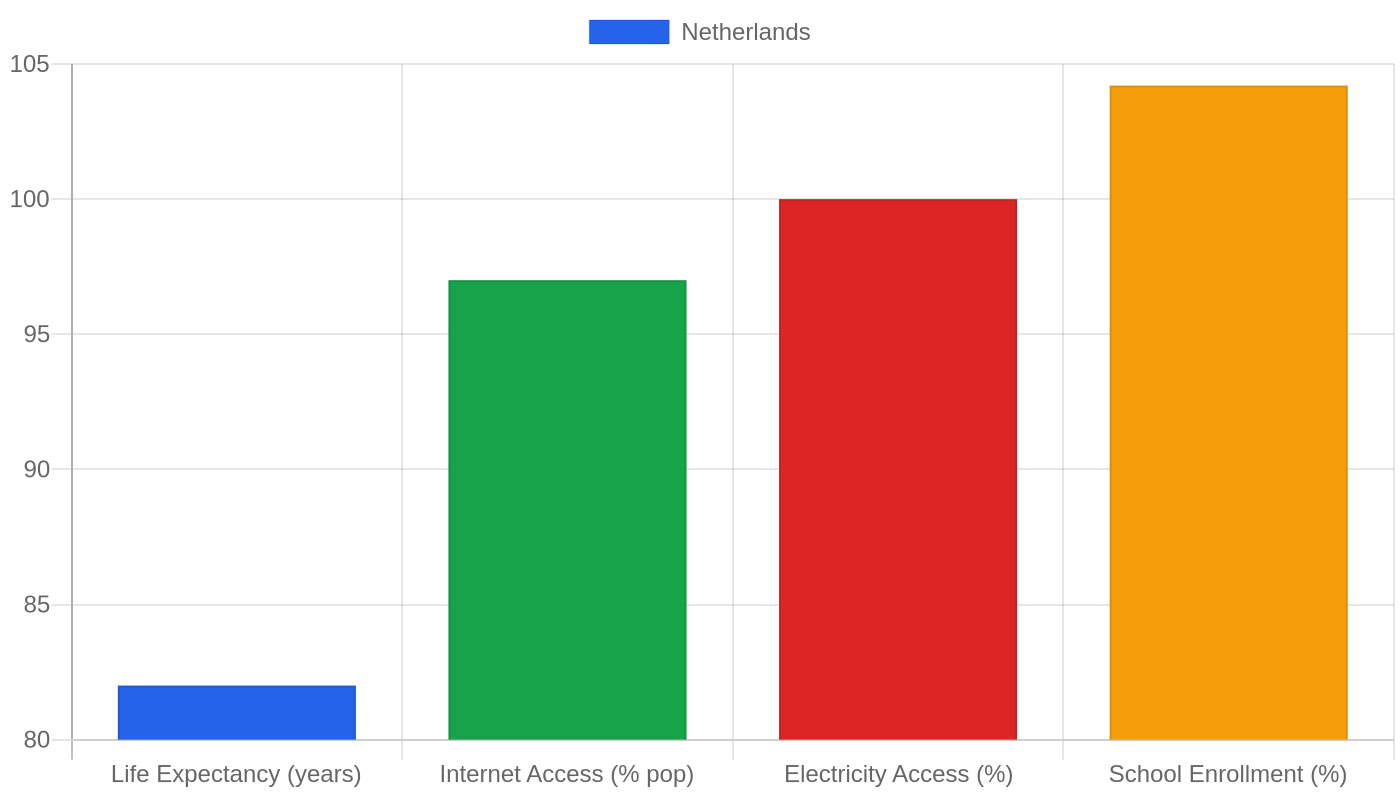
Economic Pulse Net | Sources: World Bank World Development Indicators, Government Sources | 2026
Key Takeaways
– The Netherlands remains a top-tier global democracy, ranking high on overall democratic measures with particular strengths in political representation, according to International IDEA’s Global State of Democracy (GSoD) Indices.
– As a constitutional monarchy and parliamentary democracy, Dutch governance is built on a consociational model — meaning major decisions require broad consensus across political and social groups.
– The Dutch economy is characterised by deep integration with European supply chains, a strong logistics sector, and a tradition of corporate headquarters choosing Amsterdam as their European base.
– While specific economic indicators (GDP, inflation, unemployment) are not available in the current data set, the country’s institutional strengths provide a stable backdrop for business and investment.
– The cost of living in the Netherlands, particularly in the Randstad region, remains among the highest in the Eurozone, driven largely by housing scarcity.
The Polder Model Economy: More Than Just Windmills and Tulips
The Netherlands has long been described as a “consociational state” — a term political scientists use to describe a country where deep societal differences are managed through elite-level cooperation and consensus-building. This political culture has profound economic consequences.
Where other nations lurch between policy extremes with each election cycle, the Dutch “polder model” — named after the low-lying land reclaimed from the sea — forces employers, unions, and government to sit at the same table until they reach agreement. The result is a business environment characterised by predictability, social partnership, and long-term planning horizons that many larger economies envy.
According to the World Bank, the Netherlands’ GDP growth, inflation, and unemployment figures are not available in the current data set, but the country’s institutional framework compensates for what the numbers cannot tell us. The Netherlands has been a constitutional monarchy since 1815 and a parliamentary democracy since 1848 — two centuries of political stability that have allowed the country to build one of the world’s most sophisticated trading economies.
The Port of Rotterdam, the Amsterdam Schiphol airport hub, and a dense network of waterways and rail links position the Netherlands as the gateway to Europe for goods and services. This logistics advantage, combined with a highly educated, multilingual workforce, has made the country disproportionately attractive to multinational corporations relative to its modest population size.
The Dutch economy’s reliance on foreign trade means it is particularly sensitive to European Union economic conditions and global shipping costs. When the European economy sneezes, the Netherlands catches a cold. Conversely, when global trade flows are strong, the Netherlands punches well above its weight. The country’s economic model is built on openness — both in terms of trade policy and foreign direct investment — and this openness has historically delivered steady, if not spectacular, growth.
The absence of current GDP data should not be read as a sign of economic distress; rather, it reflects the reality that the World Bank’s latest reporting cycle has not yet captured the most recent figures.
The Housing Crunch: Paying a Premium for Canal Views
The cost of living in the Netherlands, particularly in Amsterdam, Utrecht, and The Hague, is among the steepest in continental Europe. Housing is the primary driver of this expense. The Netherlands faces a chronic housing shortage, with demand persistently outstripping supply, particularly in the urban Randstad corridor that stretches from Amsterdam to Rotterdam.
This scarcity has pushed both purchase prices and rental rates to levels that strain household budgets, especially for younger workers and recent immigrants.
The rent-versus-buy calculation in the Netherlands is heavily skewed by government policy. Dutch mortgage interest payments have traditionally been tax-deductible, a generous incentive that encourages homeownership but also inflates prices. Meanwhile, the social housing sector — which accounts for a significant share of the national housing stock — provides a safety net for lower-income households but often has waiting lists stretching for years.
For those entering the private rental market, particularly in Amsterdam, the cost of a modest one-bedroom apartment in a desirable neighbourhood can consume a large share of a median salary. The regional contrast is stark: housing costs in the Randstad are substantially higher than in the northern and eastern provinces, where prices remain more moderate but job opportunities are also scarcer.
Daily expenses in the Netherlands — groceries, public transport, healthcare premiums, and childcare — are generally higher than the Eurozone average. The Dutch healthcare system is mandatory and privately administered but tightly regulated, with monthly premiums that have risen steadily in recent years. Public transport is efficient but not inexpensive, though the country’s world-class cycling infrastructure offers a cheap and culturally embedded alternative for daily commuting.
The Dutch are accustomed to these costs, and the social safety net — including generous unemployment benefits, child allowances, and a state pension system — mitigates the harshest edges of the high cost of living.
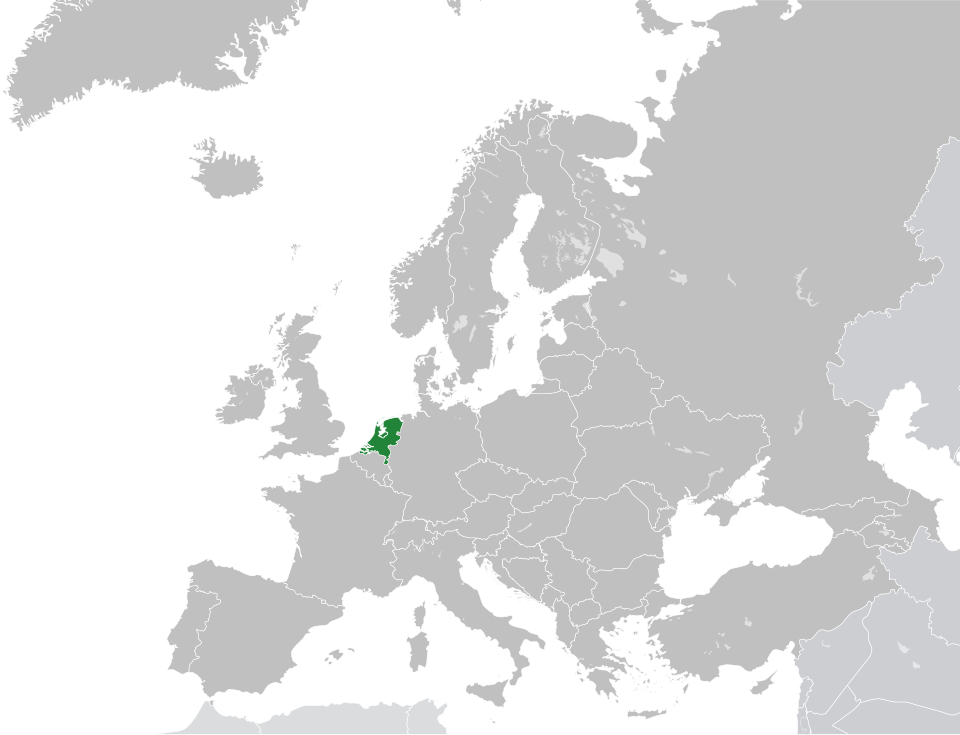
Where the Money Lives: Corporate Headquarters and the Port Economy
The Netherlands punches far above its weight in hosting major global corporations. The country’s business climate is defined by its strategic location, its sophisticated financial services sector, and a tax regime that has historically been favourable to multinational enterprises — though international pressure has led to some tightening in recent years.
Many of the world’s largest technology, consumer goods, and energy companies have chosen Amsterdam or the surrounding region for their European headquarters, drawn by the country’s infrastructure, its highly educated and multilingual talent pool, and its position as a logistics hub.
The Dutch economy is particularly strong in agri-food, with the country being one of the world’s largest exporters of agricultural products — a remarkable feat for a nation of its size. The Port of Rotterdam is the largest seaport in Europe and a critical node in global supply chains, handling everything from crude oil to consumer electronics. The country is also a hub for the semiconductor industry, with major equipment manufacturers and research institutions based in the Brainport region around Eindhoven.
The financial sector, centred in Amsterdam, has deep roots dating back to the Dutch East India Company and remains a significant contributor to GDP.
The business environment is characterised by strong rule of law, low levels of corruption, and a highly developed digital infrastructure. The Netherlands consistently ranks among the easiest places in the world to do business, with efficient company registration procedures, a transparent regulatory framework, and a reliable judicial system for resolving commercial disputes.
The Dutch labour force is among the most productive in Europe, though the country has a high share of part-time workers — a cultural preference as much as an economic one. For investors, the Netherlands offers stability and predictability, though the high cost of labour and real estate, combined with the tight housing market, can make expansion costly.
Safe Streets, Strong Institutions, and the Art of Compromise
In a world of rising political polarisation, the Netherlands remains a striking exception. International IDEA’s Global State of Democracy (GSoD) Indices and Democracy Tracker rank the Netherlands in the high range on overall democratic measures, with particular strengths in political representation.
This is not an accident of history but the product of a political culture that has evolved over two centuries to manage the country’s deep religious and ideological divisions through compromise and consensus. The Dutch political system, with its proportional representation and coalition governments, ensures that no single party can dominate — and that minority interests are protected.
The Netherlands is widely regarded as a safe country, with low rates of violent crime and high levels of public trust in institutions. While the data set does not provide specific crime or safety indices, the country’s social fabric is characterised by high levels of civic engagement, strong community ties, and a professional, well-resourced police force. The Dutch legal system is independent, efficient, and respected.
Quality of life indicators — including access to healthcare, education, and green space — are consistently strong, and the country regularly appears near the top of international wellbeing rankings.
The Dutch political landscape is not without its tensions. Immigration and integration have emerged as contentious issues in recent election cycles, and the rise of populist parties has tested the consensus-based model. Yet the consociational system has proven remarkably resilient. Coalition negotiations are often lengthy — it is not unusual for them to take months — but they ultimately produce governments that command broad support across the political spectrum.
This stability extends to economic policy, where the fundamentals — fiscal prudence, openness to trade, and social partnership — have remained remarkably consistent across successive governments.
The Gathering Storm: Housing, Migration, and the Green Transition
The Netherlands in 2026 is a country in the midst of a difficult balancing act. The housing crisis remains the most pressing domestic issue, with the government under intense pressure to accelerate construction while simultaneously grappling with environmental regulations, nitrogen emission limits, and the preferences of local communities.
The Dutch Supreme Court’s 2019 ruling on nitrogen emissions effectively froze many construction and infrastructure projects, and the political fallout from that decision continues to shape the policy landscape. Successive governments have pledged to reform the planning system, but progress has been slow.
Migration policy has become increasingly contentious. The Netherlands has a long tradition of welcoming refugees and labour migrants, but the strain on housing, schools, and healthcare has fuelled public anxiety. The government has sought to tighten asylum procedures while simultaneously attempting to attract skilled workers to address labour shortages in key sectors.
This tension between openness and control is being negotiated through the traditional Dutch process of coalition bargaining, with the outcome likely to be a compromise that satisfies no one entirely but is acceptable to most.
The green transition is another front where Dutch pragmatism is being tested. The country has committed to ambitious climate targets, including significant reductions in greenhouse gas emissions by 2030, but the transition away from natural gas — which has historically been a major source of Dutch energy and government revenue — is proving complex.
The phase-out of gas extraction in Groningen, following a series of earthquakes caused by drilling, has required the government to manage the social and economic consequences for the region while simultaneously investing in renewable energy infrastructure. The Netherlands is making progress on wind and solar power, but the pace of change is slower than many activists would like and faster than many businesses are comfortable with.
As always, the Dutch answer is to keep talking, keep negotiating, and eventually find a consensus that moves the country forward.
The Bottom Line
The Netherlands is a country that rewards patience and punishes impatience. For investors, it offers a stable, well-regulated, and strategically located base for European operations — but the cost of entry is high and the regulatory environment can be complex. For policymakers, it offers a working example of how deep political divisions can be managed through institutional design and a culture of compromise.
For the casual observer, it is a reminder that economic success is not just about growth numbers, but about the institutions, social trust, and political stability that make those numbers possible. The Netherlands may not be the fastest-growing economy in Europe, but it remains one of the most resilient — and that, in an uncertain world, is worth watching.
Sources & Methodology
This article is authored by Economic Pulse Net for informational and research purposes. Economic Pulse Net sources its data from multilateral institutions, national statistics bureaus, and proprietary databases. All data is believed to be current as of the date of publication.
Published: August 04, 2026 | Category: Research — Netherlands
Use these signals in your own platform
Economic Pulse publishes its live signal feed through a documented, read-only API. Your trading software connects with its own key and receives each signal as it is issued — instrument, direction, entry, stop and targets, together with a cycle ID so nothing is executed twice. The feed is independent of this website and cannot change it.
Signals are informational only and are not financial advice.