Economic Pulse Net | Sources: World Bank World Development Indicators, Government Sources | 2026
Key Takeaways
* Power Dynamics: Real political authority rests with unelected military and civilian “décideurs” known as “le pouvoir,” who maintain decisive control over national affairs, including presidential selection.
Corporate Landscape: The economy is anchored by state-linked giants in logistics and telecommunications, such as Air Algérie and Algérie Télécom, alongside major private entities like Cevital.
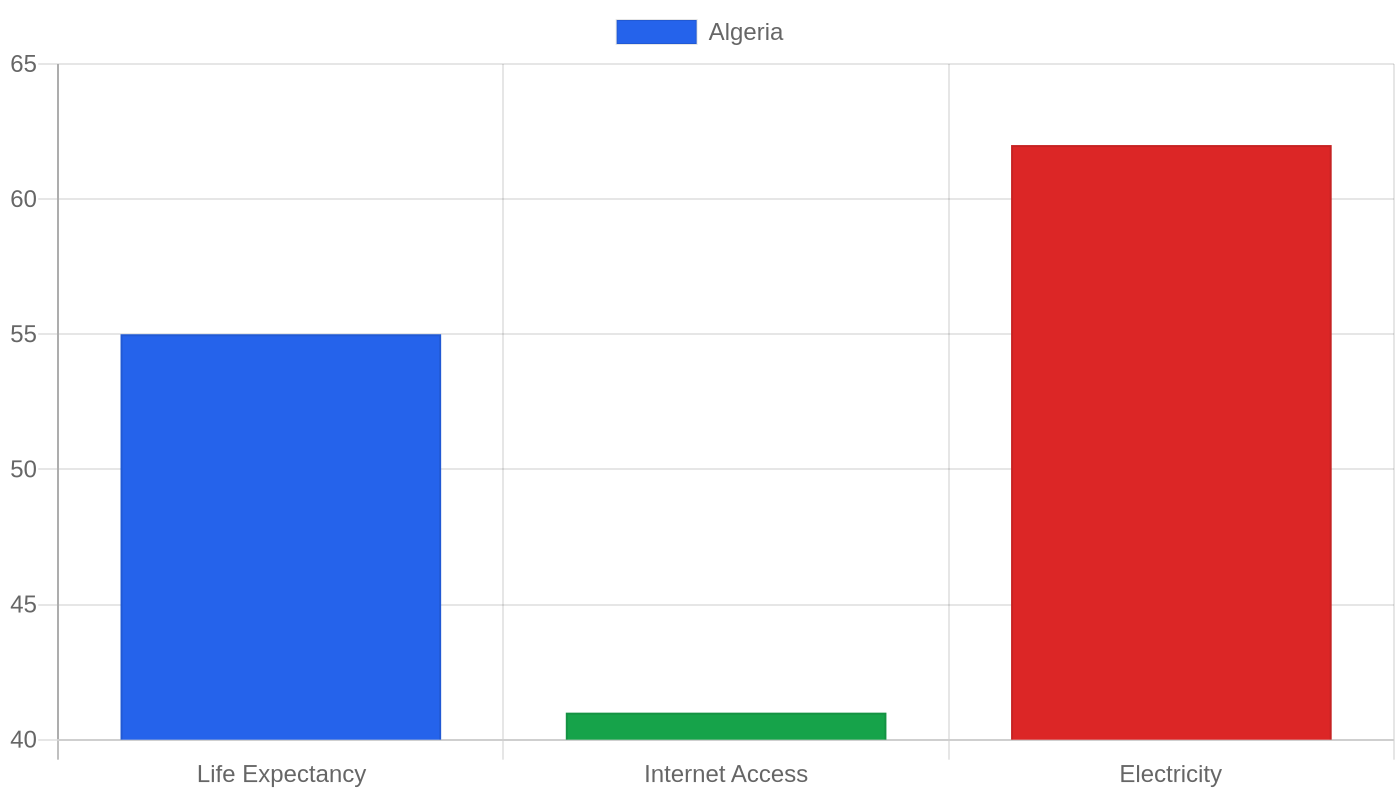
Data Transparency: Standard macroeconomic indicators, including GDP growth, inflation, and unemployment rates, are currently unreported (N/A) by the World Bank, obscuring the precise health of the broader economy.
Security Metrics: Official crime and safety indices are unavailable, leaving a gap in quantifiable data regarding public security and investor risk profiles.
Economic Engines Behind Closed Doors
The Algerian economy operates with a significant degree of opacity regarding its headline figures, as the World Bank reports no current data for GDP growth, inflation CPI, or unemployment percentages. This lack of transparent metrics makes it difficult to assess the immediate velocity of economic expansion or the pressure on consumer prices through standard channels. However, the structure of the economy reveals itself through its dominant industrial players rather than aggregate statistics.
The nation’s commercial life is driven by a mix of state-controlled logistics and private consumer goods sectors, suggesting an economy that functions more on internal distribution networks than open global trade flows. Companies like Asmidal in basic materials indicate a reliance on domestic resource processing, while the presence of multiple airline and ferry operators points to a heavy emphasis on internal connectivity and transport infrastructure.
Without specific GDP per capita or GNI figures, we must infer economic activity from these corporate footprints; the sheer volume of listed entities in consumer services and industrials suggests a market focused on servicing a large domestic population rather than exporting high-value financial services. This structural reliance on tangible industries—transport, telecommunications, and basic materials—implies an economy that is resilient but potentially insulated from rapid global digital trends.
The absence of reported population data further complicates any attempt to calculate per-capita productivity, forcing analysts to look at sectoral dominance as a proxy for overall economic weight. Ultimately, the Algerian economy appears to be a closed loop where industrial output and service provision are managed by a select few powerful entities, shielding the broader statistical picture from external scrutiny.
Living Costs and Corporate Hubs
For residents and expatriates, the cost of living in Algeria is defined by the availability and pricing of essential services provided by a handful of monopolistic or oligopolistic firms. With no explicit data on housing costs or rent-to-buy ratios, the daily expense profile is heavily influenced by the efficiency and pricing strategies of key utilities and transport providers.
Algérie Télécom and Djezzy dominate the telecommunications landscape, meaning communication costs are likely standardized across the country, reducing variability in digital living expenses. Similarly, the presence of Algérie Poste and Echorouk TV indicates a mature, albeit state-influenced, infrastructure for mail and media consumption, which forms the baseline of daily civic life.
Housing affordability cannot be quantified without regional comparisons, but the dominance of companies like Cevital in consumer goods suggests that food and household items are widely available, potentially stabilizing daily subsistence costs. The industrial sector, represented by Air Express Algeria and Algérie Ferries, implies that moving goods and people remains a central economic activity, which may keep logistical costs manageable within urban centers.
While we cannot compare these costs to regional averages due to missing data, the concentration of services in the hands of a few major players suggests a predictable, if not necessarily competitive, pricing environment for consumers. The daily experience is thus shaped less by fluctuating market forces and more by the operational policies of established national champions.
Investment Climate and State Influence
Investing in Algeria requires navigating a business environment where private enterprise coexists with profound state oversight and influence. The top companies list reveals a dichotomy between state-backed logistics and private consumer conglomerates, highlighting where opportunities may lie. Cevital stands out as a major force in consumer goods, demonstrating that private capital can achieve scale in manufacturing and distribution despite the challenging political backdrop.
In contrast, entities like Air Algérie, Algérie Poste, and Algérie Ferries operate in critical infrastructure sectors, suggesting that partnerships or investments in these areas may require direct engagement with state mechanisms. The telecommunications sector, split between Algérie Télécom and Djezzy, offers a glimpse into a competitive yet regulated market for digital services.
For foreign investors, the primary risk is not necessarily market size—which is obscured by missing population and GDP data—but the regulatory uncertainty inherent in the political system. The dominance of “le pouvoir” means that business permissions and contracts may be subject to decisions made outside of formal parliamentary processes.
Therefore, success in this market depends less on pure economic arbitrage and more on understanding the informal power structures that govern licensing and resource allocation. Investors must view the corporate landscape not just as a collection of competitors, but as a network of relationships tied to the unelected decision-makers who hold the real reins of power.
Safety, Politics, and Quality of Life
The quality of life and safety profile in Algeria are framed by a political reality that prioritizes stability over democratic transparency. Official crime and safety indices are not reported, making it impossible to quantify the level of personal risk or street-level security for residents and visitors.
This data void often leads to generalized perceptions of safety, but the underlying political structure provides context: the government is described as authoritarian, with elected politicians holding relatively little sway over actual affairs. Power is exercised by a group of unelected civilian and military “décideurs,” known collectively as “le pouvoir,” who effectively control the presidency and key state appointments.
This concentration of power, historically exemplified by figures like Mohamed Mediène before his removal during the 2019 protests, creates a political climate where dissent is tightly managed. For the average citizen, this translates to a society where social order is maintained through strong state control rather than organic community policing.
While the absence of crime data prevents a detailed safety assessment, the political atmosphere suggests that public gatherings and political expression are closely monitored. Consequently, the “safety” experienced by individuals may be high in terms of violent crime, but low in terms of political freedom and civil liberties. The happiness and well-being of the population are thus filtered through a lens of security and conformity, dictated by the needs of the ruling elite rather than popular mandate.
Current Affairs and Structural Stagnation
Right now, the defining narrative of Algeria is not one of explosive growth, but of entrenched political continuity and opaque economic management. The recent history highlights the fragility of even the most powerful figures within the regime, as evidenced by the downfall of Mohamed Mediène during the 2019 protests, signaling that internal power struggles remain a volatile factor.
Despite these shifts at the very top, the fundamental structure of “le pouvoir” remains intact, ensuring that policy changes are incremental and controlled. There are no recent reports of significant economic reforms, new election cycles, or major policy shifts that have altered the basic operating conditions for businesses or citizens.
The lack of updated World Bank data suggests that international monitoring of Algeria’s economic performance has either stalled or been deprioritized, reflecting the country’s isolation from global financial discourse. Meanwhile, the corporate sector continues to operate under the same established paradigms, with major players like Cevital and Air Algérie maintaining their positions without significant disruption.
This status quo creates an environment of predictability for insiders, but uncertainty for outsiders who cannot gauge the true health of the economy. The current moment is characterized by a quiet stagnation, where the political elite consolidate power while the broader economic indicators remain hidden from public view.
The Bottom Line
Algeria presents a complex case for observers: it is a country with significant industrial capacity and a clear corporate hierarchy, yet it lacks the transparent data necessary for rigorous economic analysis. Investors and researchers should watch this country primarily to understand how authoritarian regimes manage economic resources without relying on traditional market signals.
The focus should be on the interplay between state power (“le pouvoir”) and private enterprise, particularly in sectors like telecommunications and consumer goods. For those seeking clarity, Algeria remains a puzzle box, where the answers are held by the unelected few rather than published in official statistics.
Sources & Methodology
This article is authored by Economic Pulse Net for informational and research purposes. Economic Pulse Net sources its data from multilateral institutions, national statistics bureaus, and proprietary databases. All data is believed to be current as of the date of publication.
Published: October 22, 2026 | Category: Research — Algeria
Use these signals in your own platform
Economic Pulse publishes its live signal feed through a documented, read-only API. Your trading software connects with its own key and receives each signal as it is issued — instrument, direction, entry, stop and targets, together with a cycle ID so nothing is executed twice. The feed is independent of this website and cannot change it.
Signals are informational only and are not financial advice.