Economic Pulse Net | Sources: World Bank World Development Indicators, Government Sources | 2026
Key Takeaways
– The Netherlands operates as a consociational state, meaning its political system is built around power-sharing and broad consensus, which underpins its reputation for stability and predictability.
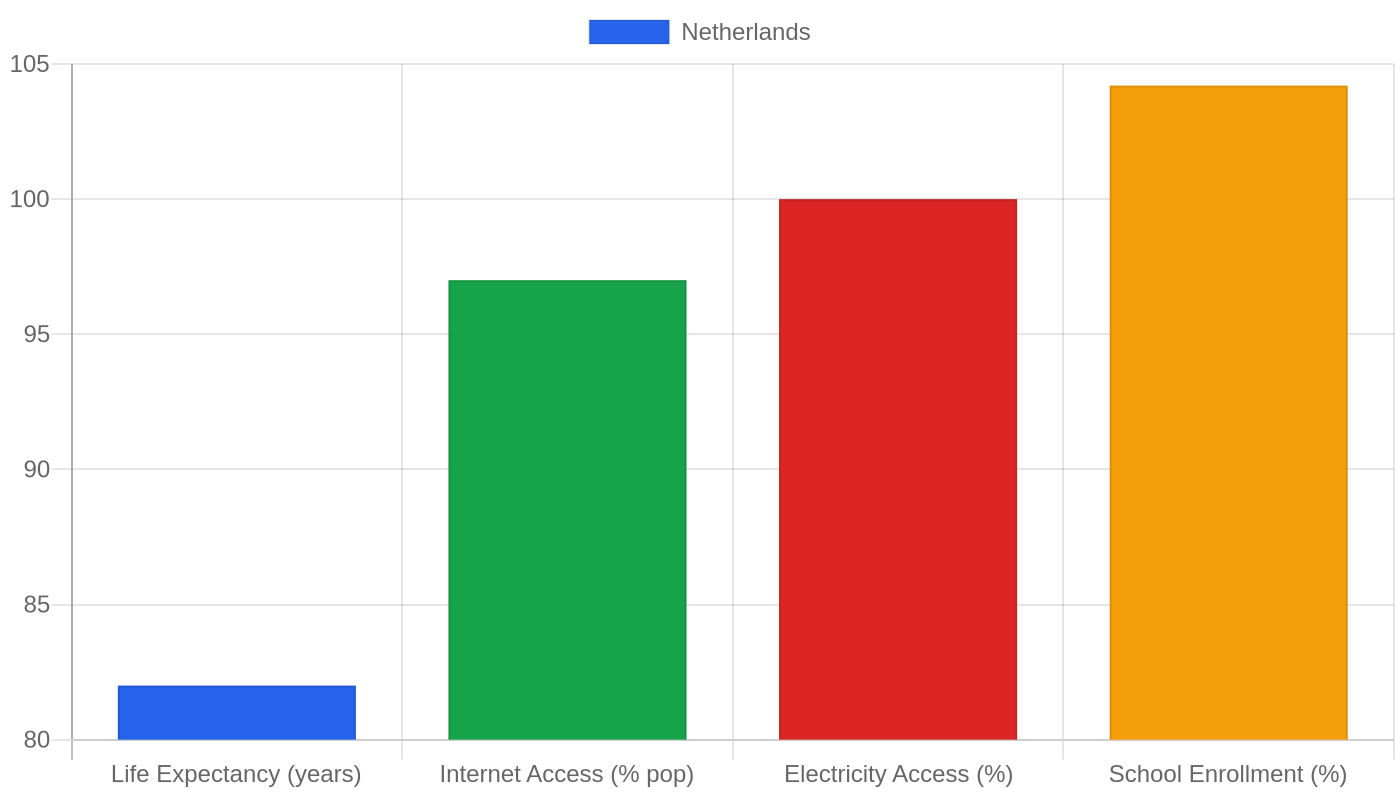
– Its economy is a high-income, export-oriented powerhouse, though the latest World Bank figures are currently unavailable, leaving room for cautious observation rather than precise forecasting.
– The country’s democratic health is rated highly by International IDEA’s Global State of Democracy (GSoD) Indices, with particular strengths in political representation.
– A constitutional monarchy since 1815 and a parliamentary democracy since 1848, the Dutch governance model remains a benchmark for institutional continuity in Europe.
– For investors and policymakers, the Netherlands offers a case study in how small nations leverage openness, logistics, and social dialogue to punch far above their weight.
The Polder Model: An Economy Built on Deliberation
The Dutch economy does not shout; it negotiates. That is the first thing to understand about the Netherlands, a nation that has turned the ancient practice of reclaiming land from the sea into a metaphor for its entire economic philosophy. The World Bank’s latest headline figures — GDP growth, inflation, unemployment, and GDP per capita — are currently marked as unavailable, which in itself is a rarity for a country of this statistical sophistication.
But the absence of fresh numbers does not diminish the structural story. The Netherlands has long been one of the world’s most open economies, with a gross domestic product heavily reliant on the Port of Rotterdam, one of Europe’s busiest maritime hubs, and Schiphol Airport, a major continental airfreight gateway.
The country’s industrial base is a mix of high-value agriculture (it is a global leader in horticulture and food processing), advanced manufacturing, chemicals, and a deep and sophisticated financial services sector.
What makes the Dutch model distinctive is not any single industry but the way decisions are made. The so-called “polder model” — named after the low-lying tracts of land reclaimed from the sea — refers to a tradition of tripartite negotiation between government, employers, and trade unions. This social pact has historically kept labour disputes to a minimum and wage growth broadly in line with productivity.
The World Bank’s data gaps make it impossible to cite precise GDP or inflation figures, but the institutional framework suggests an economy that prioritises stability over volatility. In a world of supply chain shocks and energy price spikes, the Netherlands’ reliance on consensus may prove to be a quiet competitive advantage — one that cannot be captured in a single quarterly statistic but is nonetheless vital to its long-term resilience.
The Price of a Place in the Polder: Housing and Daily Life
If there is a crack in the Dutch facade of managed prosperity, it is in the cost of living — particularly housing. While the World Bank has not provided current figures for consumer prices or household expenditure, the broader European context is well-known to any observer: the Netherlands consistently ranks among the more expensive EU member states for daily expenses, from groceries to transport.
The housing market, especially in the Randstad — the urban arc that includes Amsterdam, Rotterdam, The Hague, and Utrecht — has experienced years of intense pressure. A combination of restrictive zoning, environmental regulations, and a chronic shortage of new construction has driven property prices upward, making homeownership increasingly difficult for first-time buyers. Renting is not necessarily a relief; the private rental sector is competitive, and social housing, while extensive, has long waiting lists.
Compared to its European neighbours, the Netherlands offers high wages and a robust social safety net, which offsets some of the sticker shock. But the reality is that the Dutch model of consensus is now being tested by a generational divide: older homeowners have seen their equity swell, while younger workers feel locked out. The cost-of-living squeeze is a political issue as much as an economic one, and it has fuelled debates about immigration, urban planning, and the pace of the energy transition.
For the casual observer, the Netherlands may still look prosperous — and it is — but the affordability question is the quiet tension beneath the surface.
Where the Money Moves: Investment and the Corporate Landscape
The Netherlands is home to a remarkable concentration of global corporate heavyweights. While the World Bank data does not list specific companies, the country’s corporate registry is famously dense with multinationals, many of which use the Netherlands for their European headquarters due to its favourable tax climate, logistical infrastructure, and highly skilled, multilingual workforce. The country has a deep ecosystem of financial services, insurance, and legal expertise that supports cross-border trade.
Sectors to watch include renewable energy — particularly offshore wind, where Dutch engineering and maritime expertise are world-class — and agri-tech, where the Netherlands is a pioneer in controlled-environment agriculture and greenhouse innovation. The Port of Rotterdam is also positioning itself as a hub for green hydrogen and circular economy initiatives, aiming to transform its industrial base for a post-carbon era.
The business climate is characterised by a high degree of legal certainty, a reliable judiciary, and a government that, for all its consensus-driven deliberation, is generally pro-business. However, foreign investors should note that the Dutch are not afraid to regulate. Environmental standards are strict, labour protections are strong, and corporate governance expectations are high.
The Netherlands is not a place for quick, unencumbered profit; it is a place for patient capital that values stability and sustainability. The recent political shifts — including a more prominent role for populist parties in national debates — have introduced some uncertainty around immigration policy and the speed of the green transition, but the fundamental pillars of the investment climate remain intact.
Safety, Civility, and the Machinery of Democracy
On the social front, the Netherlands is a study in high trust and low crime. The World Bank’s crime and safety indices are currently marked as unavailable, but the country’s reputation for personal safety is well-established. Dutch cities are generally walkable, well-lit, and policed with a pragmatic, community-oriented approach. The political landscape is equally stable, if occasionally colourful.
As a constitutional monarchy since 1815 and a parliamentary democracy since 1848, the Netherlands has a political system that prizes coalition-building. Because no single party typically wins a majority, every government is a negotiation — a feature that can make policy formation slow but also ensures that major changes rarely happen without broad societal consent.
According to International IDEA’s Global State of Democracy (GSoD) Indices and Democracy Tracker, the Netherlands performs in the high range on overall democratic measures, with particular strengths in political representation. This is not a country that lurches; it steadies. The quality of life is correspondingly high, with excellent public services, a strong healthcare system, and a cultural emphasis on work-life balance.
The Dutch are famously direct in conversation but remarkably tolerant in practice, a combination that has made the country a haven for international businesses and expatriates alike. The social fabric is not without its strains — integration issues and housing pressures are real — but the institutional glue remains strong.
The Conversation Now: Migration, Housing, and the Search for Consensus
The most pressing debates in the Netherlands right now revolve around three interlocking issues: migration, housing, and the energy transition. The political landscape has shifted in recent years, with anti-immigration parties gaining traction and forcing mainstream coalition partners to adopt stricter stances on asylum and labour migration. This is a significant departure for a country that has long prided itself on openness.
At the same time, the housing shortage has become a national crisis, prompting the government to fast-track construction projects and consider new zoning laws — a move that pits environmental protections against the need for affordable homes. The energy transition is similarly contentious, as the Netherlands balances its historic reliance on natural gas (including the phased-out Groningen field) with ambitious offshore wind targets.
What makes the current moment feel different is the pace of change. The Dutch are being asked to make decisions faster than the consensus model typically allows. The government is exploring ways to streamline permitting processes, while local municipalities are experimenting with new forms of housing cooperatives. The business community is pushing for more predictable immigration rules to secure talent, while labour unions are demanding guarantees that the green transition will not cost jobs.
None of this is unique to the Netherlands — every Western European economy is wrestling with similar tensions — but the Dutch approach, rooted in deliberation and compromise, will be tested. The outcome will determine whether the polder model can evolve or whether it will become a relic of a slower, more predictable era.
The Bottom Line
The Netherlands remains a bellwether for how small, open economies navigate a world of geopolitical fragmentation and economic uncertainty. For investors, it offers a stable, well-regulated entry point into the European market; for policymakers, it is a laboratory of consensus-building and social partnership.
The World Bank’s data gaps are a reminder that even the most reliable economies can become opaque in real time, but the underlying strengths — institutional quality, human capital, and strategic location — are not in question. Watch the Netherlands not for dramatic headlines, but for the quiet, deliberate way it manages change. That is where the real story lies.
Sources & Methodology
This article is authored by Economic Pulse Net for informational and research purposes. Economic Pulse Net sources its data from multilateral institutions, national statistics bureaus, and proprietary databases. All data is believed to be current as of the date of publication.
Published: August 04, 2026 | Category: Research — Netherlands
Use these signals in your own platform
Economic Pulse publishes its live signal feed through a documented, read-only API. Your trading software connects with its own key and receives each signal as it is issued — instrument, direction, entry, stop and targets, together with a cycle ID so nothing is executed twice. The feed is independent of this website and cannot change it.
Signals are informational only and are not financial advice.