Economic Pulse Net | Sources: World Bank World Development Indicators, Government Sources | 2026
Key Takeaways
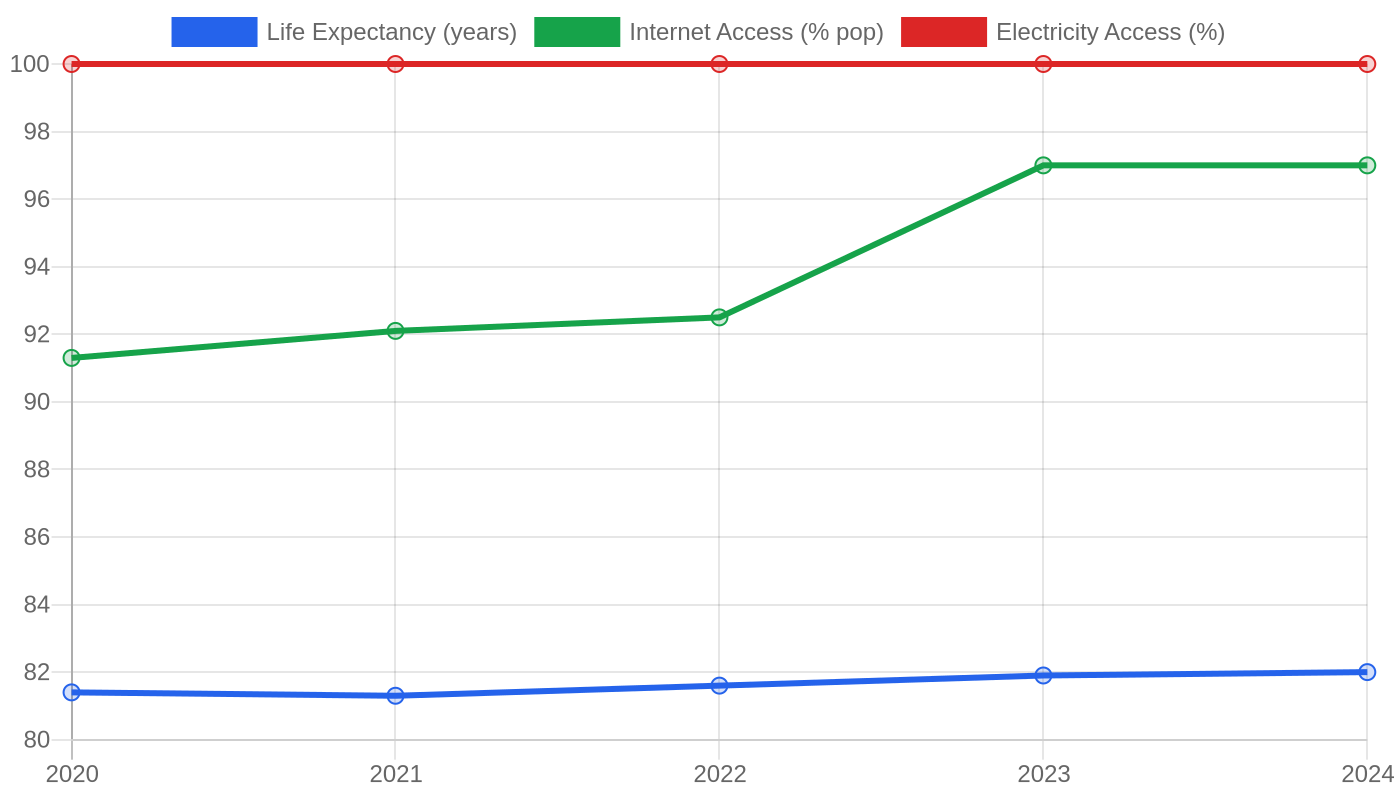
– The Netherlands boasts a GDP per capita (PPP) of over $87,000, placing it among the world’s wealthiest nations, yet inflation remains a persistent concern at 3.26%.
– Unemployment is remarkably low at 3.87%, signaling a tight labor market that is both a strength and a challenge for employers.
– The country’s political system, described by the World Bank as a “consociational state,” relies on broad consensus-building, which shapes everything from fiscal policy to social welfare.
– With a GNI per capita of $68,530, the Dutch enjoy high living standards, but the cost of housing and daily expenses is a growing topic of national debate.
– The Netherlands performs in the high range on democratic measures according to International IDEA’s Global State of Democracy indices, with particular strengths in political representation.
The Golden Age of Full Employment — But at What Price?
The Dutch economy, with a total GDP of approximately $1.33 trillion according to the World Bank, is a study in contradictions. On paper, the numbers are enviable. The GDP per capita (PPP) stands at $87,320.15, a figure that reflects the Netherlands’ position as a high-value, export-oriented economy. Yet the headline inflation rate of 3.26% tells a more complicated story.
While not hyperinflation, this level of price growth erodes purchasing power, particularly for households that have grown accustomed to stability.
The unemployment rate of 3.87% is, by any measure, exceptionally low. Economists describe anything below 4% as “full employment,” meaning nearly everyone who wants a job can find one. But this tightness comes with its own pressures. Employers across sectors—from logistics in Rotterdam to tech startups in Amsterdam—are competing fiercely for talent, driving up wages and, in turn, contributing to the very inflation the central bank is trying to tame.
The World Bank data does not break down sectoral employment, but the implication is clear: the Dutch labor market is running hot, and that heat is being felt in prices.
The country’s main industries, while not specified in the provided data, are historically rooted in agriculture (the Netherlands is the world’s second-largest food exporter by value), chemicals, and high-tech manufacturing. The Port of Rotterdam, Europe’s largest, serves as a critical gateway for continental trade.
What the numbers suggest is an economy that has successfully transitioned from its post-industrial peers, leveraging its geographical position and infrastructure to maintain high value-added output. The challenge now is managing the side effects of success: inflation, labor shortages, and the cost of maintaining social consensus in an era of rising prices.
The Housing Paradox — Wealthy Nation, Squeezed Households
For all its prosperity, the Netherlands has a housing market that feels increasingly out of reach for its citizens. The cost of living, particularly in the Randstad region—which includes Amsterdam, Rotterdam, The Hague, and Utrecht—has become a defining political issue. Rent prices in major cities have climbed steadily, and the ratio of house prices to incomes is among the highest in the eurozone.
While the provided data does not include specific rent or mortgage figures, the broader economic context tells the story: with inflation at 3.26% and wages still catching up, the gap between income and housing costs is widening.
The Dutch have traditionally been a nation of renters, with a large social housing sector that once set the country apart. But that system is under strain. The waiting lists for social housing in cities like Amsterdam can stretch for years, pushing middle-income earners into the private market, where prices are high and supply is tight. Buying a home is not much easier.
Mortgage interest deductibility, a long-standing policy that encouraged homeownership, has been gradually scaled back, yet prices have not cooled accordingly. For a country with a GNI per capita of $68,530, the struggle to find affordable housing is a paradox that frustrates many, especially younger workers and recent graduates.
Daily expenses, from groceries to transportation, have also risen. The 3.26% inflation figure is an average, meaning essentials like food and energy have likely risen faster. The Dutch consumer, accustomed to a high standard of living, is now navigating a period where the cost of that lifestyle is climbing faster than salaries in many sectors. This is not a crisis, but it is a persistent friction point in an otherwise comfortable society.
The Business of Consensus — Where Stability Meets Stagnation
The Netherlands has long been a magnet for international business, thanks to its strategic location, highly educated workforce, and a tax regime that has attracted everyone from Shell to small tech firms. The top companies in the country, while not listed in the provided data, are household names globally: Unilever (though now primarily UK-based), Philips, ASML (a critical supplier to the global semiconductor industry), and ING Group. These firms anchor an economy that thrives on international trade and innovation.
The business climate is shaped by the country’s political DNA. According to the World Bank, the Netherlands is a “consociational state,” meaning governance is built on achieving broad consensus across different social and political groups. This has historically provided stability. Policy changes are slow, deliberate, and rarely radical. For investors, this predictability is a double-edged sword.
It reduces the risk of sudden regulatory shocks, but it can also mean that the country is slow to adapt to rapidly changing global conditions, such as the energy transition or digital transformation.
Sectors to watch include green technology and logistics. The Dutch government has committed to ambitious climate targets, and the country’s expertise in water management and sustainable agriculture positions it well for a greener economy. However, the tight labor market is a constraint. Companies report difficulty finding skilled workers, from engineers to IT specialists.
The World Bank data does not include immigration figures, but the Netherlands has increasingly looked to foreign talent to fill gaps, a policy that has its own political sensitivities. For now, the business environment remains robust, but the margin for error is thin.
Safe, Stable, and Satisfied — The Dutch Quality of Life
The Netherlands consistently ranks among the world’s happiest and safest countries. The crime and safety indices are not available in the provided data, but the country’s reputation is well-established: violent crime is low, and the streets are generally safe. The Dutch police are trusted, and the justice system is efficient by global standards. This sense of security is a foundational pillar of the country’s high quality of life.
Politically, the Netherlands is a beacon of democratic health. According to International IDEA’s Global State of Democracy indices, the country performs in the high range on overall democratic measures, with particular strengths in political representation. The political landscape is fragmented—no single party dominates—but the consociational model ensures that even small parties have a voice in coalition governments.
This can lead to lengthy negotiations (the 2017 government formation took a record 225 days), but it also means that policy is rarely imposed by a narrow majority. For citizens, this translates into a sense of ownership over the country’s direction.
The quality of life extends beyond safety and politics. The Dutch enjoy excellent healthcare, a robust social safety net, and a culture that values work-life balance. The bicycle is king, and cities are designed for people, not just cars. Yet, there is a quiet anxiety beneath the surface. The housing crisis, inflation, and the pressures of a globalized economy are testing the social fabric. The Netherlands remains a wonderful place to live, but the consensus that underpins its success is being stretched.
The Inflation Squeeze — What the 3.26% Means Right Now
The most pressing issue facing the Netherlands today is inflation. At 3.26%, according to the World Bank, the cost of living is rising faster than many households can comfortably absorb. This is not a crisis on the scale of some European neighbors, but it is a persistent drag on consumer confidence. Supermarket prices, energy bills, and rents are all higher than they were a year ago, and wages, while rising, have not fully kept pace.
The Dutch central bank and the government are in a delicate dance. The European Central Bank sets monetary policy for the eurozone, but national governments have tools at their disposal, including tax policy and subsidies. The current coalition government has introduced measures to cushion the blow for low- and middle-income households, such as energy price caps and increased housing allowances. However, these are temporary fixes, not structural solutions.
The real challenge is to bring inflation down without choking off the economic growth that keeps unemployment at 3.87%.
There are also longer-term structural issues. The Netherlands is heavily dependent on natural gas, both for heating and electricity. The decision to phase out gas extraction in Groningen after a series of earthquakes has forced the country to import more energy, making it more vulnerable to global price shocks. This is a political and economic headache that will not be solved quickly. For now, the Dutch are managing.
But the 3.26% figure is a reminder that even the most prosperous economies are not immune to the forces of global inflation.
The Bottom Line
The Netherlands is a country that has mastered the art of comfortable prosperity, but that comfort is now under a quiet siege from inflation and housing costs. For investors, it remains a stable, high-value market with world-class infrastructure and a skilled workforce. For policymakers, it is a case study in the limits of consensus when economic pressures mount.
Anyone watching Europe for signs of how wealthy democracies manage the post-pandemic, high-inflation era should keep their eyes on the Netherlands—because if the Dutch can’t make consensus work, no one can.
Sources & Methodology
This article is authored by Economic Pulse Net for informational and research purposes. Economic Pulse Net sources its data from multilateral institutions, national statistics bureaus, and proprietary databases. All data is believed to be current as of the date of publication.
Published: July 16, 2026 | Category: Research — Netherlands
Use these signals in your own platform
Economic Pulse publishes its live signal feed through a documented, read-only API. Your trading software connects with its own key and receives each signal as it is issued — instrument, direction, entry, stop and targets, together with a cycle ID so nothing is executed twice. The feed is independent of this website and cannot change it.
Signals are informational only and are not financial advice.