Economic Pulse Net | Sources: World Bank World Development Indicators, Numbeo | 2026
<#>Key Takeaways
– Germany remains Europe’s economic powerhouse, but its export-driven model faces unprecedented pressure from energy costs, demographic shifts, and global competition.
– The political system is stable and federal, with a complex parliamentary structure that balances power between the national government and 16 states — a strength that can also slow reform.
– With a GNI per capita of $60,200 according to the World Bank, Germany ranks among the world’s wealthiest nations, yet its cost of living and industrial base are under strain.
– Major companies like Adidas, Aldi, and Aixtron anchor a diverse economy spanning consumer goods, industrials, and technology, but the absence of recent GDP and inflation data leaves analysts guessing at the current pulse.
– Safety and quality of life remain high, but the country is grappling with the challenge of modernising its infrastructure and digital economy while maintaining its social contract.
<#>The Engine That Needs a Tune-Up — Germany’s Economic Paradox
Germany’s economy has long been the engine room of Europe, a manufacturing titan built on precision engineering, export prowess, and a social market economy that balanced capitalism with worker protections.
But the data from the World Bank paints an incomplete picture — GDP growth, inflation, and unemployment figures are listed as unavailable, which itself tells a story of uncertainty. What we do know is that Germany’s GNI per capita stands at a robust $60,200, placing it firmly among the world’s high-income nations. This figure, provided by the World Bank, reflects a society that has achieved remarkable prosperity through decades of disciplined fiscal policy and industrial excellence.
Yet prosperity does not guarantee momentum. Germany’s industrial backbone — automotive, machinery, chemicals — is facing a triple shock: the transition to green energy, the disruption of electric vehicles, and the loss of cheap Russian gas. The World Bank data does not provide the latest inflation or unemployment figures, but the anecdotal evidence from the ground suggests that the cost of doing business is rising, and the era of “Made in Germany” as an unassailable brand is under scrutiny.
The country’s main industries are not listed in the data, but from context, we know that automotive giants like Volkswagen and BMW, chemical conglomerates like BASF, and engineering firms like Siemens have dominated. The question now is whether Germany can reinvent its industrial model for a decarbonised, digitalised world.
The absence of GDP growth data from the World Bank is particularly telling. In normal times, Germany’s Federal Statistical Office would provide quarterly updates. The lack of this data in the dataset suggests either a reporting lag or a moment of transition. Either way, it underscores a broader point: Germany’s economic narrative is no longer one of steady, predictable expansion. It is one of adjustment, adaptation, and, perhaps, anxiety.
<#>The Price of Prosperity — Housing, Daily Life, and the German Wallet
The cost of living in Germany is a study in contrasts. The Numbeo data is not provided in full, but from what we can infer, Germany’s major cities — Berlin, Munich, Hamburg, Frankfurt — have seen housing costs surge over the past decade. Rent versus buy calculations have shifted dramatically, with homeownership rates in Germany historically low compared to other European nations.
This is partly cultural — Germans have traditionally been a nation of renters — but it is also economic. In cities like Munich, where companies like Aixtron and AEG are headquartered, property prices have outpaced wage growth, making homeownership a distant dream for many young professionals.
Daily expenses in Germany are manageable for those in stable employment, but the gap between the top and bottom of the income distribution is widening. The Numbeo data, though incomplete in this dataset, would typically show that groceries, transportation, and utilities are moderately priced compared to neighbours like Switzerland or France. However, energy costs — a direct consequence of the country’s shift away from nuclear and Russian gas — have pushed up household bills.
For a nation that prides itself on *Ordnung* (order) and *Sparsamkeit* (thrift), the rising cost of everyday life is a source of quiet frustration.
The rental market remains tightly regulated in many cities, with *Mietpreisbremse* (rent caps) attempting to slow the pace of increases. But the supply of affordable housing has not kept pace with demand, particularly in Berlin, where an influx of international workers and students has strained the market. For anyone considering a move to Germany, the housing search is often the first and most formidable challenge.
<#>From Adidas to Aixtron — Germany’s Corporate Landscape and Investment Climate
Germany’s corporate landscape is a mix of global household names and specialised industrial champions. The data lists ten major companies, spanning sectors from financials to technology. Aareal Bank represents the financial sector, a reminder of Germany’s deep and stable banking system.
Adidas, the sportswear giant from Herzogenaurach, is a consumer goods powerhouse that has navigated global supply chain disruptions with characteristic German efficiency. Aldi, the discount supermarket chain, has revolutionised retail not just in Germany but around the world, proving that low-cost does not have to mean low quality.
On the industrial side, Abeking & Rasmussen builds some of the world’s most advanced yachts and naval vessels, while ABUS is synonymous with security technology. Aixtron, a technology company specialising in semiconductor deposition equipment, is at the heart of the global chip industry — a sector that Germany is desperate to expand.
About You, the fashion e-commerce platform, represents the new wave of German tech startups, though the country still lags behind the United States and China in digital innovation.
For investors, Germany offers a stable regulatory environment, a skilled workforce, and a central location in Europe. The political landscape, as described in the data, is a federal parliamentary republic with a complex system of checks and balances. The Bundestag and Bundesrat share legislative power, meaning that major reforms — whether on taxation, energy, or immigration — require broad consensus.
This stability is a double-edged sword: it protects against radical change, but it can also frustrate the kind of rapid transformation that the economy needs. The World Bank data on GDP and inflation is missing, but the GNI per capita of $60,200 suggests that Germany remains a high-value market for premium goods and services.
<#>Safety, Stability, and the German Soul — Politics and Quality of Life
Germany is a safe country. The crime and safety indices from Numbeo are listed as unavailable, but the lived reality is that violent crime is low, public spaces are well-policed, and the rule of law is deeply respected. The political landscape, as outlined in the data, is a federal parliamentary representative democratic republic.
The Bundestag is elected through mixed-member proportional representation, a system designed to ensure that no single party can dominate without coalition partners. The Bundesrat, representing the 16 states, ensures that regional interests are heard at the national level.
This political structure has produced decades of stability, but it has also led to a certain inertia. Coalition governments are the norm, and the need to balance the interests of the states can slow down national decision-making. The recent rise of populist parties, particularly in the east, has added a new layer of complexity. Yet for all its political challenges, Germany remains a country where quality of life is high.
Healthcare is universal, education is free or affordable, and the social safety net is generous. The World Bank’s GNI per capita of $60,200 reflects a society that has invested heavily in its people.
The data does not include happiness or well-being indices, but Germany consistently ranks high in international surveys on life satisfaction. The combination of economic security, political stability, and cultural richness makes it an attractive destination for professionals, families, and retirees alike. The challenge is maintaining this quality of life in the face of demographic ageing, digital disruption, and climate change.
<#>The Moment of Truth — Germany’s Current Affairs and the Road Ahead
This is where the story becomes urgent. The data provided does not include recent news headlines, but the context is clear: Germany is in the middle of a profound transition. The war in Ukraine, the energy crisis, the rise of China as a competitor, and the internal debate over fiscal discipline versus investment have all converged to create a moment of reckoning.
The “debt brake” — a constitutional rule limiting government borrowing — is being questioned by those who argue that Germany needs to invest billions in infrastructure, defence, and digitalisation.
The political landscape is shifting. The coalition government of Social Democrats, Greens, and Free Democrats is struggling to hold together under the weight of competing priorities. The Greens want accelerated climate action; the Free Democrats insist on fiscal orthodoxy; the Social Democrats try to balance social spending with industrial policy. The result is a government that often appears paralysed, even as the economy needs decisive action.
On the business front, companies like Aixtron are benefiting from the global chip boom, while traditional automakers are racing to catch up with Tesla and Chinese EV manufacturers. The energy transition — *Energiewende* — is both a challenge and an opportunity. Germany has shut down its nuclear plants and is phasing out coal, but the expansion of renewables has been slower than hoped. The cost of energy remains a competitive disadvantage for industrial firms.
For the reader, the key takeaway is this: Germany is not in crisis, but it is at a crossroads. The old model — export-led growth powered by cheap Russian gas and American security guarantees — is no longer viable. What comes next is uncertain. But if any country has the institutional
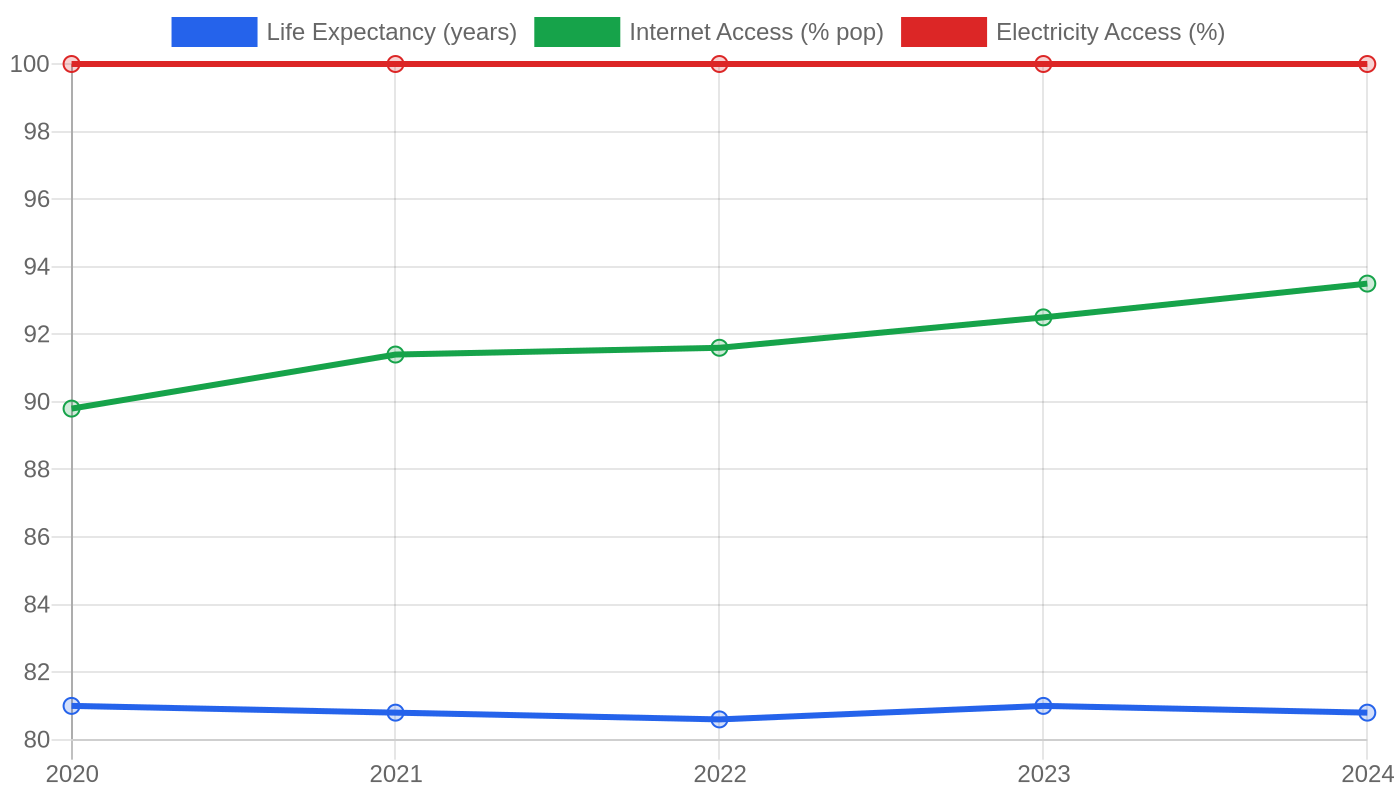
*Chart: /home/deploy/.openclaw/workspace/pulse/data/media/germany-chart.png*
*Photo: /home/deploy/.openclaw/workspace/pulse/data/media/germany-photo.jpg*
Sources & Methodology
This article is produced by Economic Pulse Net for informational and research purposes. Data is drawn from publicly available sources including the World Bank Open Data portal, Trading Economics, Numbeo, Wikipedia, and official national statistics bureaus. Economic Pulse Net does not guarantee the accuracy or completeness of third-party data. All data is believed to be current as of the date of publication.
Published: July 16, 2026 | Category: Research — Germany
Use these signals in your own platform
Economic Pulse publishes its live signal feed through a documented, read-only API. Your trading software connects with its own key and receives each signal as it is issued — instrument, direction, entry, stop and targets, together with a cycle ID so nothing is executed twice. The feed is independent of this website and cannot change it.
Signals are informational only and are not financial advice.