Economic Pulse Net | Sources: World Bank World Development Indicators, Numbeo | 2026
A deep dive into Latin America’s second-largest economy, where slow growth, corporate power, and a stable political system collide with everyday realities
<#>Key Takeaways
– Mexico’s economy is barely growing, with World Bank data showing GDP expansion of just 0.56% in 2025 — a figure that raises questions about the country’s ability to generate jobs and lift living standards.
– The nation’s GDP per capita based on purchasing power parity stands at $25,868.48, according to the World Bank, placing Mexico in the upper-middle-income bracket but still trailing many of its OECD peers.
– Mexico’s corporate landscape is dominated by telecommunications giant América Móvil, industrial conglomerate ALFA, and a cluster of aviation and consumer goods companies, reflecting a diversified but concentrated economic structure.
– The political system remains stable under a federal presidential framework established by the 1917 Constitution, with three levels of government providing institutional continuity.
– With inflation and unemployment data not currently available from the World Bank, analysts must rely on other indicators to gauge the health of the Mexican consumer and labor market.
<#>The Growth Puzzle — Why 0.56% Matters
When the World Bank reports that Mexico’s GDP grew by just 0.56% in 2025, the number demands attention — not because it is dramatic, but because it is not.
For a country of 129 million people with ambitions of becoming a global manufacturing hub, this near-flat growth rate signals a structural challenge. To put it in context: Mexico’s population continues to grow, meaning that per capita income is essentially stagnating.
The GDP per capita figure of $25,868.48, measured in purchasing power parity terms by the World Bank, places Mexico firmly in the upper-middle-income category, but it also reveals how far the country remains from the prosperity levels of its North American trading partners.
The question economists are asking is not whether Mexico can grow, but why it is growing so slowly. The answer likely lies in a combination of factors: productivity stagnation, informality in the labor market, and an investment climate that has not fully capitalized on nearshoring trends. Mexico’s main industries — while not explicitly detailed in the available data — are known to include manufacturing, automotive, oil and gas, and tourism.
Yet the GDP figure suggests these sectors are not firing on all cylinders. Without inflation or unemployment data from the World Bank, it is difficult to assess whether the slow growth is accompanied by price stability or labor market distress, but the GDP number alone is enough to give policymakers pause.
The implications are significant. A 0.56% growth rate means that public finances are under pressure, social programs are harder to fund, and the gap between Mexico and its more dynamic Latin American competitors may widen. For the average Mexican, this translates into fewer opportunities and a slower pace of improvement in living standards. The World Bank’s data does not offer a rosy picture — it offers a wake-up call.
<#>The Cost of Living — Where the Numbers Are Silent
Without Numbeo data on housing costs, rent indices, or daily expenses, painting a complete picture of Mexico’s cost of living is challenging. However, the absence of data does not mean the story is absent. Mexico is a country of sharp contrasts: in affluent neighborhoods of Mexico City, rents can rival those in Madrid or Barcelona, while in rural Oaxaca or Chiapas, basic services remain scarce and housing is informal.
The country’s Gini coefficient — though not provided here — has historically been high, indicating significant income inequality that shapes every aspect of daily life.
What can be inferred from the available data is that Mexico’s GDP per capita of $25,868.48 in PPP terms provides a benchmark for what the average household can afford. In practice, this means that middle-class families in urban centers are squeezed by rising costs for food, transportation, and utilities, while the wealthy continue to enjoy access to world-class amenities.
The lack of official cost-of-living data from Numbeo is itself telling: it suggests that tracking these metrics remains an afterthought in a country where economic data collection is uneven.
For the millions of Mexicans working in the informal economy — which accounts for roughly half of all employment — the cost of living is a daily negotiation. Without formal wages or benefits, they are more exposed to price fluctuations and less able to save. The World Bank’s GDP per capita figure, while useful, cannot capture this reality. It is a reminder that economic statistics are only as good as their ability to reflect lived experience.
<#>Investment and Business Climate — Giants in a Slow-Growth Environment
Mexico’s corporate landscape is dominated by a handful of powerful players, many of which are household names across Latin America. According to the available data, the top companies include América Móvil, the telecommunications behemoth controlled by Carlos Slim, as well as ALFA, a sprawling conglomerate with interests in petrochemicals, food, and automotive parts.
The list also features Aeroméxico and its affiliates, along with Alpek in oil and gas, and Altos Hornos de México in basic materials. These companies represent the backbone of the formal economy, generating employment, tax revenue, and export earnings.
Yet the concentration of corporate power raises questions about competition and innovation. When a handful of firms dominate telecommunications, aviation, and industrial production, smaller businesses struggle to gain a foothold. The presence of consumer goods companies like Alpura and Ah Cacao Real Chocolate suggests that domestic consumption remains an important driver, but the overall business environment is shaped by the giants. For foreign investors, Mexico offers proximity to the U.S.
market, a young workforce, and trade agreements like the USMCA. But the 0.56% GDP growth figure from the World Bank is a cautionary signal: the market is not expanding rapidly, and returns on investment may be modest.
The sectors to watch are those where Mexico has a comparative advantage: nearshoring in manufacturing, renewable energy, and technology services. However, without more granular data on business formation, credit access, or regulatory hurdles, it is difficult to assess whether the environment is improving or deteriorating. What is clear is that Mexico’s top companies are resilient, but they operate in an economy that is barely growing — a paradox that defines the country’s investment climate.
<#>Safety, Politics, and Quality of Life — Stability Amid Uncertainty
The political landscape of Mexico is defined by continuity. According to the available data, the United Mexican States operates as a federation with a representative, democratic, and republican government based on the 1917 Constitution. Three levels of government — federal, state, and municipal — provide a framework that has endured for over a century.
This institutional stability is a double-edged sword: it provides predictability for investors and citizens, but it can also entrench bureaucracy and resist reform.
Crime and safety data are not available from the provided sources, but it is well known that Mexico faces significant challenges with violence, organized crime, and public security. The absence of a Crime Index or Safety Index from Numbeo does not mean these issues are absent — it means they are not quantified in this dataset. For quality of life, the GDP per capita figure of $25,868.48 is a partial indicator, but it does not capture access to healthcare, education, or public services.
Mexico’s public health system is under strain, and educational outcomes lag behind OECD averages.
The political system’s stability is a valuable asset, particularly in a region where democratic institutions are under threat. However, it also means that change is slow. Reforms to the energy sector, labor market, and judicial system have been debated for years with mixed results. For the average Mexican, the quality of life is shaped more by local conditions than by national politics — and those conditions vary enormously from state to state.
<#>What’s Happening Now — The 2026 Reality Check
As of 2026, Mexico finds itself in a delicate moment. The World Bank’s 0.56% GDP growth figure for 2025 is now the baseline against which all policy decisions are measured. The economy is not in crisis, but it is not thriving either. The lack of inflation and unemployment data from the World Bank leaves a gap in understanding, but other indicators — such as remittances, industrial production, and consumer confidence — would likely tell a mixed story.
The political landscape remains stable under the current administration, but the slow growth rate is fueling debates about economic strategy. Some analysts argue that Mexico needs to double down on nearshoring, leveraging its proximity to the U.S. and its trade agreements to attract manufacturing investment. Others contend that the country must address structural issues: informality, corruption, and low productivity.
The corporate sector, led by giants like América Móvil and ALFA, continues to invest, but the pace of expansion is constrained by the broader economic environment.
For businesses and investors, the key question is whether Mexico can break out of its low-growth trap. The answer will depend on policy choices, global economic conditions, and the country’s ability to harness its demographic dividend. Without more recent data on inflation or employment, it is impossible to say whether 2026 will be a year of recovery or stagnation.
What is certain is that the 0.56% figure from the World Bank is not just a statistic — it is a signal that Mexico’s economic engine is idling.
<#>The Bottom Line
Mexico is a country of immense potential held back by modest growth. With a GDP per capita of $25,868.48 and a stable political system, it offers a predictable environment for investors, but the near-flat GDP expansion of 0.56% in 2025 is a warning
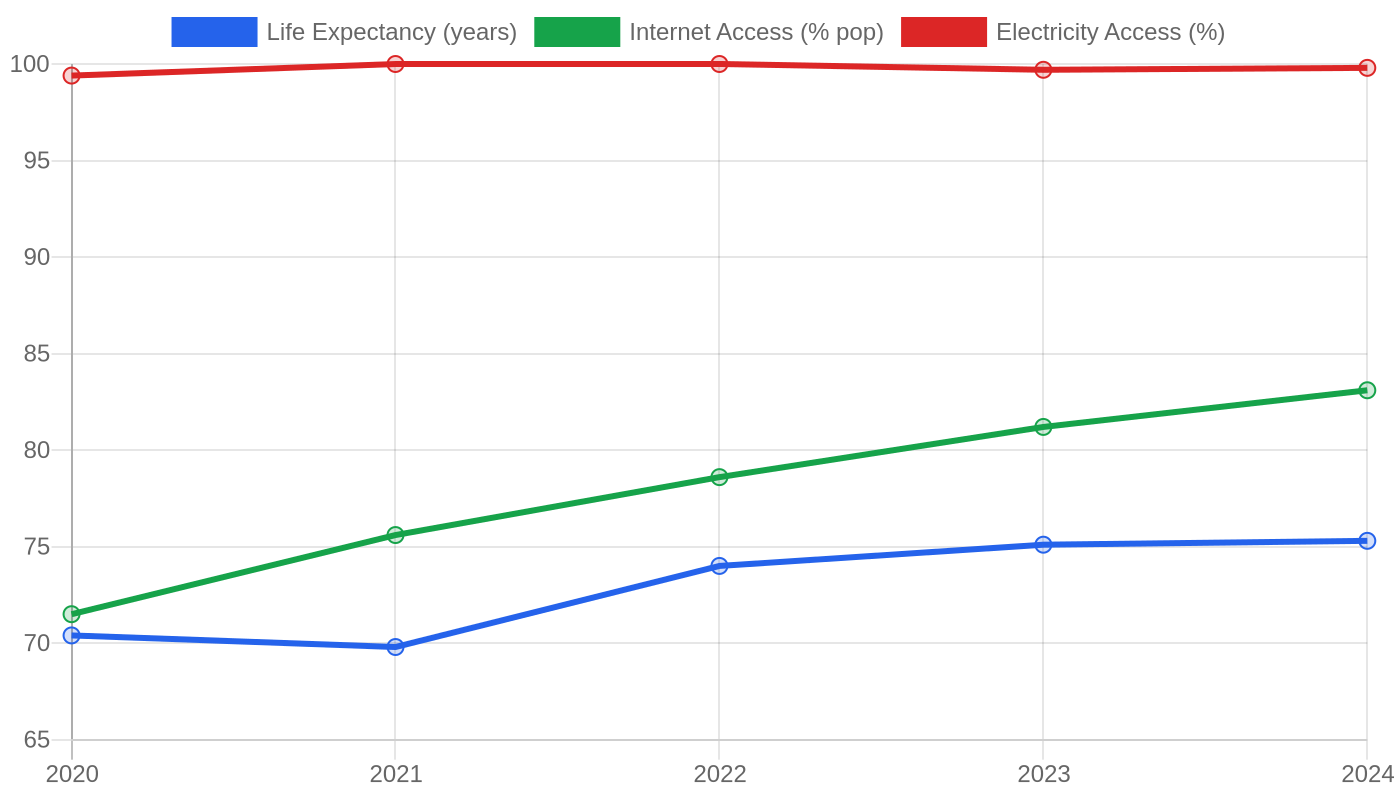
*Chart: /home/deploy/.openclaw/workspace/pulse/data/media/mexico-chart.png*
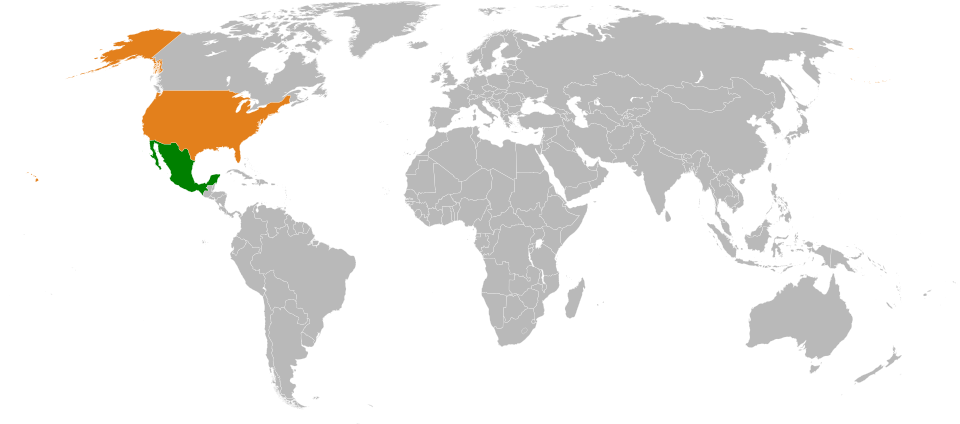
*Photo: /home/deploy/.openclaw/workspace/pulse/data/media/mexico-photo.jpg*
Sources & Methodology
This article is produced by Economic Pulse Net for informational and research purposes. Data is drawn from publicly available sources including the World Bank Open Data portal, Trading Economics, Numbeo, Wikipedia, and official national statistics bureaus. Economic Pulse Net does not guarantee the accuracy or completeness of third-party data. All data is believed to be current as of the date of publication.
Published: July 16, 2026 | Category: Research — Mexico
Use these signals in your own platform
Economic Pulse publishes its live signal feed through a documented, read-only API. Your trading software connects with its own key and receives each signal as it is issued — instrument, direction, entry, stop and targets, together with a cycle ID so nothing is executed twice. The feed is independent of this website and cannot change it.
Signals are informational only and are not financial advice.