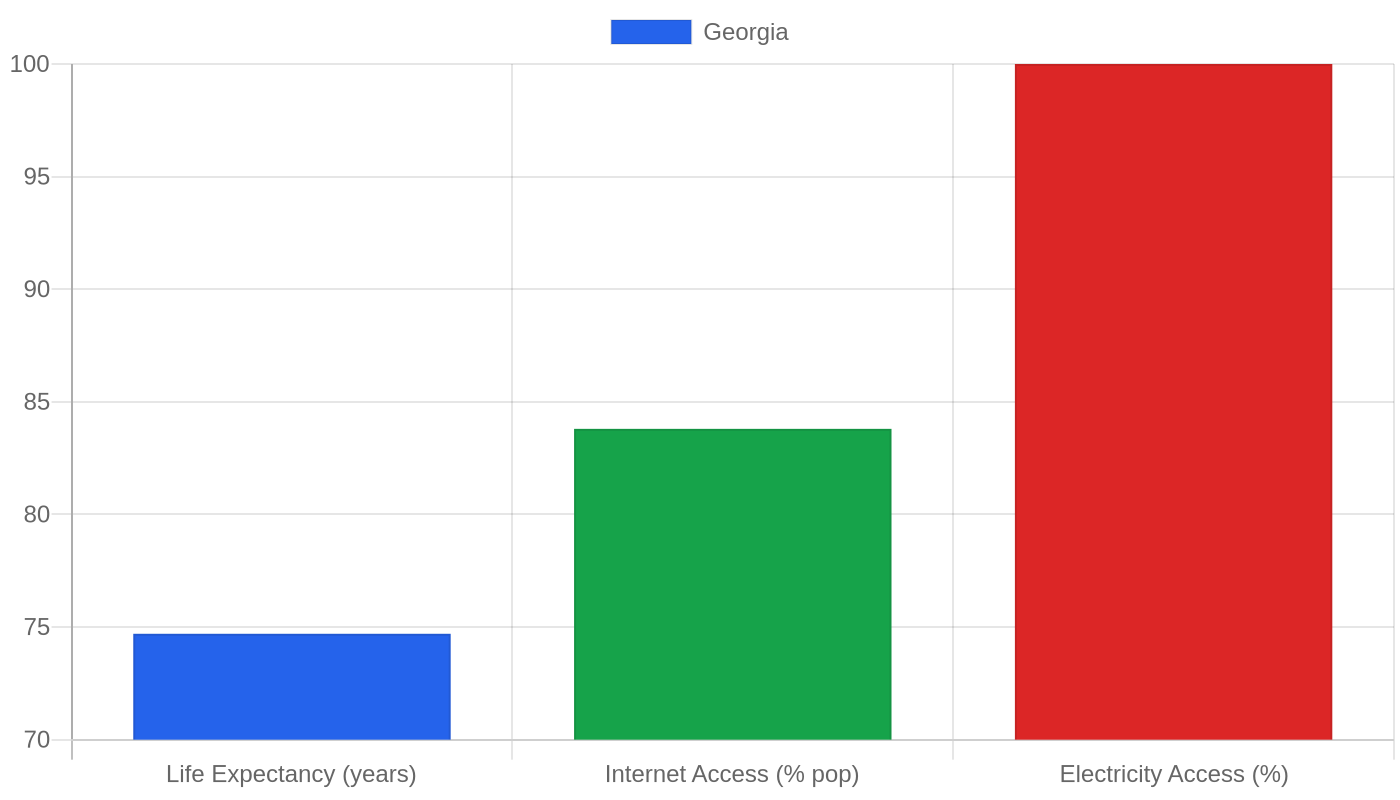
Economic Pulse Net | Sources: World Bank World Development Indicators, Government Sources | 2026
Key Takeaways
– Georgia stands at a critical juncture, with its economic trajectory increasingly defined by geopolitical positioning between major powers.
– The country’s core economic strength remains its role as a transit hub for energy and goods, a position that creates both opportunity and vulnerability.
– While precise macroeconomic data is limited, the structural story of Georgia is one of a small, open economy navigating regional turbulence.
– Political developments are the primary wildcard for investors, with the direction of policy likely to shape the business environment for years to come.
– For global readers, Georgia is a case study in how small nations manage sovereignty, economic openness, and regional pressure simultaneously.
The Economic Engine: Transit, Trade, and the Tbilisi Effect
Georgia’s economy is a study in strategic geography. Wedged between the Black Sea and the Caspian basin, it has historically served as a conduit for energy and commerce. The World Bank’s data framework places Georgia among the upper-middle-income group, though the most recent growth figures remain unpublished. What we can infer from the country’s structure is that its GDP is heavily reliant on three pillars: transportation, agriculture, and a rapidly modernizing services sector.
The transit economy is the most visible driver. Pipelines carrying Caspian oil and gas to European markets traverse Georgian territory, generating transit fees and attracting ancillary investment. The port of Batumi and the Tbilisi railway hub are strategic assets that give the country outsized regional importance relative to its population size. This role has only grown more pronounced as European buyers seek alternative energy routes.
Inflation and employment data are not currently detailed in the available records, but the structural picture suggests a labor market in transition. A significant portion of the workforce remains in agriculture, particularly in the eastern regions, while urban centers have absorbed younger workers into retail, finance, and tourism. The tourism sector, which boomed in the pre-pandemic years, remains a critical source of foreign currency and small business activity.
The challenge for Georgia’s economy is scale. With a domestic market that is relatively small, growth depends on external demand and foreign direct investment. When regional neighbors face instability, Georgia feels the ripple effects quickly. The economy is thus not merely a collection of industries; it is a barometer for the broader South Caucasus region.
The Cost of Living: Tbilisi’s Two-Tier Reality
Housing and daily expenses in Georgia present a tale of two cities—and two income brackets. Tbilisi, the capital, has seen property prices climb steadily as foreign buyers and remote workers discover its mix of historic architecture and modern amenities. Renting in the city center commands a premium that is increasingly out of reach for local professionals, pushing many younger Georgians to the suburbs or to shared apartments.
Outside the capital, the cost of living drops dramatically. In regional towns like Kutaisi or Telavi, housing costs are a fraction of Tbilisi’s prices, and daily expenses for food and transport are correspondingly lower. This geographic disparity is a defining feature of the Georgian economy, where urban opportunity and rural affordability exist side by side.
Groceries and dining out remain relatively inexpensive by European standards, with local markets offering fresh produce at low prices. However, imported goods—from electronics to certain foodstuffs—carry significant markups due to logistics costs. For expatriates and returning Georgians earning foreign salaries, the country offers a comfortable lifestyle at moderate cost. For those earning in lari, the local currency, the equation is tighter.
The real estate market is a barometer for the broader economy. A construction boom in Tbilisi over the past decade has transformed the skyline, but it has also raised questions about affordability and urban planning. The gap between housing costs and local wages is a growing source of social tension, even as it signals investor confidence in the country’s long-term prospects.
Investment & Business Climate: The Gateway Strategy
For investors, Georgia’s pitch is straightforward: a business-friendly regulatory environment, low corporate taxes, and access to regional markets. The country has positioned itself as a gateway between Europe and Asia, with free trade agreements that offer preferential access to neighboring markets. This strategy has attracted a range of international companies, particularly in logistics, energy, and financial services.
The banking sector is one of the most developed in the region, with modern regulations and a stable currency regime that has weathered regional shocks. The tourism industry remains a major draw for investment, with hotel chains and hospitality groups expanding beyond Tbilisi into the Black Sea coast and the mountain regions. Wine production, a source of national pride, has also become an export success story, with Georgian wines finding new markets in Europe and Asia.
However, the business climate is not without friction. Political uncertainty and periodic tensions with neighboring powers create a risk premium that investors must factor into their calculations. The legal system has improved significantly but still faces criticism regarding enforcement and judicial independence. For companies willing to navigate these challenges, the rewards can be substantial, particularly in sectors tied to transit and energy.
The most dynamic area for investment is arguably the digital economy. Tbilisi has developed a vibrant tech startup scene, supported by a well-educated population and relatively low operating costs. This sector represents the future of Georgian economic diversification, moving the country beyond its traditional reliance on physical transit.
Safety, Politics & Quality of Life: A Nation on Edge
Georgia’s social fabric is shaped by a complex political landscape. The country has pursued a pro-Western orientation, with aspirations for NATO and EU membership, while managing a delicate relationship with its larger neighbor to the north. This balancing act dominates political discourse and creates periodic waves of uncertainty that affect everything from currency stability to foreign investment.
Crime rates in Georgia are considered moderate, with Tbilisi generally safe for residents and visitors alike. Street crime is relatively uncommon, though economic inequality contributes to property crime in certain districts. The police force has undergone significant reform since the early 2000s, and public trust in law enforcement has improved, though it remains uneven across different communities.
Quality of life in Georgia is a mix of rich cultural heritage and modern amenities. The country offers a high standard of living for those with means, featuring a vibrant arts scene, excellent cuisine, and easy access to both mountains and sea. The healthcare system has improved but still struggles with rural access and specialist shortages. Education is valued highly, with a strong tradition of academic achievement, though brain drain remains a concern as skilled workers seek opportunities abroad.
The political atmosphere is charged with a sense of destiny. Georgians are acutely aware of their country’s strategic importance and the external pressures that come with it. This awareness manifests in a politically engaged population, with active civil society and a vocal media landscape. For residents, this creates a sense of living through history—both inspiring and exhausting.
What’s Happening Now: The Crossroads Moment
Georgia is currently navigating one of the most consequential periods in its post-Soviet history. The geopolitical realignment triggered by regional conflicts has elevated the country’s strategic importance, with Western nations courting Tbilisi even as traditional ties with Moscow remain strained. The government faces the delicate task of maintaining economic ties with all parties while advancing its stated goal of European integration.
On the economic front, the transit sector is experiencing renewed attention as global supply chains seek alternatives. International development institutions have signaled continued support for infrastructure projects, particularly those that enhance Georgia’s role as a transport corridor. The country is also positioning itself as a hub for digital services, with new initiatives aimed at attracting tech companies and remote workers.
Domestically, political tensions remain elevated. The ruling party faces opposition from pro-Western factions who argue that the government is moving too slowly on reforms and too quickly on certain diplomatic overtures. These divisions have occasionally spilled into street protests, though they have largely remained peaceful. The business community watches these dynamics closely, aware that political stability is the foundation of economic predictability.
The tourism sector is rebounding strongly, with visitor numbers approaching pre-pandemic levels. This recovery is bringing foreign currency back into the economy and supporting small businesses across the country. At the same time, inflation pressures from global markets are being felt locally, particularly in food and energy prices, creating challenges for households and policymakers alike.
The Bottom Line
Georgia is a country that rewards patient observers and punishes those who look away. Its economic fundamentals are sound, its people are entrepreneurial, and its strategic position guarantees continued international attention. For investors, the window of opportunity is open, but it requires a tolerance for political noise. For policymakers and analysts, Georgia offers a compelling case study in how small nations assert agency in a turbulent neighborhood.
This is a country to watch—not just for its own trajectory, but for what it signals about the future of the entire region.
Sources & Methodology
This article is authored by Economic Pulse Net for informational and research purposes. Economic Pulse Net sources its data from multilateral institutions, national statistics bureaus, and proprietary databases. All data is believed to be current as of the date of publication.
Published: July 31, 2026 | Category: Research — Georgia
Use these signals in your own platform
Economic Pulse publishes its live signal feed through a documented, read-only API. Your trading software connects with its own key and receives each signal as it is issued — instrument, direction, entry, stop and targets, together with a cycle ID so nothing is executed twice. The feed is independent of this website and cannot change it.
Signals are informational only and are not financial advice.