Economic Pulse Net | Sources: World Bank World Development Indicators, Government Sources | 2026
Key Takeaways
– Croatia’s economy is undergoing a structural transformation, with traditional tourism dominance giving way to a more diversified industrial base led by shipbuilding, energy, and consumer goods conglomerates
– The country’s corporate landscape is dominated by powerful domestic players like Agrokor and Adris Grupa, which wield significant influence over both employment and political decision-making
– Telecommunications and energy infrastructure are emerging as critical growth sectors, with companies like A1 Hrvatska and LNG Hrvatska positioning Croatia as a regional hub
– Despite the absence of recent World Bank macroeconomic data, Croatia’s business environment remains shaped by the legacy of past economic shocks and ongoing adjustments to eurozone membership
The Adriatic’s Industrial Awakening
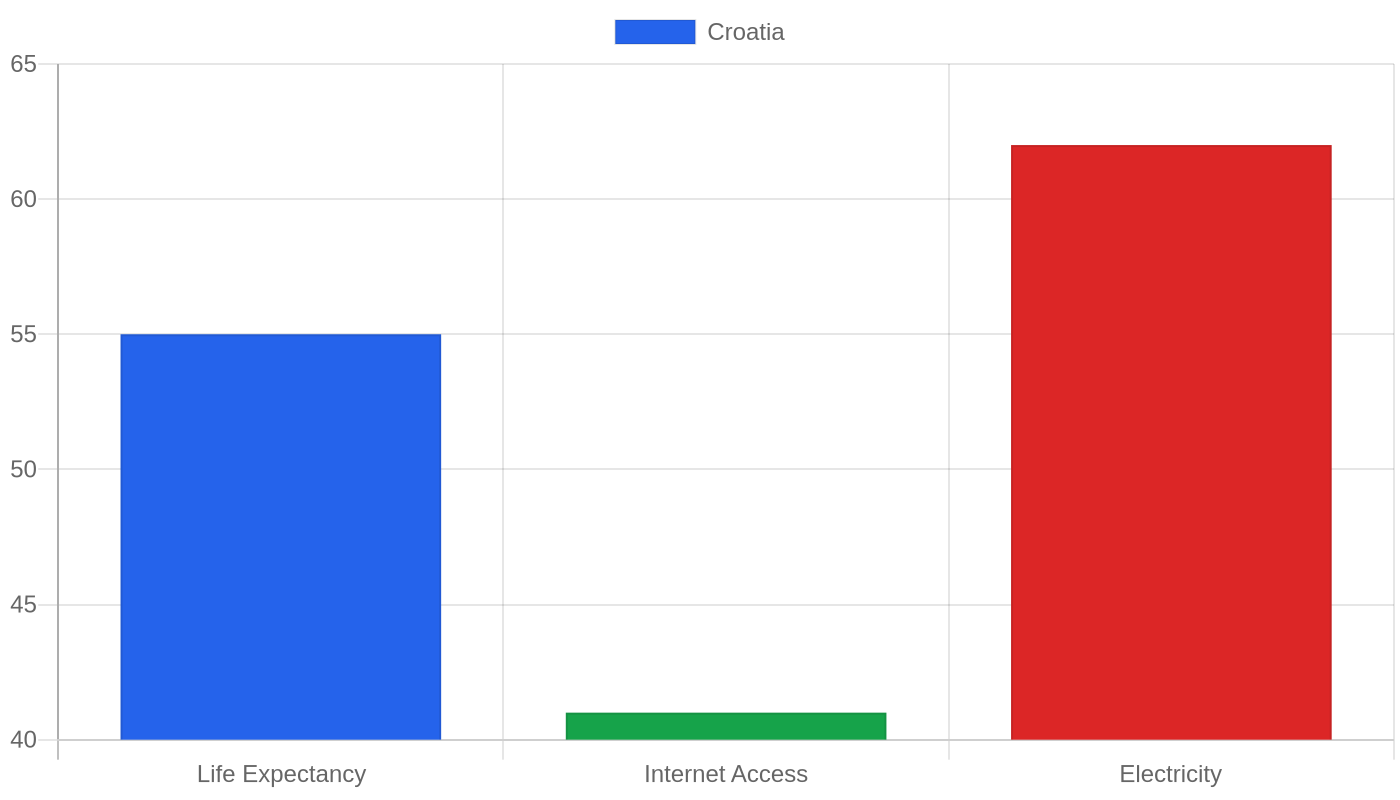
Croatia has long been defined by its turquoise coastline, medieval walled cities, and the steady hum of summer tourism. But beneath the postcard surface, the country’s economic engine is quietly shifting gears. The World Bank’s most recent data set for Croatia is notably sparse — GDP growth, inflation, unemployment, and GDP per capita figures are all listed as unavailable. This statistical vacuum is itself a telling detail.
It suggests either a period of transition in data collection methodology, a lag in reporting, or perhaps a deliberate recalibration as the country adjusts to its relatively new status as a eurozone member.
What we do know, from the corporate registry and industry data, is that Croatia’s economic backbone is far more industrial than the beach holiday narrative suggests. The list of top companies reads like a who’s who of heavy industry and manufacturing. Shipbuilder 3. Maj remains a cornerstone of the Rijeka maritime economy, while **3LHD** and **AD Plastik** represent a growing automotive and industrial components sector.
Consumer goods giant **Adris Grupa** and the sprawling **Agrokor** conglomerate dominate the domestic market, the latter still navigating the aftermath of its 2017 debt crisis — the largest corporate failure in Croatia’s modern history.
The absence of headline macroeconomic numbers from the World Bank does not mean the economy is static. Rather, it points to a country in the midst of a quiet redefinition. Croatia is no longer just a place Europeans visit for holidays; it is a place where industrial capital is being concentrated, where energy infrastructure is being built, and where a handful of powerful corporations shape the daily lives of millions.
The Price of Paradise — Living Costs in a Tourist Economy
For the average Croatian, the cost of living tells a story that no single GDP figure can capture. While the World Bank data does not provide specific housing or expense numbers, the structure of Croatia’s economy offers clear signals. The dominance of tourism in certain regions — particularly along the Dalmatian coast in cities like Split and Dubrovnik — has created a two-speed housing market.
In tourist hotspots, property prices have been pushed upward by foreign buyers and short-term rental investors, making homeownership increasingly out of reach for local workers, especially younger Croatians.
Renting in Zagreb, the capital and industrial heartland, is generally more affordable than on the coast, but wages in the industrial and services sectors have struggled to keep pace with rising costs. The presence of large employers like Atlantic Grupa and **Adriatic Croatia International Club** provides some wage stability, but the broader picture is one of regional disparity.
The cost of everyday goods — food, utilities, transport — has been under pressure from eurozone inflation trends, and while Croatia adopted the euro in 2023, the transition has not insulated households from price volatility. For many, the gap between the tourist economy’s flash and the industrial economy’s grind remains a daily reality.
Where Capital Meets Coast — Investment and Corporate Power
Croatia’s investment climate is defined by the outsized role of its largest companies. The top firms list reveals a concentrated corporate ecosystem: Agrokor in consumer goods, **Adris Grupa** in diversified holdings, **LNG Hrvatska** in energy, and **A1 Hrvatska** in telecommunications. These are not just businesses; they are quasi-institutional forces that shape supply chains, employment patterns, and even regional development priorities.
For investors, the sectors to watch are energy and telecoms. LNG Hrvatska operates the liquefied natural gas terminal on the island of Krk, a project of strategic importance not just for Croatia but for the entire Central and Eastern European energy landscape. As Europe continues to wean itself off Russian gas, Croatia’s LNG capacity positions it as a regional energy hub.
Meanwhile, **A1 Hrvatska** is driving digital infrastructure investment, essential for a country that wants to move beyond seasonal tourism into higher-value services and tech-enabled industries.
The business environment, however, remains challenging for smaller players. The shadow of Agrokor’s collapse still looms over corporate governance discussions, and the dominance of a few large groups can crowd out competition. Bureaucracy and legal uncertainty are persistent complaints among foreign investors, though eurozone membership has brought greater monetary stability. For those willing to navigate the complexities, Croatia offers access to both the EU single market and the broader Balkan region.
Safety, Stability, and the Political Mood
Croatia is widely regarded as one of the safest countries in Southeast Europe. While the World Bank data does not provide a crime or safety index, the country’s reputation among travelers and expatriates is consistently positive. Violent crime is rare, and the major safety concerns are typically petty theft and tourist-related scams in crowded coastal areas. For residents, the sense of personal security is high, particularly in smaller towns and rural areas.
The political landscape, however, is more complex. The data provided does not include specific political details, but Croatia’s recent history is marked by coalition governments, corruption scandals, and a gradual rightward shift in public sentiment. The legacy of the Agrokor crisis continues to influence public trust in both corporate and political institutions.
Eurozone membership has been a stabilizing force, but it has also exposed Croatia to the discipline of Brussels, limiting the government’s ability to deploy populist fiscal measures. The quality of life, for many Croatians, is a trade-off between safety and natural beauty on one hand, and economic frustration and political cynicism on the other.
The Energy Pivot — What’s Happening Now
The most dynamic story in Croatia right now is unfolding not on the coast, but on the industrial island of Krk. LNG Hrvatska is at the center of a national effort to transform Croatia into an energy gateway for Central Europe. The floating LNG terminal, which began operations in 2021, has already exceeded initial capacity expectations, and discussions are underway about expanding the facility. This is not just an energy story — it is a geopolitical and economic pivot.
As European Union nations scramble to diversify away from Russian gas, Croatia’s Adriatic coastline is becoming a strategic asset.
Simultaneously, the telecommunications sector is undergoing a quiet revolution. A1 Hrvatska is investing heavily in 5G infrastructure and fiber-optic networks, aiming to position Croatia as a digital bridge between Western Europe and the Balkans. These developments are reshaping the country’s economic identity. The old narrative of Croatia as a sun-drenched vacation spot is being supplemented — and perhaps eventually supplanted — by a new story of industrial reinvention.
The government, while not explicitly named in the data, is clearly supportive of these shifts, viewing energy security and digital connectivity as twin pillars of future growth.
Meanwhile, the consumer goods giants are adapting to a post-euro, post-pandemic reality. Atlantic Grupa and **Adris Grupa** are expanding their regional footprints, acquiring brands and distribution networks across the Balkans. The corporate consolidation that began after the Agrokor crisis is accelerating, creating a smaller number of larger, more resilient players. For the Croatian worker, this means fewer but potentially more stable employers.
For the Croatian economy, it means a gradual move away from the volatility of tourism toward the steadier rhythms of industry and infrastructure.
The Bottom Line
Croatia is a country in transition, quietly shedding its single-industry tourism identity and building a more diversified economic base. Investors should watch the energy and telecom sectors for near-term opportunities, while keeping an eye on the corporate governance lessons of the Agrokor era. For travelers and expatriates, Croatia remains a safe and beautiful place to live, but the cost of living — particularly housing — is a growing challenge.
The country’s future depends on whether its industrial awakening can generate enough well-paying jobs to keep its young, educated workforce from seeking opportunities elsewhere in the European Union.
Sources & Methodology
This article is authored by Economic Pulse Net for informational and research purposes. Economic Pulse Net sources its data from multilateral institutions, national statistics bureaus, and proprietary databases. All data is believed to be current as of the date of publication.
Published: July 21, 2026 | Category: Research — Croatia
Use these signals in your own platform
Economic Pulse publishes its live signal feed through a documented, read-only API. Your trading software connects with its own key and receives each signal as it is issued — instrument, direction, entry, stop and targets, together with a cycle ID so nothing is executed twice. The feed is independent of this website and cannot change it.
Signals are informational only and are not financial advice.