Economic Pulse Net | Sources: World Bank World Development Indicators, Government Sources | 2026
In the heart of Eastern Europe, Belarus stands as a paradox: a nation of vast industrial capacity and technological ambition, yet one whose political isolation and statist economic model have left it increasingly cut off from global markets. With the World Bank providing limited data on key indicators, the country’s economic picture remains opaque — but what is clear is that Belarus is at a crossroads.
Its major state-owned industrial giants continue to operate, its High Technologies Park churns out software for global clients, and its people navigate a cost of living shaped by state control.
Yet the political landscape remains dominated by President Alexander Lukashenko, described by many international observers as “Europe’s last dictator.” For investors, analysts, and policymakers, understanding Belarus means grappling with a country that is simultaneously a Soviet-era industrial relic and a surprisingly vibrant tech hub.
Key Takeaways
– Authoritarian Stasis: Belarus remains a highly centralized autocracy under President Alexander Lukashenko, with power concentrated in the executive despite a constitution that nominally provides for separation of powers.
– Industrial Backbone: The economy is anchored by massive state-owned enterprises — Belaruskali (potash), BelAZ (mining trucks), and Belarusian Railway — which dominate the industrial landscape.
– Tech Ambitions: The Belarus High Technologies Park represents a rare bright spot, positioning the country as an outsourcing destination for software development despite international sanctions.
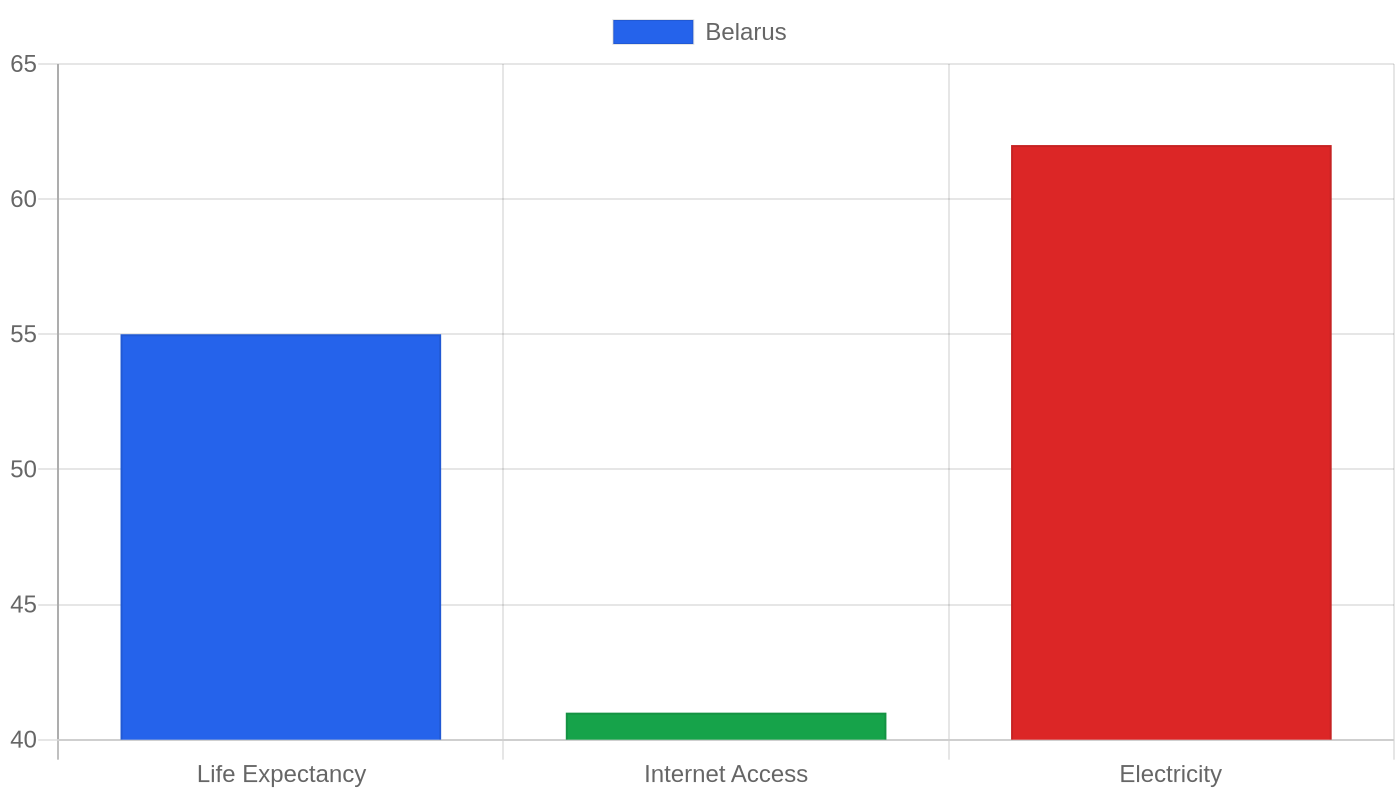
– Data Opacity: The World Bank currently reports no figures for GDP growth, inflation, unemployment, or per-capita income, making independent economic assessment exceptionally difficult.
– Strategic Crossroads: With a telecommunications sector anchored by A1 and an aviation industry represented by flag carrier Belavia, Belarus retains connectivity to global markets even as political tensions persist.
The Economic Engine — Potash, Trucks, and a State That Does Not Blink
Belarus’s economy is a creature of the state. The World Bank currently lists no figures for GDP growth, inflation, or unemployment, which is itself a telling indicator of how difficult it has become to assess the country’s true economic trajectory.
What is known is that the industrial core remains dominated by behemoths: Belaruskali, one of the world’s largest potash producers; BelAZ, which manufactures some of the largest mining dump trucks on the planet; and Belkommunmash, which produces electric buses and tramways. These are not marginal players — they are strategic national champions, and their fortunes are tied directly to the political survival of the regime.
The Belarusian Railway, another state giant, keeps the country’s logistics network running, linking Russia to European markets. The financial sector is likewise anchored by Belarusbank, the state’s primary lender, which plays a central role in channeling credit to favored industries. But the reliance on state-owned heavy industry leaves the economy vulnerable to external shocks, particularly sanctions and shifts in commodity prices.
The lack of World Bank data suggests a country where economic reporting has become politicized, and where independent verification of growth or contraction is nearly impossible. What is clear is that Belarus’s economic model — state-directed, export-oriented, and politically controlled — has not fundamentally changed, even as the world around it has.
Cost of Living — State Subsidies and Silent Strains
For ordinary Belarusians, daily life is shaped by a curious mix of Soviet-era subsidies and creeping market pressures. With no World Bank figures available for GNI per capita or GDP per capita (PPP), it is difficult to benchmark the country’s living standards against its neighbors. What can be inferred is that housing and utilities remain heavily state-influenced, with the government historically maintaining control over prices for basic goods and apartment rents.
The presence of major consumer services companies like BelaPAN and the national airline Belavia suggests a middle class that travels and consumes media, but the broader picture is one of wage stagnation relative to Western European peers. Buying an apartment in Minsk remains significantly more affordable than in Warsaw or Vilnius, but salaries are correspondingly lower, and the safety net provided by the state comes with strings attached — political conformity, in many cases.
The cost of living in Belarus is thus best understood not as a market outcome but as a political instrument: the state keeps prices manageable to maintain social peace, even as the economy’s underlying weaknesses grow.
Investment & Business Climate — The High-Tech Haven in an Authoritarian Sea
For all its political repression, Belarus has managed to cultivate one genuine success story: the Belarus High Technologies Park. This special economic zone, listed among the country’s top companies, has attracted software developers and IT firms from across the region, offering favorable tax treatment and a skilled workforce. Aliasworlds Entertainment, a technology company, and A1, a major telecommunications provider, round out a private sector that exists in careful symbiosis with the state.
The business climate, however, is not for the faint of heart. Foreign investors must navigate a system where the rule of law is subordinate to political loyalty, and where the state’s hand can be felt in virtually every significant transaction. The presence of BelaPAN, an independent news agency, suggests some space for civil society, but that space has narrowed considerably in recent years.
For companies willing to accept the risks, the rewards can be substantial — particularly in IT outsourcing, where Belarusian engineers have earned a strong reputation. But for those seeking transparency, predictable regulation, and protection against political interference, Belarus remains a challenging environment.
Safety, Politics & Quality of Life — Order Without Freedom
Belarus is often described as “Europe’s last dictatorship,” a label that reflects the reality of President Alexander Lukashenko’s rule since 1994. The constitution formally establishes a semi-presidential republic with separation of powers, but in practice, power is ultimately concentrated in the presidency, and the National Assembly serves largely as a rubber-stamp body.
The World Bank provides no crime or safety indices for the country, but anecdotal evidence suggests that street crime is relatively low — a legacy of Soviet-era social controls and heavy police presence. The quality of life, however, is defined by a trade-off: physical safety and order in exchange for political freedom. Protests are met with swift repression, independent media are shuttered, and the state’s security apparatus is ever-present.
For many Belarusians, the result is a quiet, predictable existence punctuated by moments of fear and frustration. The country’s cultural life remains vibrant — BelaPAN and other outlets continue to operate, and the arts scene persists — but the atmosphere is one of constrained possibility.
What’s Happening Now — Sanctions, Survival, and the Search for a Way Forward
As of 2026, Belarus finds itself in a state of suspended animation. The World Bank’s decision not to publish key economic indicators speaks to the country’s international isolation, and sanctions from Western nations continue to bite. Yet the state machinery grinds on. Belavia still flies, A1 still connects millions of subscribers, and the High Technologies Park continues to attract foreign currency through software exports.
The recent news cycle has been dominated by speculation about Lukashenko’s political future and the country’s deepening dependence on Russia. There have been no signs of meaningful reform — the political system remains closed, and the economy remains statist. But there are quiet signals of adaptation: the tech sector’s growth, the resilience of the industrial giants, and the population’s learned capacity to navigate shortages and sanctions.
For those watching Belarus, the key question is whether the current equilibrium can hold. The regime has survived protests, pandemics, and international pressure, but the underlying economic weaknesses have not been addressed. At some point, the bill will come due — and when it does, the world will finally get the reliable data that has been so conspicuously absent.
The Bottom Line
Belarus is a country that rewards patient observation and punishes hasty judgment. For political risk analysts, it is a case study in authoritarian resilience; for investors, a high-risk, potentially high-reward frontier; for students of economics, a reminder that data is never neutral. The country’s industrial base remains formidable, its tech sector is genuinely competitive, and its people are educated and capable.
But the political system that governs them shows no sign of opening up, and the international community shows no sign of engagement. Those who should watch Belarus are the ones who understand that the status quo cannot last forever — and that when change comes, it will be abrupt.
Sources & Methodology
This article is authored by Economic Pulse Net for informational and research purposes. Economic Pulse Net sources its data from multilateral institutions, national statistics bureaus, and proprietary databases. All data is believed to be current as of the date of publication.
Published: August 03, 2026 | Category: Research — Belarus
Use these signals in your own platform
Economic Pulse publishes its live signal feed through a documented, read-only API. Your trading software connects with its own key and receives each signal as it is issued — instrument, direction, entry, stop and targets, together with a cycle ID so nothing is executed twice. The feed is independent of this website and cannot change it.
Signals are informational only and are not financial advice.