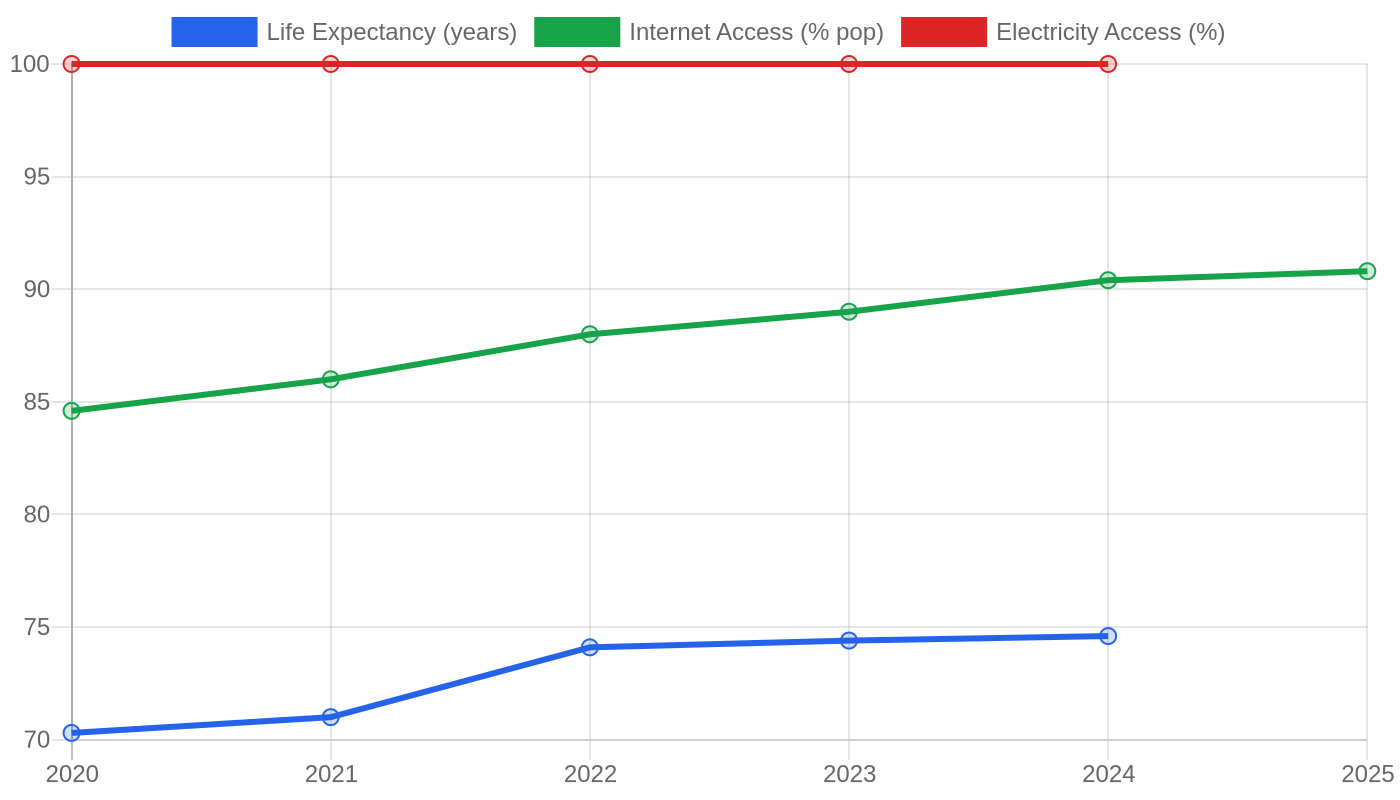
Economic Pulse Net | Sources: World Bank World Development Indicators, Government Sources | 2026
Key Takeaways
* Political Stability via Autocracy: Azerbaijan remains under the continuous rule of the Aliyev political family and the New Azerbaijan Party since 1993, characterized by an authoritarian governance structure that suppresses electoral integrity.
Industrial Dominance: The economy is heavily anchored by state-linked industrial giants, including Azerbaijan Caspian Shipping Company, Azerbaijan Railways, and major conglomerates like AF Holding.
Service Sector Growth: A robust consumer services and financial sector is emerging, driven by entities such as Medeniyyet TV, AccessBank Azerbaijan, and the ANS Group of Companies.
Opaque Economic Metrics: Official data regarding GDP growth, inflation, unemployment, and per capita income is currently unavailable, creating a significant blind spot for international investors and analysts.
Safety and Freedom Concerns: The country faces severe challenges regarding civil liberties, ranked “not free” by Freedom House, while specific crime and safety indices remain unreported.
The Industrial Engine Behind the Curtain
Azerbaijan’s economic narrative is defined less by transparent macroeconomic indicators and more by the sheer weight of its state-aligned industrial infrastructure. While the World Bank data for GDP growth, inflation, and unemployment rates remains marked as N/A, the structural backbone of the nation is visible through its top corporate entities.
The presence of massive players like Azerbaijan Caspian Shipping Company and Azerbaijan Railways suggests that logistics and transport are not just supporting industries but central pillars of the national economy. These entities likely drive the bulk of tangible economic activity, connecting the landlocked nation to broader regional trade routes.
Furthermore, the prominence of Af Holding, described as a conglomerate, indicates a diversified industrial base that may span construction, energy, or manufacturing, providing a buffer against sector-specific shocks. However, the absence of precise GDP figures makes it difficult to assess the velocity of this engine; we know the machinery exists, but we cannot measure its output with precision.
This lack of data obscures the true health of the labor market, leaving unemployment rates unknown and potentially masking underlying inefficiencies within these dominant firms.
Navigating Daily Expenses in Baku
For residents and expatriates alike, understanding the cost of living in Azerbaijan requires looking past aggregate statistics to the reality of daily consumption. With no official CPI inflation data available, tracking the erosion of purchasing power becomes a matter of anecdotal observation rather than statistical certainty.
Housing costs, rent versus buy decisions, and general daily expenses are critical components of life here, yet they lack comparative benchmarks against regional averages due to missing data points. One must infer the economic pressure on households without the comfort of standardized metrics, relying instead on the visibility of major utility providers like Azersu Open Joint Stock Company.
The existence of such utilities implies a regulated environment where basic needs are met by state-backed or large private entities, which may stabilize prices even in the absence of transparent inflation reporting. However, for those managing budgets, the unpredictability introduced by opaque price controls can make long-term financial planning challenging. Without clear inflation trends, consumers face uncertainty regarding the real value of their savings and the trajectory of everyday goods.
Investment Landscape: Giants and Conglomerates
The investment climate in Azerbaijan is shaped by a handful of powerful corporations that dominate multiple sectors. For foreign and domestic investors alike, the landscape is defined by established entities such as AccessBank Azerbaijan and AtaBank, which signal a developed, albeit concentrated, financial services sector. These banks provide the necessary credit infrastructure for business operations, suggesting that capital flow mechanisms are functional despite the political risks.
In the consumer services space, Medeniyyet TV and the ANS Group of Companies highlight a vibrant media and entertainment industry, indicating strong domestic demand for information and leisure products. Additionally, the role of AF Hotel Group underscores the importance of tourism and hospitality as potential revenue generators. Meanwhile, Akkord Industry Construction Investment Corporation points to ongoing development projects, likely tied to urban expansion or infrastructure modernization.
Investing here requires navigating a business environment where success is often linked to relationships with these key industrial and financial players rather than purely competitive market dynamics.
Safety, Politics, and Quality of Life
Quality of life in Azerbaijan is inextricably linked to its rigid political structure and the associated social climate. The government functions as an authoritarian regime in practice, with elections regularly marred by fraud and unfair practices, leading to its classification as “not free” by Freedom House. This political reality has profound implications for civil society, press freedom, and individual rights, ranking the country a dismal 7/100 on Global Freedom metrics.
For citizens and observers, this lack of political freedom creates an atmosphere of constraint that extends beyond the ballot box into daily interactions and professional opportunities. Crime and safety indices are listed as N/A, meaning there is no empirical data to guide personal security decisions, forcing individuals to rely on local knowledge and intuition.
The continuous rule of the Aliyev family and the New Azerbaijan Party since 1993 ensures policy continuity, but at the cost of democratic accountability and pluralism. This stability is brittle, maintained by suppression rather than consensus, which can lead to sudden shifts in social tension or policy enforcement.
What’s Happening Now: The Stagnant Status Quo
Currently, Azerbaijan operates in a state of political and economic stasis, where the primary narrative is the maintenance of the status quo rather than dynamic change. The recent news landscape is dominated by the continuation of the Aliyev family’s grip on power, with no significant reform movements gaining traction in the public sphere.
There are no visible signs of liberalization or economic opening; instead, the focus remains on consolidating control over strategic sectors like shipping, railways, and banking. Business developments are likely incremental, focused on maintaining the efficiency of existing state-linked enterprises rather than fostering new entrepreneurial ecosystems.
The absence of live indicators for inflation or growth suggests that the government does not prioritize transparent economic communication, keeping the public and international community in the dark about real-time economic performance. Any shifts in policy appear to be internal adjustments rather than responses to external pressures or public demand.
Consequently, the “now” in Azerbaijan is characterized by endurance and preservation of the current power structures, with little room for organic economic or political evolution.
The Bottom Line
Azerbaijan presents a complex paradox for observers: a functioning industrial and service economy operating under a deeply undemocratic and opaque political system. Investors should watch this country primarily for its strategic position and established corporate giants, but must proceed with extreme caution due to the lack of transparent economic data and severe political risks. It is a market where relationships and stability through authoritarian control outweigh meritocratic competition.
For now, Azerbaijan remains a closed book economically and politically, offering little insight into its future trajectory beyond the continuation of the current regime.
Sources & Methodology
This article is authored by Economic Pulse Net for informational and research purposes. Economic Pulse Net sources its data from multilateral institutions, national statistics bureaus, and proprietary databases. All data is believed to be current as of the date of publication.
Published: October 06, 2026 | Category: Research — Azerbaijan
Use these signals in your own platform
Economic Pulse publishes its live signal feed through a documented, read-only API. Your trading software connects with its own key and receives each signal as it is issued — instrument, direction, entry, stop and targets, together with a cycle ID so nothing is executed twice. The feed is independent of this website and cannot change it.
Signals are informational only and are not financial advice.