Economic Pulse Net | Sources: World Bank World Development Indicators, Government Sources | 2026
Key Takeaways
* Resource Monopoly: The national economy is overwhelmingly dominated by the oil and gas sector, with state-controlled giants like Türkmengaz and Türkmennebit serving as the primary engines of industrial output.
State-Directed Infrastructure: Major economic activity is funneled through specific state entities, including Demirýollary for rail logistics and MTS Turkmenistan for telecommunications, indicating a highly centralized command structure.
Historical Context: As a former Soviet union republic that declared independence in October 1991 following the dissolution of the USSR, the country’s current political and economic frameworks are deeply rooted in post-Soviet institutional legacies.
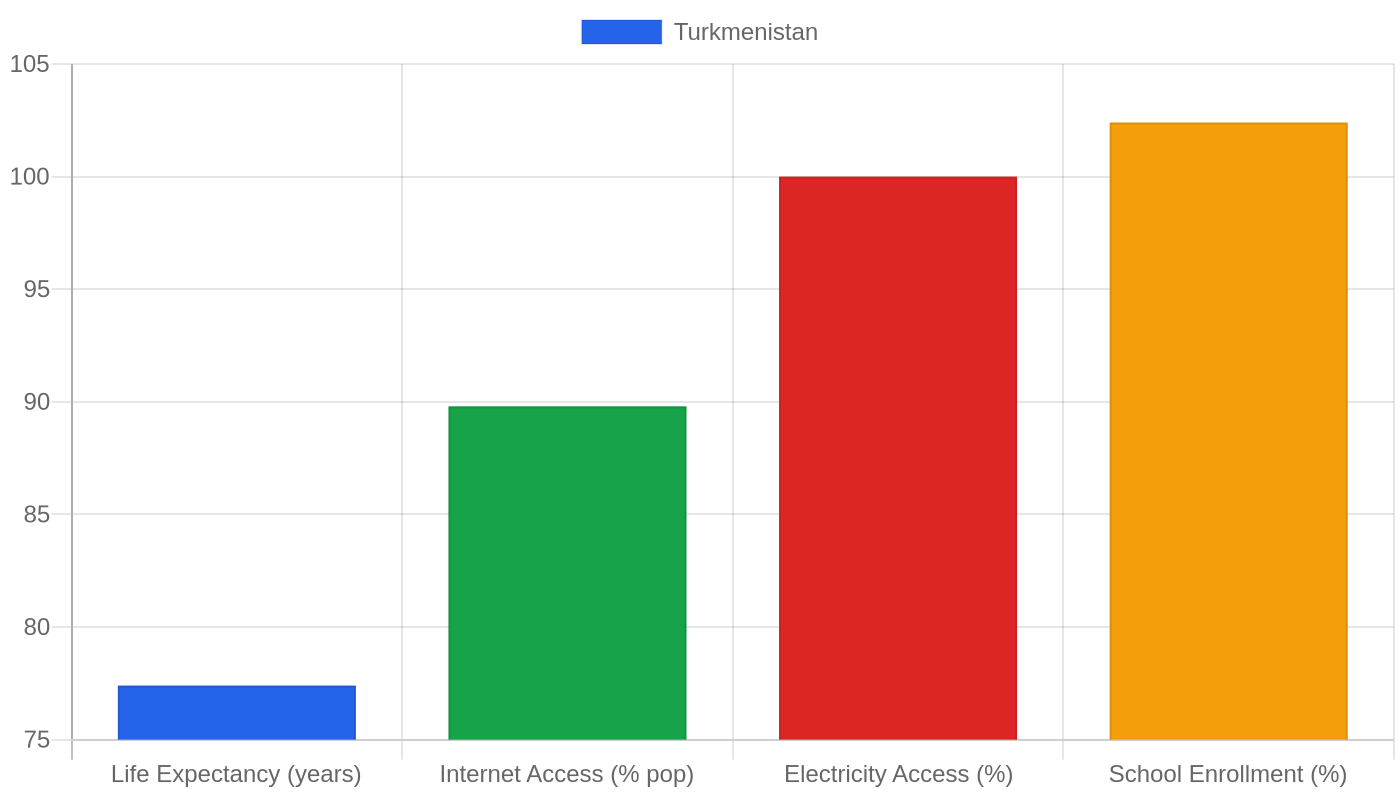
Data Opacity: Comprehensive macroeconomic indicators such as GDP growth, inflation rates, and unemployment figures are currently unavailable from standard international trackers like the World Bank, reflecting a lack of transparent statistical reporting.
Safety Paradox: While official crime and safety indices are not publicly quantified, the political landscape suggests a stable but tightly controlled environment where civil liberties and open market dynamics are severely restricted.
The Engine of Extraction
Turkmenistan’s economic identity is inextricably linked to its vast natural resources, specifically its position as one of the world’s largest natural gas reserves. The industrial landscape is not diversified; instead, it relies heavily on two primary players within the energy sector: Türkmengaz and Türkmennebit. These entities dominate the Oil & gas industry, effectively controlling the extraction, processing, and export of hydrocarbons which form the backbone of the national treasury.
Without access to granular World Bank data on GDP growth or per capita income, the sheer scale of this dependency becomes apparent when looking at the corporate hierarchy. Other major companies, such as Demirýollary in the Industrials sector, exist largely to support the logistical needs of these energy exports, particularly via rail networks connecting to neighboring markets.
This structural rigidity means that economic health is measured not by broad-based consumer spending or manufacturing innovation, but by the volume of gas flowing through pipelines. Consequently, any fluctuation in global energy prices or regional demand directly impacts the nation’s fiscal stability without the buffer of a varied industrial base.
The absence of reported unemployment figures further underscores a system where labor allocation is likely managed through state directives rather than free-market mechanisms, leaving the true employment situation opaque to outside observers.
The Cost of Living and Daily Realities
For residents and potential investors alike, understanding the cost of living in Turkmenistan requires navigating a landscape where official metrics are scarce. With no available data on Consumer Price Index (CPI) inflation or general price levels, constructing a precise budget for daily expenses remains challenging.
However, the presence of major telecommunications provider MTS Turkmenistan indicates a baseline level of digital infrastructure, suggesting that while physical goods may be subject to state pricing or import restrictions, communication services operate within a structured framework. Housing costs and rent versus buy scenarios are similarly difficult to quantify due to the lack of real estate market transparency.
In economies with such high centralization, housing is often tied to employment or state allocation rather than open market speculation, which can suppress visible rental yields but also limit mobility. Comparing this to regional averages is speculative without hard data, but the general trend in similar post-Soviet states suggests that basic utilities and imported goods may carry premium prices due to logistical complexities and currency controls.
Therefore, the “cost” of living is not just financial but administrative, requiring navigation of a bureaucratic environment that prioritizes state control over consumer convenience.
Investment Climate and Corporate Landscape
The business environment in Turkmenistan is characterized by heavy state involvement and limited foreign direct investment opportunities in non-energy sectors. The top companies listed—Demirýollary, MTS Turkmenistan, Türkmengaz, Türkmennebit, and O′zbekiston Pochtasi—reveal a mixed picture of domestic and regional integration.
Notably, the inclusion of O′zbekiston Pochtasi, which is technically an entity from Uzbekistan, in a list of Turkmenistan’s top companies highlights the interconnected nature of Central Asian industrial relations, possibly through joint ventures or shared logistical corridors. For investors, the Oil & gas sector remains the only viable entry point, governed entirely by Türkmengaz and Türkmennebit.
These entities operate with significant autonomy under state oversight, meaning private equity or minority stakes are rare and highly regulated. The Industrials sector, represented by rail and postal services, offers indirect exposure to trade flows but lacks the explosive growth potential seen in more liberalized markets.
Consequently, the business climate is one of cautious engagement, where success depends less on competitive innovation and more on securing government contracts and navigating complex regulatory hurdles. The lack of transparency in financial reporting further complicates due diligence, making long-term strategic planning difficult for external stakeholders.
Safety, Politics, and Quality of Life
Turkmenistan’s political landscape is defined by its historical trajectory and current isolationist tendencies. After being part of the Russian Empire and then the Soviet Union—including 67 years as a union republic—the country declared independence on 27 October 1991. This foundational moment established a sovereign identity that has since been maintained through strict political control and limited political pluralism.
Regarding safety, both the Crime Index and Safety Index are listed as N/A, which in this context often reflects a lack of independent monitoring or public disclosure rather than necessarily implying extreme danger. The state maintains tight control over public order, which can result in low street crime but also restricts freedom of movement and assembly.
Quality of life is influenced by this political stability; while there is likely minimal violent conflict, the absence of open political discourse and independent media limits personal freedoms. Happiness data is similarly unreported, suggesting that subjective well-being is not a metric tracked by state authorities or international bodies operating freely within the country. Thus, the social contract appears to prioritize security and order over individual expression or political participation.
Current Affairs and Strategic Outlook
Currently, Turkmenistan operates in a state of economic quietude, with no recent news headlines or live indicators pointing to immediate reforms or policy shifts. The absence of new data points suggests that the government is maintaining the status quo, relying on existing gas revenues to sustain operations without pursuing aggressive modernization. There are no reports of elections, legislative changes, or new trade agreements in the provided data, indicating a period of stagnation or deliberate opacity.
This lack of activity is itself a signal; in a region increasingly focused on connectivity and diversification, Turkmenistan’s refusal to publish updated economic statistics isolates it from global investment trends. The focus remains inward, with state-owned enterprises continuing their established roles without significant disruption.
For analysts, this silence is the most prominent feature of the current affairs landscape, suggesting that any future changes will likely be gradual and internally driven rather than reactive to external pressures.
The Bottom Line
Turkmenistan remains a closed chapter in the global economic narrative, accessible primarily through the lens of energy geopolitics. Investors should watch this country only if they have specific ties to the gas sector or regional logistics, as broader market opportunities are virtually nonexistent. The lack of transparent data makes it unsuitable for conventional portfolio analysis, rendering it a niche case study in resource-dependent state capitalism.
Ultimately, it is a nation where history dictates economics, and where the silence of the data speaks louder than any headline could.
Sources & Methodology
This article is authored by Economic Pulse Net for informational and research purposes. Economic Pulse Net sources its data from multilateral institutions, national statistics bureaus, and proprietary databases. All data is believed to be current as of the date of publication.
Published: October 30, 2026 | Category: Research — Turkmenistan
Use these signals in your own platform
Economic Pulse publishes its live signal feed through a documented, read-only API. Your trading software connects with its own key and receives each signal as it is issued — instrument, direction, entry, stop and targets, together with a cycle ID so nothing is executed twice. The feed is independent of this website and cannot change it.
Signals are informational only and are not financial advice.