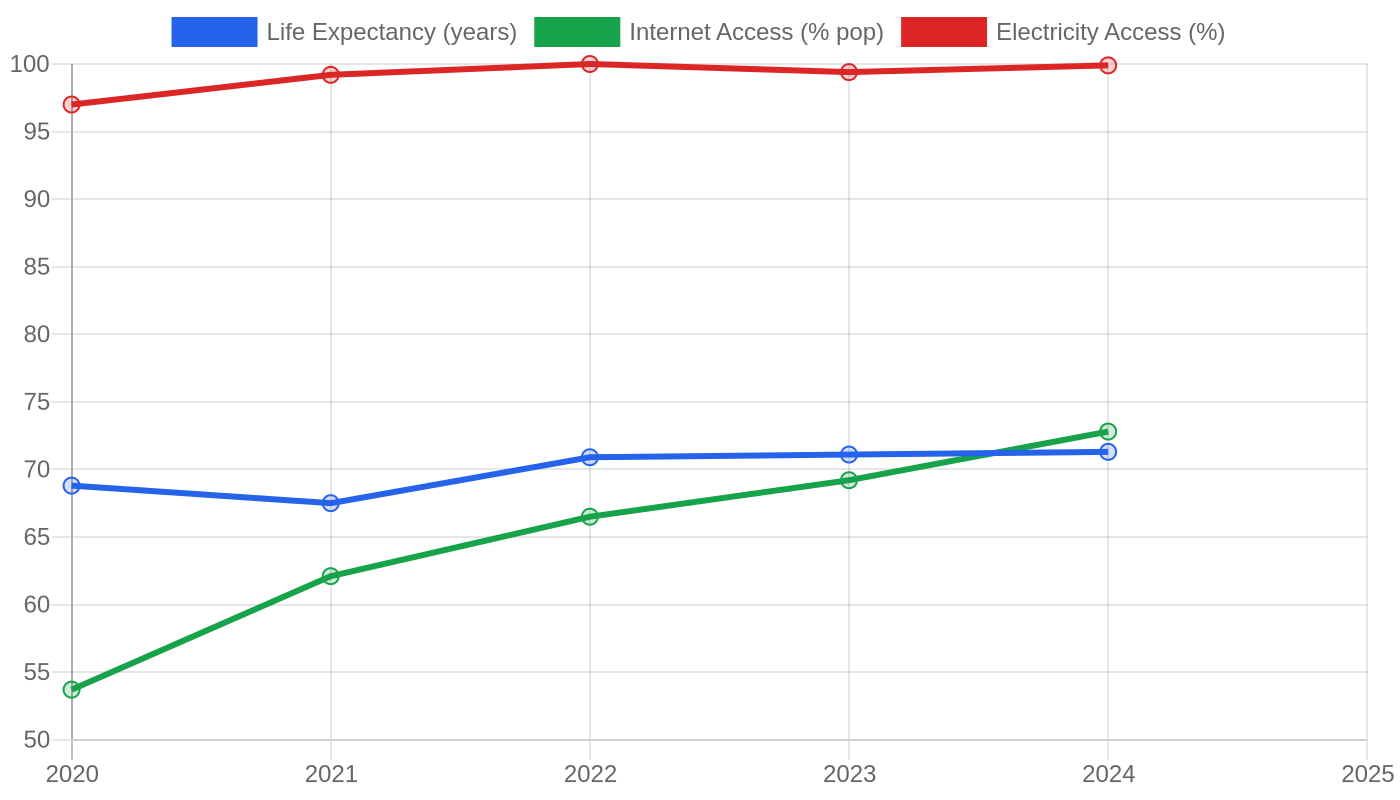
Economic Pulse Net | Sources: World Bank World Development Indicators, Government Sources | 2026
Key Takeaways
– Indonesia’s economy grew at 5.1% in 2025, maintaining its status as one of Southeast Asia’s most resilient large economies despite global headwinds.
– Inflation remains remarkably subdued at just 1.9%, well within the central bank’s target range, giving policymakers rare breathing room.
– Unemployment has fallen to an enviable 3.2%, though this headline figure masks persistent questions about underemployment and informal sector dominance.
– The rupiah is under pressure, prompting Bank Indonesia to hold interest rates while exploring unconventional tools to defend the currency.
– A deep bench of state-linked and private financial giants — including Bank Mandiri, Bank Central Asia, and Bank Rakyat Indonesia — anchors the corporate landscape.
The 5% Paradox — Growth Without Euphoria
Indonesia’s gross domestic product expanded by 5.1% in 2025, according to the World Bank — a figure that many developed economies would envy but which barely registers as remarkable in Jakarta. The country has been stuck in a narrow growth band for years, consistently delivering between 4.5% and 5.5% expansion, never quite breaking out into the accelerated development needed to transform its vast archipelago of nearly 286 million people.
The numbers tell a story of steady but incomplete progress. Total GDP now stands at approximately $1.45 trillion, making Indonesia the largest economy in Southeast Asia and a member of the G20. Yet per capita income tells a humbler tale: GNI per capita is $5,120, placing the country firmly in the lower-middle-income bracket.
That figure explains why Indonesian policymakers obsess over structural transformation — the country needs to move beyond commodity dependence and into higher-value manufacturing and services if it hopes to achieve its ambition of becoming a high-income nation by 2045.
Inflation, at 1.9%, is a bright spot. The World Bank data shows consumer prices rising at a pace that would be the envy of many central bankers worldwide. This low inflation environment has allowed Bank Indonesia to focus on other priorities — namely, supporting the rupiah, which has faced persistent depreciation pressure as global capital flows shift and the dollar strengthens.
The central bank’s decision to hold its benchmark rate while seeking alternative ways to stabilize the currency, as reported by The Jakarta Post, reflects this delicate balancing act.
The unemployment rate of 3.2% is remarkably low by global standards, though this official figure should be interpreted with caution. Indonesia’s labour market is characterized by a large informal sector, where workers move between casual jobs without formal contracts or social protections.
The real challenge is not unemployment in the traditional sense but underemployment and productivity — millions of Indonesians work, but too many work in low-productivity occupations that fail to lift living standards meaningfully.
Living Costs in the Archipelago — A Tale of Two Indonesias
The cost of living in Indonesia is as varied as the 17,000 islands that make up the nation. In Jakarta, the sprawling capital of more than 10 million people, housing costs consume a significant portion of household budgets. A modest apartment in a decent neighbourhood can easily cost $300 to $600 per month in rent, while prices in upscale areas of South Jakarta or the new business district of Thamrin can exceed $1,000 — a substantial sum in a country where the average annual income hovers around $5,000.
The rent-versus-buy calculation tilts heavily toward renting for most Indonesians. Mortgage rates, while competitive by regional standards, require substantial down payments that are out of reach for many. The government has attempted to address this through various subsidized housing schemes, but demand far outstrips supply in major urban centres. Outside Jakarta and a handful of other big cities like Surabaya and Bandung, housing costs drop dramatically, though so do economic opportunities.
Daily expenses remain relatively affordable compared to regional peers. Street food, public transport, and local produce keep day-to-day costs manageable for those with steady incomes. However, the gap between what the middle class can afford and what the working poor can manage is widening, particularly in education and healthcare, where private provision increasingly dominates.
The cost-of-living pressures that Indonesians feel are less about headline inflation and more about the structural mismatch between incomes and the costs of essential services.
Banking on Growth — Indonesia’s Corporate Powerhouses
Indonesia’s corporate landscape is dominated by financial institutions, a reflection of both the country’s under-banked population and the central role that state-linked entities play in the economy. The World Bank data highlights ten major companies, and eight of them are banks or financial services firms. Bank Mandiri, Bank Central Asia, Bank Rakyat Indonesia, and Bank Negara Indonesia form the core of a banking sector that has become the engine of consumer finance and infrastructure lending.
Astra International stands out as the sole conglomerate on the list, a sprawling entity with interests ranging from automotive manufacturing to mining and plantations. Its presence underscores the importance of the domestic market and natural resources to Indonesia’s economic model.
Badak LNG represents the energy sector, though its inclusion alongside other industrial firms like Alumindo and Angkasa Pura — the state airport operator — shows that infrastructure and basic materials remain critical to the country’s development story.
The investment climate in Indonesia has improved considerably over the past decade, with regulatory reforms aimed at attracting foreign capital into sectors previously reserved for domestic players. The Omnibus Law on Job Creation, passed in 2020, was designed to cut red tape and reduce labour rigidities, though its implementation has been uneven.
Sectors to watch include nickel processing and electric vehicle battery manufacturing, where Indonesia has leveraged its vast mineral reserves to attract massive investment from Chinese and South Korean firms. The digital economy, powered by a young and increasingly connected population, also presents opportunities in fintech, e-commerce, and ride-hailing.
Pancasila Politics — Stability with a Watchful Eye
Indonesia’s political system is built on the five principles of Pancasila, a state ideology that emphasizes unity, democracy, and social justice. The country is a unitary republic with a presidential system operating under the 1945 Constitution, as the World Bank notes.
After the fall of the New Order regime in 1998, a series of constitutional amendments fundamentally reshaped the political landscape, introducing direct presidential elections, strengthening checks and balances, and granting greater autonomy to the regions.
The result has been remarkable political stability for a country of such diversity and size. Indonesia has held multiple peaceful transfers of power, with elections that, while not without flaws, are broadly accepted as legitimate by the population.
The current administration under President Prabowo Subianto, who took office in 2024, has continued the infrastructure push begun by his predecessor Joko Widodo, though questions remain about the sustainability of the country’s debt levels and the effectiveness of its industrial policy.
Crime and safety data for Indonesia are not available in the provided information, but the country is generally considered safe for both residents and visitors, particularly outside of petty crime hotspots in tourist areas. The quality of life varies enormously by location and income level. Jakarta offers world-class amenities for those who can afford them, but traffic congestion and air pollution remain serious quality-of-life concerns.
The government’s ambitious plan to move the capital to Nusantara in East Kalimantan reflects a recognition that Jakarta’s problems have become existential.
The Rupiah Tightrope — What’s Happening Now
The most pressing economic story in Indonesia right now is the battle to stabilize the rupiah. The Jakarta Post reports that Bank Indonesia has held its benchmark interest rate steady, choosing instead to explore other policy tools to support the currency. This decision reflects a central bank caught between competing pressures: raising rates would help the rupiah but risk slowing an economy that needs faster growth, while cutting rates would stimulate activity but accelerate capital outflows.
The rupiah has been under pressure from multiple directions. Global interest rates remain elevated, drawing capital away from emerging markets. Indonesia’s reliance on commodity exports makes it vulnerable to price swings, and while the country has made progress in developing downstream processing industries — particularly in nickel — it remains exposed to shifts in global demand. The current account deficit, while manageable, limits the central bank’s room for manoeuvre.
The business community is watching these developments closely. A weaker rupiah benefits exporters but raises the cost of imported inputs and debt service for companies with foreign-currency obligations. For the average Indonesian, the currency’s slide means higher prices for imported goods and, potentially, a slower pace of job creation if businesses delay investment decisions.
The Jakarta Post’s coverage of the economy and markets suggests that the coming months will be critical in determining whether Indonesia can navigate this period of global uncertainty without sacrificing its growth momentum.
The Bottom Line
Indonesia in 2025 is a country of solid fundamentals and nagging frustrations. The 5.1% growth rate and 1.9% inflation are enviable by global standards, but they have not translated into the rapid income convergence that policymakers promise. For investors, Indonesia offers exposure to a large domestic market, abundant natural resources, and a growing middle class — but also currency risk, regulatory uncertainty, and the ever-present challenge of infrastructure gaps.
For the casual observer, this is a nation that has mastered the art of steady progress without quite achieving the breakthrough it needs.
Sources & Methodology
This article is authored by Economic Pulse Net for informational and research purposes. Economic Pulse Net sources its data from multilateral institutions, national statistics bureaus, and proprietary databases. All data is believed to be current as of the date of publication.
Published: July 22, 2026 | Category: Research — Indonesia
Use these signals in your own platform
Economic Pulse publishes its live signal feed through a documented, read-only API. Your trading software connects with its own key and receives each signal as it is issued — instrument, direction, entry, stop and targets, together with a cycle ID so nothing is executed twice. The feed is independent of this website and cannot change it.
Signals are informational only and are not financial advice.