Economic Pulse Net | Sources: World Bank World Development Indicators, Government Sources | 2026
Key Takeaways
– Indonesia’s unemployment rate stands at a remarkably low 3.237%, according to World Bank data, suggesting a labor market that is absorbing workers despite global headwinds — though this figure must be read against the reality of widespread informal employment.
– The country’s GNI per capita of $5,120 places it firmly in lower-middle-income territory, reflecting the structural challenge of lifting millions of workers into higher-productivity jobs.
– Bank Indonesia has held its benchmark interest rate steady, as reported by *The Jakarta Post*, signaling a preference for stability even as policymakers explore alternative tools to support the embattled rupiah.
– Indonesia’s political system, anchored by the 1945 Constitution and the Pancasila principles, has undergone significant reform since the fall of the New Order in 1998, introducing direct presidential elections and greater regional autonomy.
– The country’s corporate landscape is dominated by financial institutions and state-linked industrial giants, with banks accounting for half of the top ten listed companies.
The Great Middle-Income Puzzle — Growth Without the Numbers
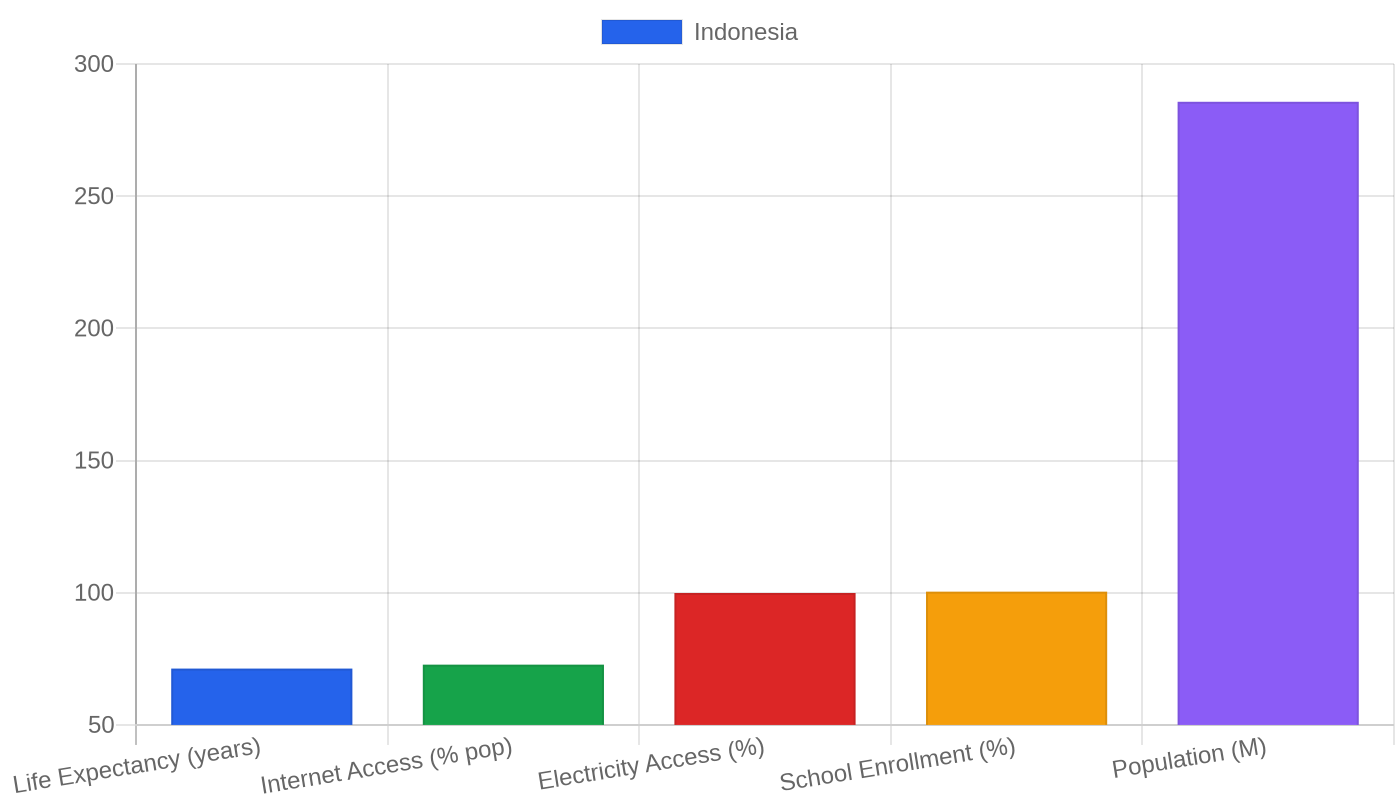
The World Bank’s data on Indonesia presents an intriguing paradox: the latest GDP growth figure is listed as unavailable, and yet the country’s unemployment rate of 3.237% is the kind of number that would make most developed economies envious. But in Indonesia, low unemployment tells only part of the story. The archipelago of nearly 286 million people — the fourth-largest population on Earth — has long grappled with the gap between formal and informal labor markets.
A job in Indonesia is often not the same as a stable, productive livelihood.
The GNI per capita of $5,120 is the most telling number in the dataset. It places Indonesia squarely in the World Bank’s lower-middle-income category, a bracket that many nations find difficult to escape. This is the so-called middle-income trap: countries that grow rapidly from low-income levels but then stall before reaching high-income status.
Indonesia has been flirting with this threshold for years, and the lack of a current GDP growth figure — whether due to reporting lags or data revisions — only adds to the sense of uncertainty around the trajectory.
The country’s industrial base is diverse but heavily weighted toward resource extraction and processing. Among the top companies listed, names like Badak LNG (liquefied natural gas) and Alumindo (aluminum) point to a economy still heavily dependent on commodity exports.
The dominance of financial institutions — Bank Mandiri, Bank Central Asia, Bank Rakyat Indonesia, Bank Negara Indonesia, and Bank Tabungan Negara — suggests that the banking sector has grown faster than the real economy it is meant to serve. This is not necessarily a problem, but it does raise questions about whether credit is flowing to the most productive sectors.
Astra International, the conglomerate that sits at the heart of Indonesian business, is a microcosm of the economy itself: sprawling, diversified, and deeply connected to both domestic consumption and global supply chains. The presence of Angkasa Pura, the state-owned airport operator, in the top companies list underscores the importance of infrastructure and connectivity in a nation of more than 17,000 islands.
The Price of Paradise — Living Costs in the Archipelago
The World Bank data does not provide specific cost-of-living figures for Indonesia, but the broader economic indicators offer important context. With a GNI per capita of $5,120, the average Indonesian earns roughly $427 per month. Against this backdrop, housing costs — particularly in Jakarta, Surabaya, and other major urban centers — become a defining feature of household budgets.
In Jakarta, a city of more than 10 million people, the gap between rents and incomes has been widening for years. A modest apartment in a decent neighborhood can easily consume 40 to 50 percent of a middle-class salary. For the millions of Indonesians working in the informal sector — street vendors, drivers, domestic workers — housing is often a matter of finding space in a *kampung* (urban village) or commuting from distant suburbs on overcrowded trains and buses.
The cost of food, transportation, and utilities in Indonesia is generally lower than in neighboring Singapore or Malaysia, but it is rising. Inflation data is not available in the current dataset, but the fact that Bank Indonesia has chosen to hold rates suggests that price pressures remain a concern. For the average household, the combination of stagnant wages and creeping costs creates a constant squeeze — the kind of pressure that does not always show up in official statistics but is felt keenly on the ground.
Banking on the Future — Investment Climate and Corporate Power
Indonesia’s investment climate is shaped by a curious duality. On one hand, the country offers a vast domestic market, abundant natural resources, and a young, growing workforce. On the other hand, bureaucracy, corruption, and infrastructure gaps continue to deter foreign investors who might otherwise be eager to enter Southeast Asia’s largest economy.
The top companies list tells a story of financial depth and industrial ambition. Asuransi Jasindo, the state-owned insurance firm, and the five major banks — Bank Central Asia, Bank Mandiri, Bank Rakyat Indonesia, Bank Negara Indonesia, and Bank Tabungan Negara — dominate the financial landscape. These institutions are not just lenders; they are pillars of the state’s economic strategy, often tasked with channeling credit to priority sectors like agriculture, small business, and infrastructure.
For investors, the sectors to watch are those that sit at the intersection of policy support and demographic demand. Infrastructure remains a major theme, driven by the government’s long-term development plans. The presence of Badak LNG and Alumindo in the top companies list signals that energy and materials will continue to attract capital.
But the real opportunity may lie in consumer services — Angkasa Pura’s inclusion is a reminder that as Indonesians become wealthier, they will travel more, eat out more, and demand better services.
Democracy and Disorder — Politics, Safety, and the Quality of Life
Indonesia’s political system is a study in managed complexity. Since the fall of Suharto’s New Order in 1998, the country has undergone four constitutional amendments that fundamentally reshaped the state. Direct presidential elections were introduced, new institutions were created, and the once-omnipotent People’s Consultative Assembly (MPR) saw its powers reduced.
The 1945 Constitution, amended but still in force, enshrines the five principles of Pancasila — belief in one God, just and civilized humanity, national unity, democracy guided by consensus, and social justice — as the foundation of citizenship.
The system is not without its tensions. Regional autonomy, granted constitutional basis in the post-1998 reforms, has empowered local governments but also created new avenues for corruption and inefficiency. The presidency remains powerful, but the checks and balances introduced over the past two decades have made Indonesian democracy more vibrant — and more unpredictable.
Crime and safety data are not available in the current dataset, but Indonesia’s reputation among travelers and expatriates is generally positive. Violent crime is relatively low compared to many developing nations, though petty theft and scams are common in tourist areas. The bigger safety concern for most Indonesians is not crime but infrastructure: traffic accidents, natural disasters, and the daily hazards of living in a sprawling, rapidly urbanizing society.
The Rupiah Tango — What’s Happening Right Now
The most immediate story in Indonesia today is the tug-of-war over the rupiah. As *The Jakarta Post* reported, Bank Indonesia has chosen to hold its benchmark interest rate steady, resisting the temptation to hike further in defense of the currency. Instead, the central bank is exploring other policy tools — likely including intervention in the foreign exchange market, tighter liquidity management, or moral suasion aimed at exporters — to stem the rupiah’s decline.
This is a delicate balancing act. Raising rates would have helped the rupiah but risked slowing an economy that is already navigating uncertain global conditions. Holding rates, by contrast, signals that the central bank believes the currency’s weakness is temporary or manageable. The risk is that the rupiah continues to slide, importing inflation and eroding the purchasing power of Indonesian households.
The broader economic context is one of cautious optimism tempered by structural constraints. The *Jakarta Post*’s business coverage also touches on broader economic trends and market movements, though the specific details are not available in the dataset. What is clear is that Indonesia is in a period of watchful waiting — trying to sustain growth, manage inflation, and defend its currency, all while the global economy sends mixed signals.
The Bottom Line
Indonesia is a country of immense potential and persistent challenges. For investors, the appeal lies in a young population, a growing consumer class, and a corporate sector anchored by some of Southeast Asia’s most resilient financial institutions. For policymakers, the task is to navigate the middle-income trap, manage currency pressures, and ensure that the benefits of growth reach the 286 million people who call this archipelago home.
This is a country to watch — not for dramatic breakthroughs, but for the steady, grinding work of building a modern economy in one of the world’s most complex and dynamic regions.
Sources & Methodology
This article is authored by Economic Pulse Net for informational and research purposes. Economic Pulse Net sources its data from multilateral institutions, national statistics bureaus, and proprietary databases. All data is believed to be current as of the date of publication.
Published: July 22, 2026 | Category: Research — Indonesia
Use these signals in your own platform
Economic Pulse publishes its live signal feed through a documented, read-only API. Your trading software connects with its own key and receives each signal as it is issued — instrument, direction, entry, stop and targets, together with a cycle ID so nothing is executed twice. The feed is independent of this website and cannot change it.
Signals are informational only and are not financial advice.