Economic Pulse Net | Sources: World Bank World Development Indicators, Government Sources | 2026
Key Takeaways
– Nepal’s economy remains heavily dependent on remittances from millions of workers abroad, creating a fragile balance between household consumption and national productivity.
– The country’s political landscape is fragmented, with seven major parties jostling for power in a federal parliamentary system that has struggled to deliver consistent economic reform.
– Nepal’s private sector is dominated by airlines, financial services, and consumer goods, reflecting a service-oriented economy with limited industrial diversification.
– Despite rich cultural heritage and tourism potential, Nepal faces structural challenges in infrastructure, employment, and cost-of-living pressures that constrain broad-based prosperity.
The Growth Puzzle — Where Are the Engines?
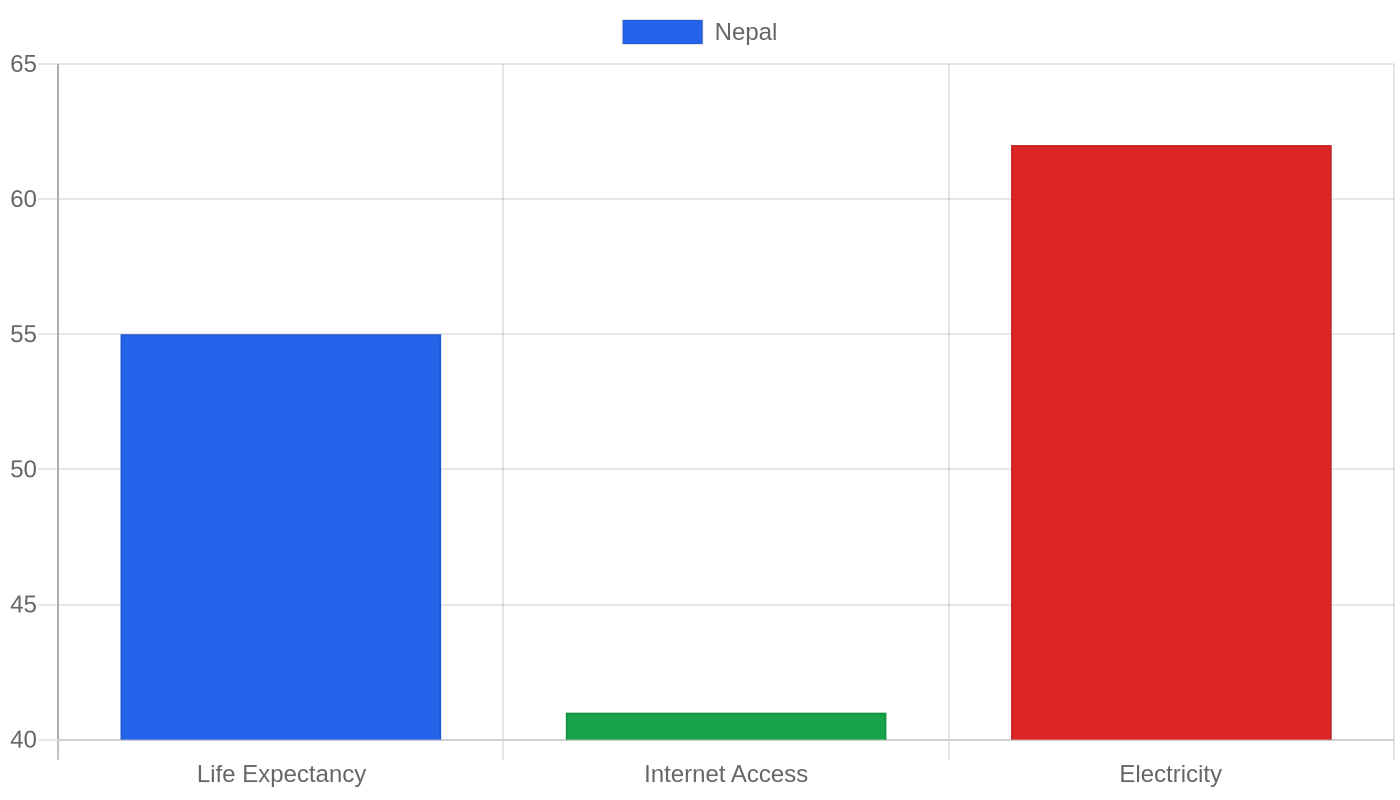
The World Bank’s latest data on Nepal presents a curious void: GDP growth, inflation, unemployment, and per capita income figures are all listed as unavailable. This absence itself tells a story. For a nation that sits between two economic giants — China and India — Nepal’s statistical opacity reflects deeper institutional challenges.
The economy has historically relied on three pillars: remittances from the estimated millions of Nepalis working in the Gulf, Malaysia, and elsewhere; tourism drawn to the Himalayas; and agriculture, which still employs the majority of the population but contributes a shrinking share of output.
Without hard GDP numbers from the World Bank, analysts must look to proxies. Remittance inflows have long been the silent engine, propping up household consumption and foreign exchange reserves. But this creates a paradox: the nation’s most reliable economic driver is also a signal of its failure to generate sufficient jobs at home.
Inflation, though unquantified in the latest data, has been a persistent headache for Nepali households, particularly for food and fuel imports that pass through India’s supply chains. The unemployment data gap is equally telling; Nepal’s labour force is largely informal, with many working in subsistence agriculture or micro-enterprises that escape formal tracking.
The real story is not the missing numbers but what they reveal about an economy that remains statistically invisible in key areas, making policy-making a game of shadows.
The Price of Living in the Shadow of the Himalayas
Nepal’s cost of living is a study in contrasts. In Kathmandu, the capital, daily expenses for food, transport, and housing have climbed steadily, driven by imported inflation and urban migration. Rent for a modest apartment in a decent neighbourhood can consume a significant portion of a salaried worker’s income, while buying property remains out of reach for most young families without family wealth or remittance support. Outside the Kathmandu Valley, costs drop sharply, but so do opportunities.
The gap between urban and rural living standards is vast.
Compared to regional neighbours, Nepal’s cost of living is lower than India’s major metros but higher than much of Bangladesh or Myanmar. However, the key metric is not absolute cost but purchasing power. With a GNI per capita that the World Bank has not updated in its latest release, it is difficult to benchmark precisely. What is clear is that the cost of essentials — rice, lentils, cooking oil, fuel — has been rising faster than wages for most workers.
The remittance economy creates a peculiar distortion: families receiving money from abroad can afford more, pushing up prices for everyone else. This has made daily life a balancing act for the urban middle class and a source of deepening hardship for rural households that depend on local income.
Business and Investment — Airlines, Banks, and the Conglomerate Crown
The list of Nepal’s top companies reads like a directory of the service economy, with a heavy tilt toward aviation. Agni Air, Air Nepal International, Asian Airlines, Base Air, Buddha Air, and Cosmic Air all feature prominently, reflecting the country’s geography — a nation where mountains make roads difficult and air travel is often the only practical option. The airline sector is fiercely competitive, with several carriers vying for domestic and regional routes.
Buddha Air has emerged as a dominant player, but the sheer number of airlines suggests a market that may be overcrowded.
Beyond aviation, the financial sector is represented by the Agriculture Development Bank, a state-backed institution that is supposed to channel credit to the rural economy but has often been criticised for inefficiency. The consumer sector features Bhatbhateni Supermarket, a major retail chain, and Bajeko Sekuwa, a popular restaurant brand that has expanded from a single outlet to a national chain.
The most significant player, however, is the Chaudhary Group, a sprawling conglomerate with interests in food, beverages, hospitality, and infrastructure. The Chaudhary Group is Nepal’s closest equivalent to a family-owned industrial giant, and its performance is often seen as a bellwether for the broader business climate.
The investment environment remains challenging. Political instability, bureaucratic red tape, and inconsistent regulatory enforcement deter foreign direct investment. Nepal has enormous potential in hydropower, tourism, and information technology, but realising that potential requires political consensus and infrastructure investment that have been slow to materialise. For now, the business landscape is dominated by domestic players serving a domestic market that is heavily influenced by remittance flows.
Politics and Safety — A Fragile Federal Experiment
Nepal’s political landscape is defined by its 2015 transition to a federal democratic republic, a move that was supposed to decentralise power and bring government closer to the people. The reality has been more complicated.
The country now has seven national political parties recognised in the federal parliament, according to the data provided: the Communist Party of Nepal (Unified Marxist–Leninist), Nepali Congress, Communist Party of Nepal (Maoist Centre), Rastriya Swatantra Party, Rastriya Prajatantra Party, People’s Socialist Party, and Janamat Party. This fragmented system has produced coalition governments that are often unstable, with parties more focused on political survival than economic reform.
The two largest parties — the CPN-UML and the Nepali Congress — both officially espouse democracy but differ sharply on economic policy. The UML leans toward state intervention, while the Congress favours market-oriented reforms. In practice, neither has been able to implement a coherent economic strategy due to the demands of coalition partners. The Maoist Centre, born from a decade-long civil war that ended in 2006, remains a significant force, particularly in rural areas.
On safety, Nepal has historically been considered a relatively peaceful country, with low violent crime compared to global averages. The crime index and safety index are listed as unavailable in the data, but anecdotal evidence and travel advisories generally rate Nepal as safe for visitors and residents alike, with petty theft being the primary concern in tourist areas. Political demonstrations can occasionally turn disruptive, but large-scale civil unrest is rare.
The bigger safety concern for most Nepalis is economic insecurity rather than physical danger.
What’s Happening Now — Navigating Uncertainty Without a Map
As of early 2026, Nepal’s economy is navigating a period of acute uncertainty. The absence of updated World Bank data means policymakers are essentially flying blind on key indicators like GDP growth and inflation. This statistical blackout comes at a time when the global economy is shifting, with India’s growth trajectory and China’s post-pandemic recovery both having direct implications for Nepal’s trade and investment flows.
The remittance economy, which has been the lifeline for millions of households, faces headwinds as Gulf countries diversify their labour forces and tighten visa requirements.
On the political front, the coalition government is under pressure to deliver tangible results ahead of the next election cycle. The seven-party system, as noted in the data, makes it difficult to pass major legislation, and there are growing calls from business groups for a more stable policy environment. The Chaudhary Group and other major conglomerates have been vocal about the need for infrastructure investment, particularly in energy and transport.
Nepal’s hydropower potential remains largely untapped, and delays in dam construction have frustrated both domestic investors and international development partners.
The airline sector, so prominent among the top companies, is facing its own turbulence. Rising fuel costs and intense competition have squeezed margins, and several carriers are reportedly struggling with debt. The consumer sector, led by Bhatbhateni and Bajeko Sekuwa, continues to expand, but growth is constrained by the limited purchasing power of the domestic market.
For now, Nepal’s economy is in a holding pattern — waiting for political stability, statistical clarity, and a new wave of investment that has been promised for years but has yet to materialise at scale.
The Bottom Line
Nepal is a country of extraordinary potential trapped in a cycle of political fragmentation and economic dependence. For investors, the opportunity lies in hydropower, tourism, and the consumer sector, but only for those with patience and a high tolerance for regulatory risk. For policymakers and development agencies, the priority must be filling the data gaps that make informed decision-making impossible.
For the Nepali people, the bottom line is simple: the remittance economy has bought time, but it cannot buy the future. The nation needs a new economic model — one that generates jobs at home, diversifies beyond services, and turns the Himalayan geography from a challenge into an advantage.
Sources & Methodology
This article is authored by Economic Pulse Net for informational and research purposes. Economic Pulse Net sources its data from multilateral institutions, national statistics bureaus, and proprietary databases. All data is believed to be current as of the date of publication.
Published: July 23, 2026 | Category: Research — Nepal
Use these signals in your own platform
Economic Pulse publishes its live signal feed through a documented, read-only API. Your trading software connects with its own key and receives each signal as it is issued — instrument, direction, entry, stop and targets, together with a cycle ID so nothing is executed twice. The feed is independent of this website and cannot change it.
Signals are informational only and are not financial advice.