Economic Pulse Net | Sources: World Bank World Development Indicators, Government Sources | 2026
Key Takeaways
– Hydrocarbon Dominance: Brunei’s economy remains overwhelmingly reliant on its oil and gas sector, with major state-linked players like Brunei Shell Petroleum and Brunei LNG anchoring national output.
– Financial Sector Sophistication: Despite its small size, Brunei hosts a mature financial ecosystem, including Baiduri Bank, Bank Islam Brunei Darussalam, and the Brunei Investment Agency, signaling a push toward economic diversification.
– Governance by Design: The Sultanate operates under the Malay Islamic Monarchy (MIB) philosophy, with a fully appointed parliament and no elections — a system that prioritizes stability over democratic participation.
– Strategic Neutrality: Brunei’s political and economic model offers a unique case study in how a resource-rich state manages global energy demand while preserving domestic social order.
The Sultanate’s Economic Engine: Beyond the Barrel
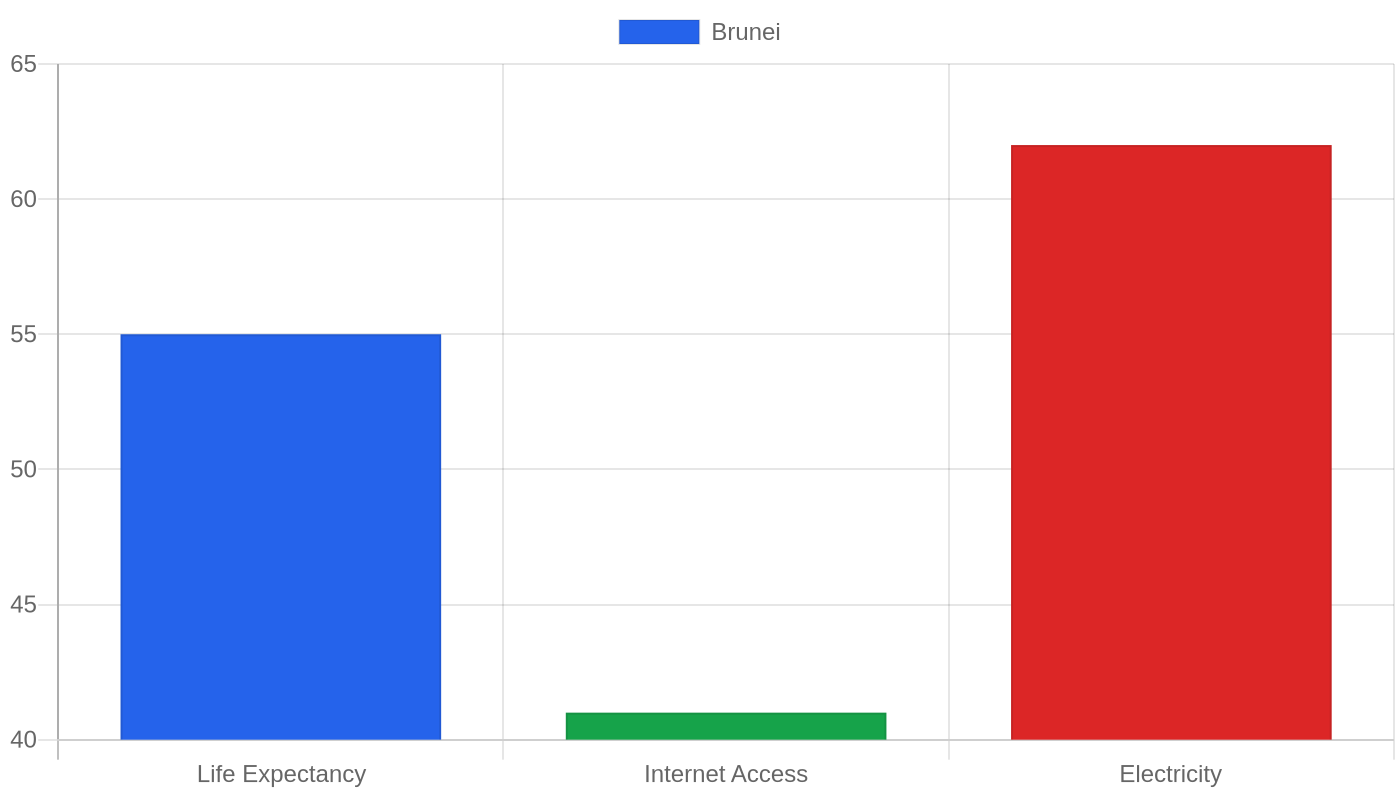
Brunei’s economic narrative is written in hydrocarbons. The country’s GDP and fiscal health are intrinsically tied to global energy prices, with the World Bank’s latest data showing a picture that is more qualitative than quantitative — a reflection of the nation’s tightly controlled data environment rather than economic stagnation.
The main industries are dominated by oil and gas extraction, liquefied natural gas production, and petrochemical manufacturing, with Brunei LNG and Brunei Methanol Company serving as flagship operations.
The structure of Brunei’s economy tells a compelling story of state-directed development. Brunei Shell Petroleum, the joint venture between the government and Royal Dutch Shell, remains the backbone of the energy sector, while Brunei Fertilizer Industries represents a strategic pivot toward downstream value-added products. This is a country that understands its reserves are finite and is methodically building industrial capacity beyond raw extraction.
The World Bank’s lack of updated GDP and inflation figures suggests a statistical opacity that itself is noteworthy — Brunei’s economic managers prioritize stability over transparency, a trade-off that has maintained social peace for decades.
Employment data remains underreported, but the absence of visible social unrest implies a labor market that, while heavily reliant on public sector employment and energy jobs, has not yet faced the acute pressures seen in other petro-states. The challenge ahead is clear: diversifying an economy where the energy sector’s gravitational pull makes non-oil industries difficult to scale.
The Cost of Living in a Rentier State
Brunei presents a peculiar paradox for residents and economists alike: a high-income country with subsidized essentials, yet limited data on inflation and consumer prices. The absence of CPI figures from the World Bank suggests either a benign price environment or a government that prefers not to publicize cost pressures. Housing in Brunei is characterized by a mix of government-subsidized schemes for citizens and private market options in areas like Bandar Seri Begawan.
The rent-versus-buy calculation is heavily skewed toward ownership, with citizens benefiting from land grants and favorable financing through Islamic banking products offered by institutions like Bank Islam Brunei Darussalam.
Daily expenses are moderated by fuel subsidies and the absence of income tax, but consumer goods — heavily reliant on imports — carry a premium. Compared to regional neighbors, Brunei’s cost of living is elevated for expatriates but manageable for citizens who access subsidized housing and services.
The lack of detailed cost-of-living indices makes precise comparisons difficult, but the country’s high GNI per capita trajectory historically suggests a population with significant purchasing power relative to Southeast Asian peers.
Investment and Business Climate: The State as Entrepreneur
The corporate landscape in Brunei is defined by the intertwining of state and commerce. The Brunei Investment Agency manages the country’s overseas assets, serving as the sovereign wealth engine that buffers the economy against oil price volatility. For foreign investors, the business climate is characterized by clarity of process but limited market size — a reality that makes Brunei more attractive as a regional hub than a mass-market destination.
The financial sector is notably sophisticated for a country of Brunei’s size. Baiduri Bank and Bank Islam Brunei Darussalam provide a full suite of services, while Brunei Darussalam Central Bank regulates a system that has embraced Islamic finance as a core competency. Brunei Energy Services and Trading and Brunei Methanol Company represent the industrial frontier, where the government is actively courting partnerships to develop downstream capabilities.
The Brunei Fertilizer Industries project, in particular, signals a strategic bet on food security and agricultural inputs for Asian markets. This is not a laissez-faire economy; it is a carefully managed ecosystem where the state identifies priorities and the private sector executes within defined parameters.
Safety, Politics, and the Social Contract
Brunei’s political system is a singular construct: a constitutional monarchy filtered through the lens of the Malay Islamic Monarchy (MIB) philosophy. The three pillars of MIB — Malay culture, Islamic religion, and monarchical governance — form an inseparable trinity that shapes everything from legal codes to economic policy. The legal framework is based on English common law, but sharia law supersedes it in certain cases, creating a dual system that foreign observers often find complex.
The country has a parliament, yet its members are appointed by the Sultan, and the last election occurred in the distant past — the data provided cuts off mid-sentence, which is fitting for a nation where electoral politics are largely ceremonial. Crime and safety indices are not available, but the anecdotal evidence from travelers and expatriates consistently points to Brunei as one of the safest countries in Asia, with low rates of violent crime and a visible but unobtrusive security presence.
The social contract is clear: the monarchy provides economic security, subsidized living, and religious infrastructure, and in return, the population accepts a political system with limited formal participation.
Current Affairs: The Quiet Push for Post-Oil Viability
The most significant story in Brunei right now is not a political crisis or an economic shock — it is the slow, deliberate construction of a post-oil economy. The World Bank’s data gaps are themselves a story: they suggest a government that is not prioritizing external reporting metrics while it focuses on domestic industrial transformation.
The development of Brunei Fertilizer Industries and the expansion of methanol production capacity indicate a strategic bet on becoming a regional petrochemical hub, leveraging natural gas reserves to produce higher-value products rather than exporting raw LNG alone.
The financial sector is also evolving, with Brunei Darussalam Central Bank taking a more active role in regulating and modernizing the banking system, particularly in the area of Islamic finance, where Brunei seeks to position itself as a niche but credible player. The Brunei Investment Agency continues to manage the country’s sovereign wealth, and its investment decisions — while opaque — are believed to be increasingly focused on sectors that can transfer knowledge back to the domestic economy.
Meanwhile, the energy services sector, anchored by Brunei Energy Services and Trading, is developing local capabilities to service the oil and gas industry, reducing dependence on foreign contractors. This is not a dramatic reform agenda; it is a steady, state-guided evolution that reflects the MIB philosophy of measured, orderly progress.
The Bottom Line
Brunei is a country that rewards patient observation. For economists and investors, it offers a case study in how a small, resource-rich state can maintain social stability and fiscal prudence while navigating the long-term decline of the global hydrocarbon economy. The country’s political system, with its appointed parliament and MIB ideology, may seem anachronistic, but it has delivered a standard of living and safety that many more democratic nations struggle to match.
The World Bank data may be sparse, but the signals are clear: Brunei is not standing still. It is quietly building the industries and financial infrastructure that will define its post-oil future. For those watching Southeast Asia’s less prominent economies, Brunei is a slow-burning story of adaptation — one that deserves attention not for its drama, but for its discipline.
Sources & Methodology
This article is authored by Economic Pulse Net for informational and research purposes. Economic Pulse Net sources its data from multilateral institutions, national statistics bureaus, and proprietary databases. All data is believed to be current as of the date of publication.
Published: August 09, 2026 | Category: Research — Brunei
Use these signals in your own platform
Economic Pulse publishes its live signal feed through a documented, read-only API. Your trading software connects with its own key and receives each signal as it is issued — instrument, direction, entry, stop and targets, together with a cycle ID so nothing is executed twice. The feed is independent of this website and cannot change it.
Signals are informational only and are not financial advice.